
Farm Automation: How New Machines Change the Seasonal Crew’s Jobs
• Hari Yellina
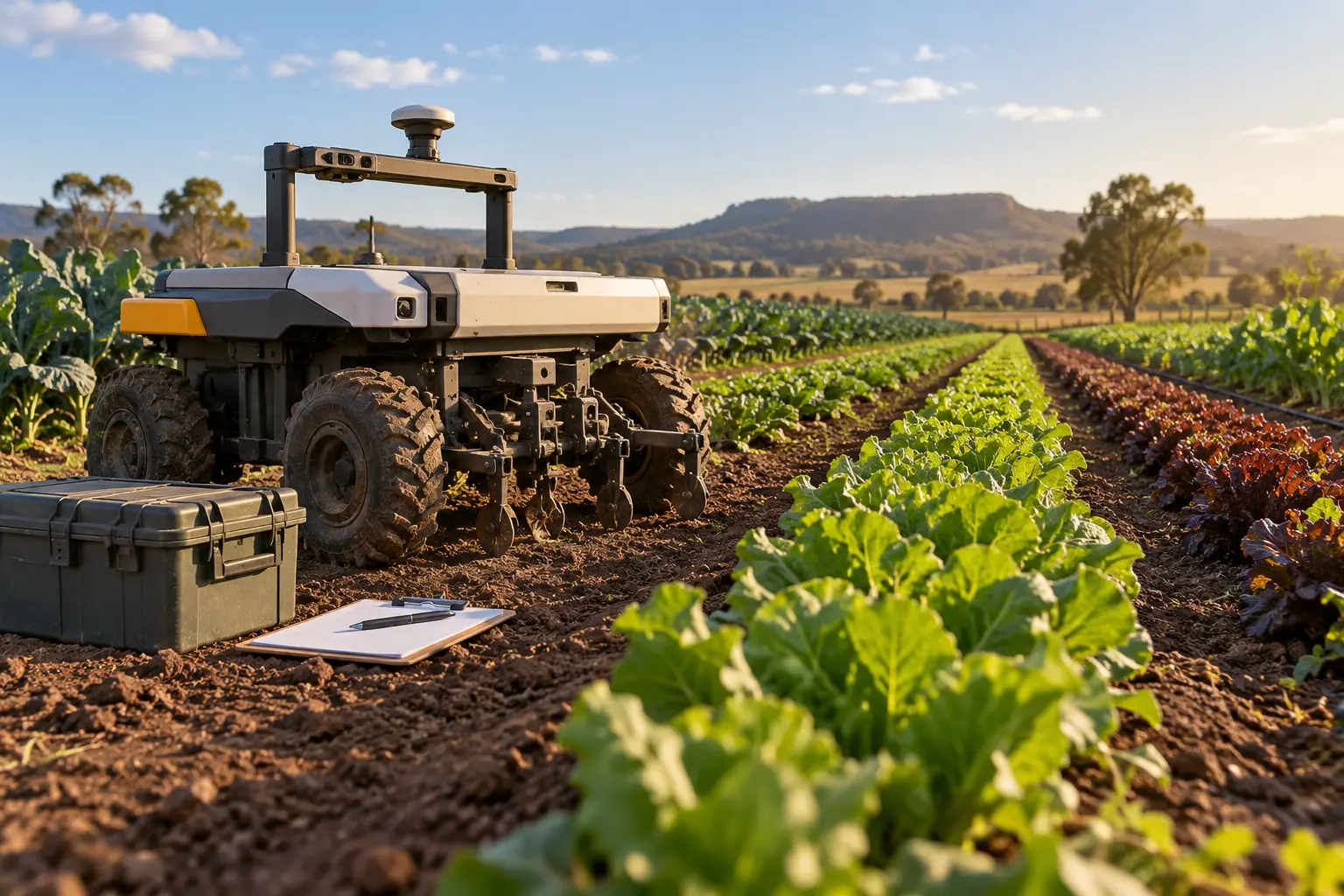
Featured image: AI-generated fictional illustration; conceptual machinery, no named product.
A machine that completes one field task changes the work around it. Someone still has to prepare the rows, set the equipment up, check the result and respond when conditions change. For a seasonal crew, the first planning question is which jobs move, which jobs remain and which new jobs appear.
What Australian trials can tell us
Hort Innovation’s April 2026 productivity update describes commercial-farm trials of precision weeding and autonomous equipment. Its ongoing vegetable mechanisation project, VG23003, is assessing technologies through demonstrations and qualitative and quantitative efficiency information.
This is a reason to examine the evidence for a particular task and farm. It is not a promise that any new machine will deliver the same labour saving in every crop, soil condition or planting layout.
Map a complete work cycle
Start with a task the farm already understands. Record how the crew completes it today, including preparation, productive work, quality checks, interruptions and clean-up. Then map the proposed machine-assisted version over the same boundaries.
| Stage | Question for the crew plan |
|---|---|
| Preparation | Who checks the rows, access, crop condition and readiness? |
| Set-up | Who adjusts the equipment and checks the first result? |
| Operation | What supervision and support does this particular system need? |
| Quality | Who checks missed work or damage and decides whether to continue? |
| Interruption | What happens when the equipment stops or the conditions change? |
| Finish | Who records the completed area and prepares for the next shift? |
The answers may describe different roles from the original manual job. Give those roles clear names and responsibilities before reducing the manual crew.
Measure completed work, including the support time
In a hypothetical vegetable trial, a machine covers a block in four hours. Two additional person-hours are spent preparing and checking the block, and one person-hour is needed for follow-up work. A comparison that records only the four machine hours leaves out three person-hours of support.
The example does not establish whether that machine is worthwhile. It shows why the farm needs both machine-time and person-time records, together with the quality of the finished task. Record the same information on several representative days, including interruptions. A favourable demonstration on an easy row is a starting observation, not a season-long staffing commitment.
Keep capital, maintenance and operating costs separate from the workforce calculation. A reduction in one manual task does not automatically establish a positive financial return.
Write the new roles into the booking brief
Tell the labour hire provider which tasks remain manual, which support tasks are new and who will supervise the work. Specify the capabilities needed and how training will be arranged. Do not assume that a worker booked for picking can immediately operate, adjust or maintain unfamiliar plant.
Use the equipment supplier’s instructions and the farm’s safety process to establish safe operation, access and recovery arrangements. Our farm induction guide is a useful companion when the task or work area changes.
Keep a workable fallback
Agree what will trigger a pause in the trial: unacceptable crop damage, unreliable completion, missing support or conditions outside the intended operating range. Name the person who can make that decision. Plan the alternative work rather than asking a depleted crew to recover the entire delay at the end of the day.
Before the next booking, compare the trial records with the original task map. The best crew plan reflects the work the farm has demonstrated it can complete, including the people needed around the machine.
Research checked 2 October 2026. The scenario and featured machine illustration are fictional; no particular product or labour saving is endorsed.
About the author
Hari Yellina is Chief Executive Officer at Orchard Tech. View his profile and more articles.
Related Articles
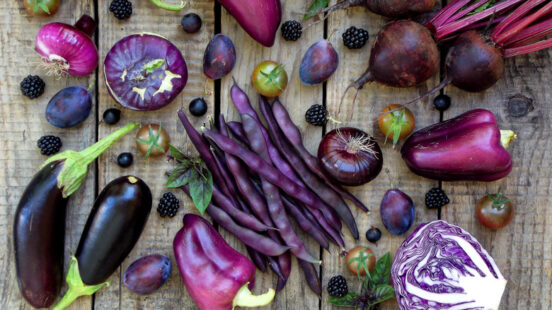
Purple ‘Greens’ the New Normal in Australia?
It seems that Australia is heading towards a colourful palette. In recent times, coloured vegetables are taking over the fresh markets. For instance, Australians have been enjoying the aesthetic eggplants, beetroots and cabbages. Now adding to this selection, producers have also introduced purple cauliflower, carrots and broccoli. These purple ‘greens’ are now available in supermarkets […]
Read More →
Organic Spinach a Winner in Australia
Archive article. This article describes the period originally reported. It is not a current market, recruitment, health or regulatory update. For newer reading, visit the Orchard Tech Knowledge Centre and check the relevant official sources before acting. While growers appreciate rain, it may often be excessive. Additionally, rain is viewed as a godsend in a […]
Read More →
Fresh Spuds on the Market
Thomas Foods International is investing in a major processing unit to beat the time on potato shelf life. As part of extensive upgrades to its Penfield Gardens-based manufacturing plant, the firm, which is one of Australia’s leading food processors, has built a world-first Spectrim potato grading line. A 12-lane Compac sorter with Spectrim grading technology, […]
Read More →