
Harvest
Almond conditioning
The conditioner picks up almonds from the windrow (a row of almonds lying on the ground). Your host will explain what its conditioner does. If it uses a different type of conditioner, it will train you on that one. Operating the tractor and conditioner is the job, but only when you are authorised. Do it only after your host has trained, assessed and authorised you on that tractor and conditioner. Get training for each new tractor and conditioner. A licence alone does not show you can operate them safely. Your supervisor will check your work.
English available · English–Tongan version also available. The Tongan did not pass the full language check. The English is the official version.LANGUAGE-QA FAIL - blocking control failed: B5, G5
Know the limits
Limits and safety rules for this job
These points are copied from the approved job sheet. “Not part of this job” is work this sheet does not cover. “Only if it is part of your confirmed job and you are trained and authorised” is work that needs this permission first. “Never do these” are things you must never do. “Other limits that always apply” are limits and safety rules for every shift. All the steps and safety instructions for this job are in the full job sheet below.
Not part of this job
- This sheet covers operating the tractor and conditioner. Other harvest jobs, such as shaking, sweeping and pick-up, are separate tasks. So are adjustments, greasing, maintenance, repairs, cleaning with compressed air (blowing down), jump-starting, chemicals, electrical work, working at heights and entering confined spaces, dams, tanks or channels. They need their own instructions, training and authorisation.
Only if it is part of your confirmed job and you are trained and authorised
- Operating the tractor and conditioner is the job, but only when you are authorised. Do it only after your host has trained, assessed and authorised you on that tractor and conditioner. Get training for each new tractor and conditioner. A licence alone does not show you can operate them safely. Your supervisor will check your work.
Never do these
- Guards: never use the machine if a guard or guard cover is missing, loose or damaged. If a cover comes loose while you work, shut down all equipment and make it safe. Refitting a cover is not part of this job and must never be done alone. Call your supervisor for help.
- Do not enter a block that is being sprayed or has a no-entry sign. Do not drink irrigation water: it may contain fertiliser or chemicals.
Other limits that always apply
- This sheet describes typical almond conditioning work and conditions. Your actual duties depend on the farm and what you are trained and authorised to do. Reading this sheet does not authorise you to operate a tractor or conditioner, use other machinery or repair equipment.
- Before you start: doing the pre-start checks you were taught, with the tractor and conditioner shut down and made safe so they cannot start or move, using your host's procedure. Checks may include the guards, PTO guards and chains, the stick belt, any cameras and the radio channel. Adjust the seat and controls. Report faults straight away. If a fault could make a machine unsafe, do not use it. Tag it out as your host shows you and tell your supervisor.
- Emptying the stick belt: when the stick belt starts to fill, empty it only where your host tells you, such as an open area at the end of the block.
- Ends of rows: your host will show you how to set the conditioner before you turn, reverse or travel. Do not make tight turns at the ends of rows.
- PTO and moving parts: a turning PTO shaft can catch clothing, hair or a hand and pull a person in. So can the conditioner's pick-up head, belts, chains and drives. This can cause very serious injury or death. Do not wear loose clothing, cords or jewellery, and tie back long hair. Keep yourself and others clear while the PTO and conditioner are running. Never stand on or climb into the conditioner.
- Blockages, sticks and obstacles: if sticks or debris block the pick-up, or a large obstacle is in the row, stop. Before anyone goes near, shut down the tractor and conditioner and make them safe, using your host's procedure. Wait until all moving parts have stopped. Clear a blockage only if you are trained and authorised.
- Public roads: never drive on or across a public road unless your host has confirmed that the tractor, the conditioner, your licence and the route are approved.
- Getting on and off: keep the steps free of mud. Use three points of contact (two hands and one foot, or one hand and two feet). Never get on or off a moving tractor. Start the tractor only from the driver's seat, as your host shows you. Never start it from the ground or bypass a safety switch.
- Roll-overs: tractors can roll over, especially on slopes and banks, on rough or wet ground, near dams and channels, and with heavy or raised loads. The roll-over frame (ROPS) protects you only if you wear your seat belt, because the belt keeps you inside the frame. Some frames fold down for work under trees. A folded frame cannot protect you in a roll-over. Your host will show you when it may be folded down. Put it back up as soon as there is enough room.
- Driver and passengers: wear your seat belt every time you operate the tractor. Keep the cab doors and windows shut while the tractor moves. Carry a passenger only if your host allows it and the tractor has a passenger seat and seat belt approved by the tractor manufacturer. The passenger must wear the seat belt. Never lift or carry anyone on the conditioner, another attachment or a trailer.
- People on foot: keep people away from the tractor and conditioner while they work or move. If someone comes close, stop and wait until they are clear. Before reversing, make sure no one is near. Contact your supervisor and follow the reversing procedure your host teaches you. Never let anyone stand between the tractor and the conditioner unless the tractor is stopped, the handbrake is on and the engine is off.
- Headlands and radio: take extra care when you enter or leave tree rows and headlands (the turning areas at the ends of the rows). Stop at every headland and check for other machines, trucks and people. Your host will teach you the radio calls and replies needed before you enter a headland. Do not enter until you get the reply your host's procedure requires.
- When you are on foot: wear high-visibility clothing and keep clear of moving machinery. Never approach a working machine until the operator has stopped and clearly signalled you to come closer. Eye contact alone is not enough.
- This sheet describes typical almond conditioning work. Before you start, your host will give you the job description and safe work instructions for your actual duties, the PPE you need, a farm induction and training for your tasks. Follow those instructions. Do not do any work without the required PPE, training and authorisation. Complete the induction at every new farm, and get the instructions and training for every new task. If anything is missing, unsafe or unclear, stop and ask your supervisor. You can also contact Orchard Tech.
A picture guide
See the work at a glance
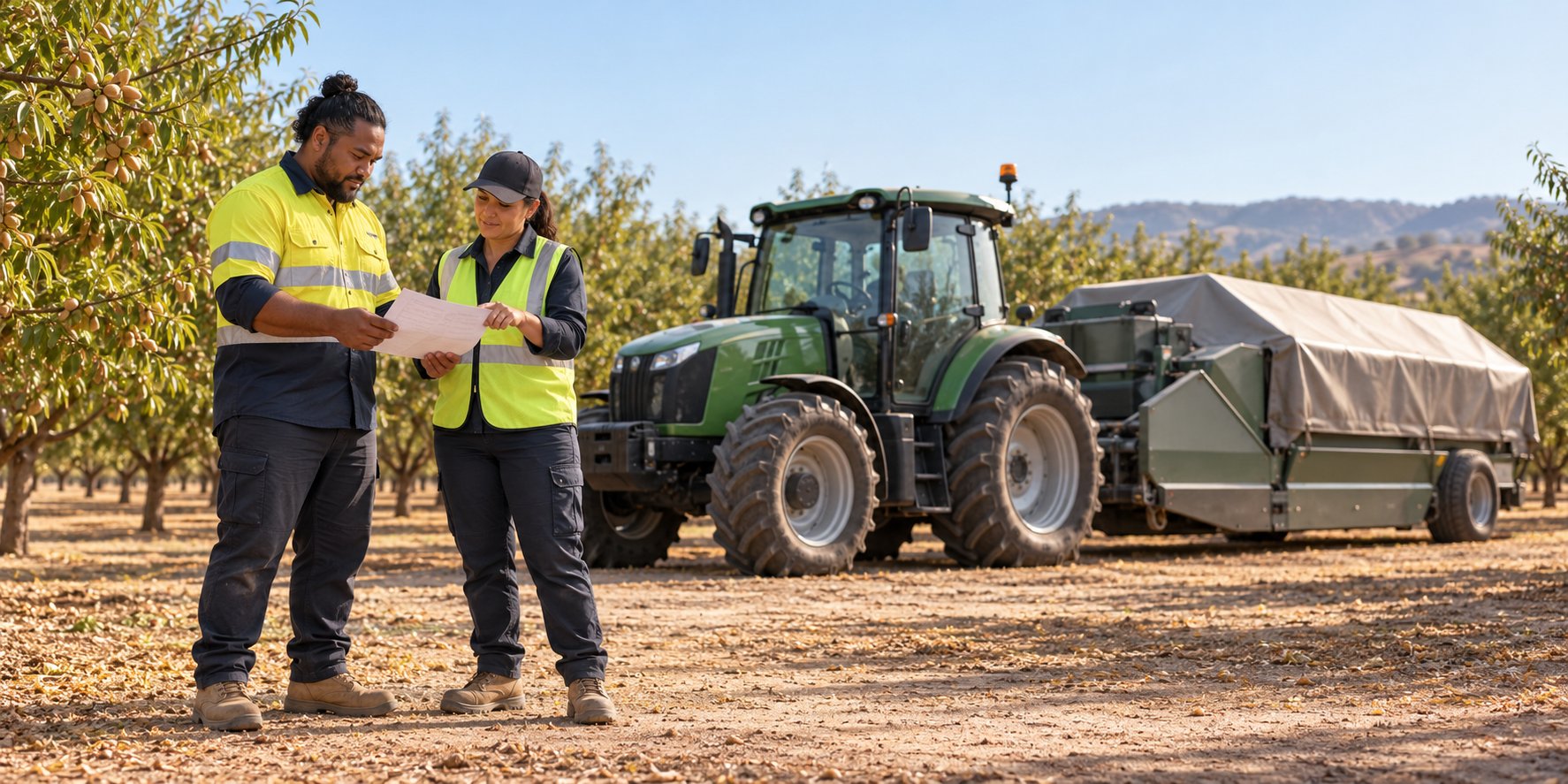
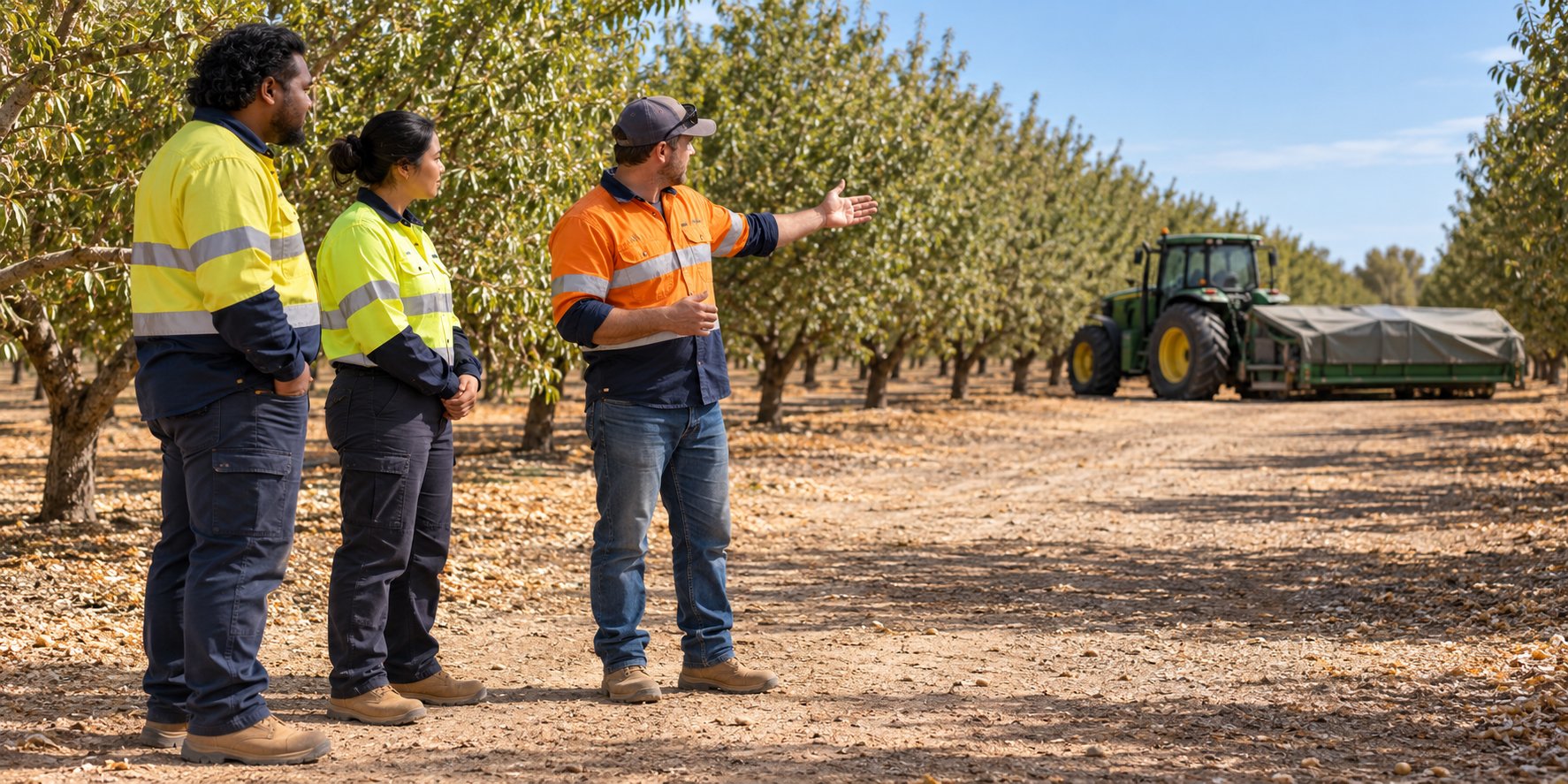
These AI-generated illustrations do not depict actual Orchard Tech employees. They introduce the approved source sheet below and do not replace induction, training or host instructions.




Read before you start
The paired view always keeps English with the existing Tongan. There is no Tongan-only view.
Full English source
Almond conditioning at harvest
What to expect before you start
Version 1.1 | Date of review: 18 October 2026 | Date of next review: 18 October 2028
This sheet describes typical almond conditioning work and conditions. Your actual duties depend on the farm and what you are trained and authorised to do. Reading this sheet does not authorise you to operate a tractor or conditioner, use other machinery or repair equipment.
Who you work for
Orchard Tech is your employer. Your host farm (your host) directs your daily work. Both are responsible for your health and safety. Raise questions or safety concerns with your supervisor or Orchard Tech: Hari Yellina, 0439 32 32 32, or Soana Fanua, 0400 174 471.
Your working hours
Your confirmed roster sets your days, hours and breaks. Ask your supervisor if you are unsure.
The work you may do
What a conditioner is. A conditioner is a harvest machine. In Orchard Tech's guidance, it is pulled by a tractor and powered by the tractor's PTO (power take-off), a turning shaft at the back of the tractor. The conditioner picks up almonds from the windrow (a row of almonds lying on the ground). Your host will show you the elevator, where almonds come out, and the stick belt, where sticks collect. Your host will explain what its conditioner does. If it uses a different type of conditioner, it will train you on that one.
Operating the tractor and conditioner is the job, but only when you are authorised. Do it only after your host has trained, assessed and authorised you on that tractor and conditioner. Get training for each new tractor and conditioner. A licence alone does not show you can operate them safely. Your supervisor will check your work.
Your host will train you in its own procedure. The work may include:
- Before you start: doing the pre-start checks you were taught, with the tractor and conditioner shut down and made safe so they cannot start or move, using your host's procedure. Checks may include the guards, PTO guards and chains, the stick belt, any cameras and the radio channel. Adjust the seat and controls. Report faults straight away. If a fault could make a machine unsafe, do not use it. Tag it out as your host shows you and tell your supervisor.
- Picking up the windrow: lining up the pick-up head (the front part that lifts the almonds) with the windrow, as you were trained. Keep watching the drives, belts, chains and guard covers. Check that almonds keep coming out of the elevator. If cameras are fitted, use them to watch the windrow and for sticks building up.
- Emptying the stick belt: when the stick belt starts to fill, empty it only where your host tells you, such as an open area at the end of the block.
- Ends of rows: your host will show you how to set the conditioner before you turn, reverse or travel. Do not make tight turns at the ends of rows.
- Checking the work: your host will show you what it calls the ‘sand row’ and how to check it. If you see almonds in the sand row, stop straight away and contact your supervisor.
- End of shift: with the machine shut down and made safe, remove all nuts and sticks from it, as you were trained. Park where your host tells you. Report anything that could affect the next shift.
This sheet covers operating the tractor and conditioner. Other harvest jobs, such as shaking, sweeping and pick-up, are separate tasks. So are adjustments, greasing, maintenance, repairs, cleaning with compressed air (blowing down), jump-starting, chemicals, electrical work, working at heights and entering confined spaces, dams, tanks or channels. They need their own instructions, training and authorisation.
Conditioner dangers to watch for
- PTO and moving parts: a turning PTO shaft can catch clothing, hair or a hand and pull a person in. So can the conditioner's pick-up head, belts, chains and drives. This can cause very serious injury or death. Do not wear loose clothing, cords or jewellery, and tie back long hair. Keep yourself and others clear while the PTO and conditioner are running. Never stand on or climb into the conditioner.
- Blockages, sticks and obstacles: if sticks or debris block the pick-up, or a large obstacle is in the row, stop. Before anyone goes near, shut down the tractor and conditioner and make them safe, using your host's procedure. Wait until all moving parts have stopped. Clear a blockage only if you are trained and authorised.
- Guards: never use the machine if a guard or guard cover is missing, loose or damaged. If a cover comes loose while you work, shut down all equipment and make it safe. Refitting a cover is not part of this job and must never be done alone. Call your supervisor for help.
- Blower and thrown material: the conditioner has a blower. Dust, sticks and other material can be blown or thrown out of the machine. Your host will tell you how far away people must stay.
Driving the tractor safely
- Public roads: never drive on or across a public road unless your host has confirmed that the tractor, the conditioner, your licence and the route are approved.
- Getting on and off: keep the steps free of mud. Use three points of contact (two hands and one foot, or one hand and two feet). Never get on or off a moving tractor. Start the tractor only from the driver's seat, as your host shows you. Never start it from the ground or bypass a safety switch.
- Roll-overs: tractors can roll over, especially on slopes and banks, on rough or wet ground, near dams and channels, and with heavy or raised loads. The roll-over frame (ROPS) protects you only if you wear your seat belt, because the belt keeps you inside the frame. Some frames fold down for work under trees. A folded frame cannot protect you in a roll-over. Your host will show you when it may be folded down. Put it back up as soon as there is enough room.
- Driver and passengers: wear your seat belt every time you operate the tractor. Keep the cab doors and windows shut while the tractor moves. Carry a passenger only if your host allows it and the tractor has a passenger seat and seat belt approved by the tractor manufacturer. The passenger must wear the seat belt. Never lift or carry anyone on the conditioner, another attachment or a trailer.
- Leaving the seat: your host will teach you the safe-stop procedure for the tractor and conditioner. It covers the handbrake, stopping the PTO, turning off the engine and making raised parts safe. Follow it every time before you leave the seat. Tell nearby workers by radio before you get off, using your host's procedure.
People, other machines and power lines
- Before you move: warn nearby workers as you were trained, and wait until they are clear. There are places around a tractor and conditioner that the driver cannot see. These are called blind spots. Look in all directions and use your mirrors. If you cannot see that the way is clear, stop and ask for help.
- People on foot: keep people away from the tractor and conditioner while they work or move. If someone comes close, stop and wait until they are clear. Before reversing, make sure no one is near. Contact your supervisor and follow the reversing procedure your host teaches you. Never let anyone stand between the tractor and the conditioner unless the tractor is stopped, the handbrake is on and the engine is off.
- Follow the farm traffic plan: learn it before you enter the orchard. Use set routes, obey signs and speed limits, and give way to working machinery. Watch for wash-outs, bog holes, rough ground and irrigation equipment. Keep away from steep slopes, banks and water. Talk with your supervisor about known obstacles before work. Report new ones straight away.
- Headlands and radio: take extra care when you enter or leave tree rows and headlands (the turning areas at the ends of the rows). Stop at every headland and check for other machines, trucks and people. Your host will teach you the radio calls and replies needed before you enter a headland. Do not enter until you get the reply your host's procedure requires.
- Seeing clearly: keep the windows clean. Dust, low sun, dawn and dusk can make it hard to see. If you cannot see that the way is clear, stop in a safe place. Stop in a safe place before you use a phone.
- Power lines: look up for overhead power lines before you raise any part of the conditioner and when you move the tractor and conditioner. Electricity can jump to a machine that comes close to a line, even if it does not touch it. Ask your host where the power lines are. If your tractor or conditioner touches a power line, or electricity jumps to it, stay in the tractor. Call 000 or ask someone to call 000. Warn others to keep away. Stay inside unless fire or another immediate danger makes it unsafe. Your host will teach you the emergency escape procedure.
- When you are on foot: wear high-visibility clothing and keep clear of moving machinery. Never approach a working machine until the operator has stopped and clearly signalled you to come closer. Eye contact alone is not enough.
Weather and the outdoors
Most work is outdoors in heat, cold, wind, rain and dust. Watch for holes, pipes, slippery ground and snakes. Work may change or stop in heat, storms or smoke: follow your host's instructions. Use sun protection all year (broad-brim hat, long sleeves, sunglasses, sunscreen), drink water often, take shade breaks and dress for the weather. Tell your supervisor straight away if you or a co-worker feel sick, dizzy or very hot.
- Do not enter a block that is being sprayed or has a no-entry sign. Do not drink irrigation water: it may contain fertiliser or chemicals.
Noise, dust and long hours in the seat
You may sit for long periods and climb on and off the tractor many times. Use your breaks and report pain or discomfort early. If you feel too tired or unwell to operate the machine safely, stop in a safe place and tell your supervisor.
- Noise: tractors and conditioners can be loud. Wear the hearing protection your host provides, as you are instructed.
- Dust: follow your host's instructions for dust. If dust makes it hard to breathe or to see clearly, stop the tractor in a safe place and tell your supervisor.
PPE and help on the farm
Your host will provide the personal protective equipment (PPE) for your tasks and show you how to wear, check and look after it. This may include safety boots, high-visibility clothing, gloves, long sleeves and long trousers, eye or hearing protection, sun protection and a dust mask. Report missing, damaged or poorly fitting PPE before you start. PPE does not replace training, instructions or other safety controls.
- Oil and grease: if oil or grease gets on your skin, wash it off.
At induction, learn who your supervisor is, where water, toilets and first aid are, the emergency plan, how to get help where there is no phone coverage, and the check-in arrangements when you work alone.
- In a life-threatening emergency, call Triple Zero (000), then tell your supervisor. If you see a snake, keep clear and never try to catch or kill it. If a snake bites you, or you think you have been bitten, keep as still as possible and call 000 or ask someone to call.
- Report every injury, near miss or unsafe situation to your supervisor and Orchard Tech as soon as possible, even if it seems small.
- Ask for a demonstration, an explanation or language help whenever you do not understand.
Important note before starting any jobThis sheet describes typical almond conditioning work. Before you start, your host will give you the job description and safe work instructions for your actual duties, the PPE you need, a farm induction and training for your tasks. Follow those instructions. Do not do any work without the required PPE, training and authorisation. Complete the induction at every new farm, and get the instructions and training for every new task. If anything is missing, unsafe or unclear, stop and ask your supervisor. You can also contact Orchard Tech. |
Paired English + Lea Fakatonga
The Tongan did not pass the full language check. The English is the official version. If anything is unclear, ask for a human interpreter — Orchard Tech will provide one.
11 safety instructions and the rule that English is the official version are shown in English only. This is not a passed or certified translation.
BILINGUAL AID - ENGLISH IS THE AUTHORITATIVE VERSION - NOT AUTHORISED FOR TONGAN-ALONE DISPLAY
Source record details (for supervisors)
The paired English–Tongan source was issued under an owner exception. The source records 11 blocking issues and 162 composed Tongan rows. 11 safety instructions and the English-authority policy remain in exact English. This is not a passed or certified translation.
LANGUAGE-QA FAIL - blocking control failed: B5, G5
BILINGUAL AID - ENGLISH IS THE AUTHORITATIVE VERSION - NOT AUTHORISED FOR TONGAN-ALONE DISPLAY
If you do not understand any part of this sheet, ask for a human interpreter. Orchard Tech will provide one.
Kapau ʻoku ʻikai mahino kiate koe ha konga ʻo e laʻipepa ni, kole ha tokotaha fakatonulea. ʻE ʻomi ʻe Orchard Tech ha tokotaha fakatonulea maʻau. °
Almond conditioning at harvest
Ngāue conditioner ki he almond ʻi he havesi °
What to expect before you start
Meʻa ke ke ʻamanaki ki ai kimuʻa pea ke kamata °
English and Tongan version 1.4, based on English version 1.1 | Date of review: 18 October 2026 | Date of next review: 18 October 2028
Version fakapalangi mo Fakatonga 1.4, makatuʻunga ʻi he Version fakapalangi 1.1 | ʻAho ʻo e toe vakaiʻi: 18 October 2026 | ʻAho ʻo e toe vakaiʻi hoko: 18 October 2028 °
Each Tongan line is printed under its English. Lines marked ° were written by Orchard Tech. See About this Tongan version at the end.
ʻOku paaki ʻa e laine Fakatonga takitaha ʻi lalo ʻi heʻene lea fakapalangi. Ko e ngaahi laine ʻoku fakaʻilongaʻi ʻaki ʻa e ° naʻe faʻu ʻe Orchard Tech. Vakai ki he konga Fekauʻaki mo e Version Fakatonga ni ʻi he ngataʻanga. °
This sheet describes typical almond conditioning work and conditions. Your actual duties depend on the farm and what you are trained and authorised to do. Reading this sheet does not authorise you to operate a tractor or conditioner, use other machinery or repair equipment.
ʻOku fakamatala ʻa e laʻipepa ni ki he ngāue conditioner ki he almond ʻoku faʻa fai mo e ngaahi tuʻunga ʻoku fai ai. ʻOku makatuʻunga ho ngaahi fatongia moʻoni ʻi he faama mo e ngaahi ngāue kuo akoʻi koe ke fai pea kuo fakangofua koe ke fai. ʻOku ʻikai ʻoatu ʻe hoʻo lau ʻa e laʻipepa ni ha ngofua ke ke ngāueʻaki ha tulekitoa pe conditioner, ngāueʻaki ha ngaahi mīsini kehe pe fakaleleiʻi ha meʻangāue. °
Who you work for
Tokotaha ʻoku ke ngāue ki ai °
Orchard Tech is your employer. Your host farm (your host) directs your daily work. Both are responsible for your health and safety. Raise questions or safety concerns with your supervisor or Orchard Tech: Hari Yellina, 0439 32 32 32, or Soana Fanua, 0400 174 471.
Ko Orchard Tech ʻa hoʻo pule ngāue. Ko e faama ʻoku ke ngāue ai (hoʻo host) ʻoku ne fakahinohino hoʻo ngāue fakaʻaho. ʻOku na fakatou fatongiaʻaki hoʻo moʻui lelei mo hoʻo malu. Tala ki hoʻo supavaisa pe Orchard Tech hoʻo ngaahi fehuʻi pe ngaahi meʻa ʻoku ke hohaʻa ki ai fekauʻaki mo e malu: Hari Yellina, 0439 32 32 32, pe Soana Fanua, 0400 174 471. °
Your working hours
Ho ngaahi houa ngāue °
Your confirmed roster sets your days, hours and breaks. Ask your supervisor if you are unsure.
Ko hoʻo fokotuʻutuʻu ngāue (roster) kuo fakapapauʻi ʻoku ne fokotuʻu ho ngaahi ʻaho, houa ngāue mo e taimi mālōlō. ʻEke ki hoʻo supavaisa kapau ʻoku ke veiveiua. °
The work you may do
Ngaahi ngāue te ke ala fai °
What a conditioner is. A conditioner is a harvest machine. In Orchard Tech's guidance, it is pulled by a tractor and powered by the tractor's PTO (power take-off), a turning shaft at the back of the tractor. The conditioner picks up almonds from the windrow (a row of almonds lying on the ground). Your host will show you the elevator, where almonds come out, and the stick belt, where sticks collect. Your host will explain what its conditioner does. If it uses a different type of conditioner, it will train you on that one.
ʻUhinga ʻo e conditioner. Ko e conditioner ko ha mīsini havesi. ʻI he ngaahi fakahinohino ʻa Orchard Tech, ʻoku toho ʻe ha tulekitoa ʻa e conditioner pea ʻoku fakalele ia ʻe he PTO (power take-off) ʻo e tulekitoa, ʻa ia ko ha konga (shaft) ʻoku vilo ʻi mui ʻi he tulekitoa. ʻOku toʻo hake ʻe he conditioner ʻa e ngaahi fua almond mei he windrow (ha ʻotu ʻo e ngaahi fua almond ʻoku tokoto ʻi he kelekele). ʻE fakaʻaliʻali atu ʻe he faama ʻoku ke ngāue ai ʻa e elevator, ʻa ia ʻoku hū ki tuʻa mei ai ʻa e ngaahi fua almond, mo e stick belt, ʻa ia ʻoku tānaki ai ʻa e ngaahi konga ʻakau (sticks). ʻE fakamatalaʻi atu ʻe he faama ʻoku ke ngāue ai ʻa e ngāue ʻoku fai ʻe heʻene conditioner. Kapau ʻoku ngāueʻaki ʻe he faama ʻoku ke ngāue ai ha faʻahinga conditioner kehe, te ne akoʻi koe ki he conditioner ko ia. °
Operating the tractor and conditioner is the job, but only when you are authorised. Do it only after your host has trained, assessed and authorised you on that tractor and conditioner. Get training for each new tractor and conditioner. A licence alone does not show you can operate them safely. Your supervisor will check your work.
Ko e ngāue ko hono ngāueʻaki ʻo e tulekitoa mo e conditioner, ka ʻi he taimi pē kuo fakangofua ai koe. Toki fai ia ʻo kapau pē kuo akoʻi koe ʻe he faama ʻoku ke ngāue ai ki he tulekitoa mo e conditioner ko ia, kuo ne siviʻi koe pea kuo ne fakangofua koe ke ngāueʻaki kinaua. Maʻu ha akoʻi ki he tulekitoa foʻou takitaha mo e conditioner foʻou takitaha. ʻOku ʻikai fakahaaʻi ʻe ha laiseni pē ʻe lava ke ke ngāueʻaki malu ʻa e ngaahi meʻa ko ia. ʻE vakaiʻi ʻe hoʻo supavaisa hoʻo ngāue. °
Your host will train you in its own procedure. The work may include:
ʻE akoʻi koe ʻe he faama ʻoku ke ngāue ai ki heʻene founga ngāue ʻaʻana. ʻE ala kau ʻi he ngāue ʻa e ngaahi meʻa ni: °
- English
Before you start: doing the pre-start checks you were taught, with the tractor and conditioner shut down and made safe so they cannot start or move, using your host's procedure. Checks may include the guards, PTO guards and chains, the stick belt, any cameras and the radio channel. Adjust the seat and controls. Report faults straight away. If a fault could make a machine unsafe, do not use it. Tag it out as your host shows you and tell your supervisor.
Lea FakatongaKimuʻa pea ke kamata: ko hono fai ʻo e ngaahi vakaiʻi kimuʻa ʻi he kamata ngāue (pre-start checks) naʻe akoʻi atu, ʻi he taimi kuo tamateʻi ai ʻa e tulekitoa mo e conditioner pea ʻai ke malu ke ʻoua naʻa lava ʻo kamata pe ngaʻunu, ʻo ngāueʻaki ʻa e founga ngāue ʻa e faama ʻoku ke ngāue ai. ʻE ala kau ʻi he ngaahi vakaiʻi ʻa e ngaahi meʻa maluʻi (guards), ngaahi meʻa maluʻi mo e ngaahi seini (chains) ʻo e PTO, ʻa e stick belt, ha ngaahi meʻa faita (cameras) pē ʻoku ʻi ai, mo e halanga fetuʻutaki ʻi he radio (radio channel). Fakafeʻungaʻi ʻa e sea mo e ngaahi meʻa puleʻi (controls). Lipooti ha ngaahi palopalema (faults) ʻi he taimi pē ko ia. Kapau ʻe ala ʻai ʻe ha palopalema (fault) ha mīsini ke ʻikai malu, ʻoua naʻa ke ngāueʻaki ia. Fakamaʻu ki ai ha fakaʻilonga ʻoku tapu ke ngāueʻaki ia (tag out), ʻo fakatatau ki he founga ʻoku fakaʻaliʻali atu ʻe he faama ʻoku ke ngāue ai, pea tala ki hoʻo supavaisa. °
- English
Picking up the windrow: lining up the pick-up head (the front part that lifts the almonds) with the windrow, as you were trained. Keep watching the drives, belts, chains and guard covers. Check that almonds keep coming out of the elevator. If cameras are fitted, use them to watch the windrow and for sticks building up.
Lea FakatongaHono toʻo hake ʻo e windrow: ko hono fokotuʻu ʻo e pick-up head (ʻa e konga ʻi muʻa ʻoku ne hiki hake ʻa e ngaahi fua almond) ke hangatonu mo e windrow, ʻo fakatatau ki he founga naʻe akoʻi atu. Siofi maʻu pē ʻa e ngaahi meʻa fakalele (drives), ngaahi leta (belts), ngaahi seini (chains) mo e ngaahi ʻufiʻufi maluʻi (guard covers). Vakaiʻi ʻoku kei hū ki tuʻa ʻa e ngaahi fua almond mei he elevator. Kapau kuo fakamaʻu ha ngaahi meʻa faita (cameras), ngāueʻaki ʻa e ngaahi meʻa faita ko ia ke siofi ʻa e windrow pea vakai pe ʻoku tānaki ʻa e ngaahi konga ʻakau (sticks). °
- English
Emptying the stick belt: when the stick belt starts to fill, empty it only where your host tells you, such as an open area at the end of the block.
Lea FakatongaHono toʻo ʻo e ngaahi meʻa mei he stick belt: ʻi he taimi ʻoku kamata fonu ai ʻa e stick belt, toʻo ʻa e ngaahi meʻa mei ai ʻi he feituʻu pē ʻoku tala atu ʻe he faama ʻoku ke ngāue ai, hangē ko ha feituʻu ʻatā ʻi he ngataʻanga ʻo e poloka. °
- English
Ends of rows: your host will show you how to set the conditioner before you turn, reverse or travel. Do not make tight turns at the ends of rows.
Lea FakatongaNgaahi ngataʻanga ʻo e ngaahi ʻotu: ʻe fakaʻaliʻali atu ʻe he faama ʻoku ke ngāue ai ʻa e founga ke fokotuʻu ai ʻa e conditioner kimuʻa pea ke afe, fakaʻuli fakaholomui pe fononga. ʻOua naʻa ke fai ha ngaahi afe fasiʻi (tight turns) ʻi he ngaahi ngataʻanga ʻo e ngaahi ʻotu. °
- English
Checking the work: your host will show you what it calls the ‘sand row’ and how to check it. If you see almonds in the sand row, stop straight away and contact your supervisor.
Lea FakatongaHono vakaiʻi ʻo e ngāue: ʻe fakaʻaliʻali atu ʻe he faama ʻoku ke ngāue ai ʻa e meʻa ʻoku ne ui ko e sand row mo e founga ke vakaiʻi ai. Kapau te ke sio ki ha ngaahi fua almond ʻi he sand row, tuʻu ʻi he taimi pē ko ia pea fetuʻutaki ki hoʻo supavaisa. °
- English
End of shift: with the machine shut down and made safe, remove all nuts and sticks from it, as you were trained. Park where your host tells you. Report anything that could affect the next shift.
Lea FakatongaNgataʻanga ʻo e sifi: ʻi he taimi kuo tamateʻi ai ʻa e mīsini pea ʻai ke malu, toʻo kotoa ʻa e ngaahi fuaʻi ʻakau ngeʻesi fefeka (nuts) mo e ngaahi konga ʻakau (sticks) mei ai, ʻo fakatatau ki he founga naʻe akoʻi atu. Tau ʻi he feituʻu ʻoku tala atu ʻe he faama ʻoku ke ngāue ai. Lipooti ha meʻa pē ʻe ala uesia ai ʻa e sifi hono hoko. °
This sheet covers operating the tractor and conditioner. Other harvest jobs, such as shaking, sweeping and pick-up, are separate tasks. So are adjustments, greasing, maintenance, repairs, cleaning with compressed air (blowing down), jump-starting, chemicals, electrical work, working at heights and entering confined spaces, dams, tanks or channels. They need their own instructions, training and authorisation.
ʻOku fakamatala ʻa e laʻipepa ni ki hono ngāueʻaki ʻo e tulekitoa mo e conditioner. Ko e ngaahi ngāue havesi kehe, hangē ko e luluʻi (shaking), tafi (sweeping) mo e pick-up, ko e ngaahi ngāue makehe (separate tasks). Ko e ngaahi fakatonutonu (adjustments), vali lolo matolu (greasing), ngāue tokangaʻi (maintenance), ngaahi fakaleleiʻi, fakamaʻa ʻaki ʻa e ʻea ʻoku ʻi ai ha teke (compressed air) (blowing down), jump-starting, kemikale, ngāue ʻuhila, ngāue ʻi he ngaahi feituʻu maʻolunga, mo e hū ki he ngaahi feituʻu mapuni (confined spaces), ngaahi feituʻu tauhi vai (dams), ngaahi ʻaiʻanga (tanks) pe ngaahi halanga vai (channels), ko e ngaahi ngāue makehe foki. ʻOku fiemaʻu ki he ngāue taki taha ʻa ʻene ngaahi fakahinohino pē ʻaʻana, ʻene akoʻi pē ʻaʻana mo ʻene ngofua pē ʻaʻana. °
Conditioner dangers to watch for
Ngaahi fakatuʻutāmaki ʻo e conditioner ke tokanga ki ai °
- English
PTO and moving parts: a turning PTO shaft can catch clothing, hair or a hand and pull a person in. So can the conditioner's pick-up head, belts, chains and drives. This can cause very serious injury or death. Do not wear loose clothing, cords or jewellery, and tie back long hair. Keep yourself and others clear while the PTO and conditioner are running. Never stand on or climb into the conditioner.
Lea FakatongaPTO mo e ngaahi konga ʻoku ngaʻunu: ʻe lava ʻe he konga ʻoku vilo ʻo e PTO (PTO shaft) ʻo puke ʻa e vala, louʻulu pe ha nima, pea toho ha tokotaha ki loto. ʻE lava foki ʻe he pick-up head, ngaahi leta (belts), ngaahi seini (chains) mo e ngaahi meʻa fakalele (drives) ʻo e conditioner ʻo puke ha vala, louʻulu pe ha nima, pea toho ha taha ki loto. ʻE lava ʻe he meʻa ni ʻo fakatupunga ha lavea lahi ʻaupito pe mate. ʻOua naʻa ke tui ha vala ʻoku tautau (loose clothing), ngaahi afo pe ngaahi teuteu (jewellery), pea haʻi ki mui ho louʻulu loloa. Tauhi koe mo e niʻihi kehe ke mamaʻo mei he PTO mo e conditioner lolotonga ʻoku na ngāue. ʻOua ʻaupito naʻa ke tuʻu ʻi ʻolunga ʻi he conditioner pe kaka ki loto ai. °
- English
Blockages, sticks and obstacles: if sticks or debris block the pick-up, or a large obstacle is in the row, stop. Before anyone goes near, shut down the tractor and conditioner and make them safe, using your host's procedure. Wait until all moving parts have stopped. Clear a blockage only if you are trained and authorised.
Lea FakatongaNgaahi punitia, ngaahi konga ʻakau mo e ngaahi meʻa ʻi he hala (obstacles): kapau ʻoku punitia ʻa e pick-up ʻe ha ngaahi konga ʻakau (sticks) pe veve (debris), pe ʻoku ʻi ai ha meʻa lahi ʻi he hala (obstacle) ʻi he ʻotu, tuʻu. Kimuʻa pea ʻunuʻunu ofi atu ha taha, tamateʻi ʻa e tulekitoa mo e conditioner pea ʻai ke malu, ʻo ngāueʻaki ʻa e founga ngāue ʻa e faama ʻoku ke ngāue ai. Tatali kae ʻoua kuo tuʻu kotoa ʻa e ngaahi kongokonga ʻoku ngaʻunu. Toʻo ha meʻa ʻoku ne fakatupu ha punitia (blockage) ʻo kapau pē kuo akoʻi koe pea fakangofua koe ke ke fai. °
- English
Guards: never use the machine if a guard or guard cover is missing, loose or damaged. If a cover comes loose while you work, shut down all equipment and make it safe. Refitting a cover is not part of this job and must never be done alone. Call your supervisor for help.
Lea FakatongaNgaahi meʻa maluʻi (guards): ʻoua ʻaupito naʻa ke ngāueʻaki ʻa e mīsini kapau ʻoku ʻikai maʻu, homo pe maumau ha meʻa maluʻi (guard) pe ha ʻufiʻufi maluʻi (guard cover). Kapau ʻoku homo ha ʻufiʻufi maluʻi (guard cover) lolotonga hoʻo ngāue, tamateʻi ʻa e ngaahi meʻangāue kotoa pē pea ʻai ke malu. ʻOku ʻikai kau ʻi he ngāue ni ʻa e toe fakamaʻu ʻo ha ʻufiʻufi maluʻi (guard cover), pea ʻoua ʻaupito naʻa fai ia toko taha. Ui ki hoʻo supavaisa ke maʻu ha tokoni. °
- English
Blower and thrown material: the conditioner has a blower. Dust, sticks and other material can be blown or thrown out of the machine. Your host will tell you how far away people must stay.
Lea FakatongaMeʻa ifi ʻea (blower) mo e ngaahi meʻa ʻoku laku atu: ʻoku ʻi he conditioner ha meʻa ifi ʻea (blower). ʻE lava ke pupuhi pe laku ki tuʻa mei he mīsini ʻa e efu, ngaahi konga ʻakau (sticks) mo e ngaahi meʻa kehe. ʻE tala atu ʻe he faama ʻoku ke ngāue ai ʻa e mamaʻo kuo pau ke nofo ai ʻa e kakai. °
Driving the tractor safely
Fakaʻuli ʻa e tulekitoa ʻi ha founga malu °
- English
Public roads: never drive on or across a public road unless your host has confirmed that the tractor, the conditioner, your licence and the route are approved.
Lea FakatongaNgaahi hala puleʻanga: ʻoua ʻaupito naʻa ke fakaʻuli ʻi ha hala puleʻanga pe kolosi ai, tukukehe kapau kuo fakapapauʻi ʻe he faama ʻoku ke ngāue ai kuo fakangofua ʻa e tulekitoa, ʻa e conditioner, hoʻo laiseni mo e hala ke ke fou ai. °
- English
Getting on and off: keep the steps free of mud. Use three points of contact (two hands and one foot, or one hand and two feet). Never get on or off a moving tractor. Start the tractor only from the driver's seat, as your host shows you. Never start it from the ground or bypass a safety switch.
Lea FakatongaHeka mo hifo: tauhi ʻa e ngaahi sitepu ke ʻoua naʻa ʻi ai ha pelepela. Ngāueʻaki ʻa e ngaahi feituʻu piki ʻe tolu (three points of contact), ʻa ia ko e ongo nima mo e vaʻe ʻe taha, pe nima ʻe taha mo e ongo vaʻe. ʻOua ʻaupito naʻa ke heka pe hifo mei ha tulekitoa ʻoku ngaʻunu. Fakamoʻui ʻa e tulekitoa mei he sea ʻo e tokotaha fakaʻuli pē, ʻo fakatatau ki he founga ʻoku fakaʻaliʻali atu ʻe he faama ʻoku ke ngāue ai. ʻOua ʻaupito naʻa ke fakamoʻui ia mei he kelekele pe fai ha founga ke ʻoua ʻe ngāue ai ha meʻa kamosi malu (safety switch). °
- English
Roll-overs: tractors can roll over, especially on slopes and banks, on rough or wet ground, near dams and channels, and with heavy or raised loads. The roll-over frame (ROPS) protects you only if you wear your seat belt, because the belt keeps you inside the frame. Some frames fold down for work under trees. A folded frame cannot protect you in a roll-over. Your host will show you when it may be folded down. Put it back up as soon as there is enough room.
Lea FakatongaNgaahi fulihi: ʻe lava ke fulihi ʻa e ngaahi tulekitoa, tautefito ʻi he ngaahi feituʻu tahifo mo e ngaahi tapa maʻolunga (banks), ʻi he kelekele tokakovi pe viviku, ofi ki he ngaahi feituʻu tauhi vai (dams) mo e ngaahi halanga vai (channels), pea ʻi he taimi ʻoku mamafa ai pe hiki hake ʻa e uta. ʻOku maluʻi koe ʻe he faʻunga maluʻi ʻi ha fulihi (ROPS) ʻo kapau pē ʻoku ke fakamaʻu ho leta maluʻi, koeʻuhi ʻoku tauhi koe ʻe he leta ʻi loto ʻi he faʻunga. ʻOku lava ke peluki ki lalo ʻa e ngaahi faʻunga ʻe niʻihi ke fai ʻa e ngāue ʻi lalo ʻi he ngaahi fuʻu ʻakau. ʻOku ʻikai lava ʻe ha faʻunga kuo peluki ki lalo ke maluʻi koe ʻi ha fulihi. ʻE fakaʻaliʻali atu ʻe he faama ʻoku ke ngāue ai ʻa e taimi ʻoku fakangofua ai ke peluki ia ki lalo. Toe fokotuʻu hake ia ʻi he vave taha ʻe lava, ʻi he taimi ʻoku ʻatā feʻunga ai ʻa e feituʻu. °
- English
Driver and passengers: wear your seat belt every time you operate the tractor. Keep the cab doors and windows shut while the tractor moves. Carry a passenger only if your host allows it and the tractor has a passenger seat and seat belt approved by the tractor manufacturer. The passenger must wear the seat belt. Never lift or carry anyone on the conditioner, another attachment or a trailer.
Lea FakatongaTokotaha fakaʻuli mo e kau pasese: fakamaʻu ho leta maluʻi ʻi he taimi kotoa pē ʻoku ke ngāueʻaki ai ʻa e tulekitoa. Tauhi ʻa e ngaahi matapā mo e ngaahi matapā sioʻata ʻo e fale fakaʻuli (cab) ke tāpuni lolotonga ʻoku ngaʻunu ʻa e tulekitoa. ʻAve ha pasese ʻo kapau pē ʻoku fakangofua ʻe he faama ʻoku ke ngāue ai, pea ʻoku ʻi he tulekitoa ha sea ki he pasese mo ha leta maluʻi kuo fakangofua fakatouʻosi ʻe he kautaha naʻa ne ngaohi ʻa e tulekitoa. Kuo pau ke fakamaʻu ʻe he pasese ʻa e leta maluʻi. ʻOua ʻaupito naʻa ke hiki hake pe fetuku ha taha ʻi he conditioner, ha meʻangāue kehe ʻoku fakahoko ki he tulekitoa (attachment) pe ha taulani (trailer). °
- English
Leaving the seat: your host will teach you the safe-stop procedure for the tractor and conditioner. It covers the handbrake, stopping the PTO, turning off the engine and making raised parts safe. Follow it every time before you leave the seat. Tell nearby workers by radio before you get off, using your host's procedure.
Lea FakatongaMavahe mei he sea: ʻe akoʻi koe ʻe he faama ʻoku ke ngāue ai ki he founga taʻofi malu (safe-stop procedure) ki he tulekitoa mo e conditioner. ʻOku kau ai ʻa e meʻa taʻofi nima (handbrake), ʻa hono taʻofi ʻo e PTO, ʻa hono tamateʻi ʻo e mīsini (engine), mo hono ʻai ʻa e ngaahi konga kuo hiki hake ke malu. Muimui ki ai ʻi he taimi kotoa pē kimuʻa pea ke mavahe mei he sea. Tala ʻi he radio ki he kau ngāue ʻoku ofi mai kimuʻa pea ke hifo, ʻo ngāueʻaki ʻa e founga ngāue ʻa e faama ʻoku ke ngāue ai. °
People, other machines and power lines
Kakai, ngaahi mīsini kehe mo e ngaahi laine ʻuhila °
- English
Before you move: warn nearby workers as you were trained, and wait until they are clear. There are places around a tractor and conditioner that the driver cannot see. These are called blind spots. Look in all directions and use your mirrors. If you cannot see that the way is clear, stop and ask for help.
Lea FakatongaKimuʻa pea ke ngaʻunu: ʻoatu ha fakatokanga ki he kau ngāue ʻoku ofi atu, ʻo fakatatau ki he founga naʻe akoʻi atu, pea tatali kae ʻoua kuo nau mavahe atu ʻo ʻatā. ʻOku ʻi ai ha ngaahi feituʻu takatakai ʻi ha tulekitoa mo ha conditioner ʻoku ʻikai lava ke sio ki ai ʻa e tokotaha fakaʻuli. ʻOku ui ʻa e ngaahi feituʻu ni ko e “blind spots”. Sio ki he ngaahi tafaʻaki kotoa pē pea ngāueʻaki ho ngaahi sioʻata (mirrors). Kapau ʻoku ʻikai ke ke lava ʻo sio ʻoku ʻatā ʻa e hala, tuʻu pea kole tokoni. °
- English
People on foot: keep people away from the tractor and conditioner while they work or move. If someone comes close, stop and wait until they are clear. Before reversing, make sure no one is near. Contact your supervisor and follow the reversing procedure your host teaches you. Never let anyone stand between the tractor and the conditioner unless the tractor is stopped, the handbrake is on and the engine is off.
Lea FakatongaKakai ʻoku lue: tauhi ʻa e kakai ke mamaʻo mei he tulekitoa mo e conditioner lolotonga ʻoku na ngāue pe ngaʻunu. Kapau ʻoku ʻunuʻunu ofi ha taha, tuʻu pea tatali kae ʻoua kuo ne mavahe atu ʻo ʻatā. Kimuʻa pea ke fakaʻuli fakaholomui, fakapapauʻi ʻoku ʻikai ha taha ʻoku ofi. Fetuʻutaki ki hoʻo supavaisa pea muimui ki he founga fakaʻuli fakaholomui ʻoku akoʻi atu ʻe he faama ʻoku ke ngāue ai. ʻOua ʻaupito naʻa ke tuku ha taha ke tuʻu ʻi he vahaʻa ʻo e tulekitoa mo e conditioner, tukukehe kapau kuo tuʻu ʻa e tulekitoa, kuo fakamaʻu ʻa e meʻa taʻofi nima (handbrake), pea kuo tamateʻi ʻa e mīsini (engine). °
- English
Follow the farm traffic plan: learn it before you enter the orchard. Use set routes, obey signs and speed limits, and give way to working machinery. Watch for wash-outs, bog holes, rough ground and irrigation equipment. Keep away from steep slopes, banks and water. Talk with your supervisor about known obstacles before work. Report new ones straight away.
Lea FakatongaMuimui ki he palani fefonongaʻaki ʻa e faama: ako ke ke ʻilo ia kimuʻa pea ke hū ki he ngoueʻanga ʻakau (orchard). Ngāueʻaki ʻa e ngaahi hala kuo fokotuʻu, talangofua ki he ngaahi fakaʻilonga mo e ngaahi fakangatangata ʻo e vave, pea tuku ʻa e ngaahi mīsini ʻoku ngāue ke nau muʻomuʻa. Tokanga ki he ngaahi feituʻu kuo tafi ʻe he vai (wash-outs), ngaahi luo pela (bog holes), kelekele tokakovi mo e ngaahi meʻangāue fuʻifuʻi ngoue. Nofo mamaʻo mei he ngaahi feituʻu ʻoku tahifo lahi, ngaahi tapa maʻolunga (banks), mo e vai. Talanoa mo hoʻo supavaisa fekauʻaki mo e ngaahi meʻa kuo ʻosi ʻilo ʻoku ʻi he hala (obstacles) kimuʻa ʻi he ngāue. Lipooti ha ngaahi meʻa foʻou ʻoku ʻi he hala (obstacles) ʻi he taimi pē ko ia. °
- English
Headlands and radio: take extra care when you enter or leave tree rows and headlands (the turning areas at the ends of the rows). Stop at every headland and check for other machines, trucks and people. Your host will teach you the radio calls and replies needed before you enter a headland. Do not enter until you get the reply your host's procedure requires.
Lea FakatongaNgaahi feituʻu afe (headlands) mo e radio: toe tokanga ange ʻi he taimi ʻoku ke hū ai ki he ngaahi ʻotu ʻakau mo e ngaahi feituʻu afe (headlands), ʻa ia ko e ngaahi feituʻu afe ʻi he ngataʻanga ʻo e ngaahi ʻotu, pe mavahe mei ai. Tuʻu ʻi he feituʻu afe (headland) kotoa pē pea vakai pe ʻoku ʻi ai ha ngaahi mīsini kehe, loli mo e kakai. ʻE akoʻi koe ʻe he faama ʻoku ke ngāue ai ki he ngaahi ui mo e ngaahi tali ʻi he radio ʻoku fiemaʻu kimuʻa pea ke hū ki ha feituʻu afe (headland). ʻOua naʻa ke hū kae ʻoua kuo ke maʻu ʻa e tali ʻoku fiemaʻu ʻe he founga ngāue ʻa e faama ʻoku ke ngāue ai. °
- English
Seeing clearly: keep the windows clean. Dust, low sun, dawn and dusk can make it hard to see. If you cannot see that the way is clear, stop in a safe place. Stop in a safe place before you use a phone.
Lea FakatongaSio lelei: tauhi ʻa e ngaahi matapā sioʻata ke maʻa. ʻE lava ke faingataʻa ʻa e sio koeʻuhi ko e efu, laʻā ʻoku maʻulalo, mafoa ʻa e ata mo e fakapoʻuli hifo ʻa e ʻaho. Kapau ʻoku ʻikai ke ke lava ʻo sio ʻoku ʻatā ʻa e hala, tuʻu ʻi ha feituʻu malu. Tuʻu ʻi ha feituʻu malu kimuʻa pea ke ngāueʻaki ha telefoni. °
- English
Power lines: look up for overhead power lines before you raise any part of the conditioner and when you move the tractor and conditioner. Electricity can jump to a machine that comes close to a line, even if it does not touch it. Ask your host where the power lines are. If your tractor or conditioner touches a power line, or electricity jumps to it, stay in the tractor. Call 000 or ask someone to call 000. Warn others to keep away. Stay inside unless fire or another immediate danger makes it unsafe. Your host will teach you the emergency escape procedure.
Lea FakatongaNgaahi laine ʻuhila (power lines): sio ki ʻolunga ki he ngaahi laine ʻuhila ʻi ʻolunga kimuʻa pea ke hiki hake ha konga pē ʻo e conditioner, pea ʻi he taimi ʻoku ke ʻunuaki ai ʻa e tulekitoa mo e conditioner. ʻE lava ke puna ʻa e ʻuhila ki ha mīsini ʻoku ʻunuʻunu ofi ki ha laine ʻuhila, neongo kapau ʻoku ʻikai ke ala ki ai ʻa e mīsini. ʻEke ki he faama ʻoku ke ngāue ai pe ʻoku ʻi fē ʻa e ngaahi laine ʻuhila. °
English retained in the sourceLea Fakatonga: If your tractor or conditioner touches a power line, or electricity jumps to it, stay in the tractor.
English retained in the sourceLea Fakatonga: Call 000 or ask someone to call 000.
English retained in the sourceLea Fakatonga: Warn others to keep away.
English retained in the sourceLea Fakatonga: Stay inside unless fire or another immediate danger makes it unsafe.
English retained in the sourceLea Fakatonga: Your host will teach you the emergency escape procedure.
- English
When you are on foot: wear high-visibility clothing and keep clear of moving machinery. Never approach a working machine until the operator has stopped and clearly signalled you to come closer. Eye contact alone is not enough.
Lea FakatongaʻI hoʻo lue: tui ʻa e vala lanu mataʻāʻā pea nofo mamaʻo mei he ngaahi mīsini ʻoku ngaʻunu. ʻOua ʻaupito naʻa ke ʻunuʻunu ofi ki ha mīsini ʻoku ngāue kae ʻoua kuo taʻofi ia ʻe he tokotaha ʻoku ne ngāueʻaki pea kuo ne ʻoatu ha fakaʻilonga mahino ke ke ʻunuʻunu ofi ange. ʻOku ʻikai feʻunga ʻa e fesiofaki pē. °
Weather and the outdoors
Ko e ʻea mo e ngāue ʻi tuʻa °
Most work is outdoors in heat, cold, wind, rain and dust. Watch for holes, pipes, slippery ground and snakes. Work may change or stop in heat, storms or smoke: follow your host's instructions. Use sun protection all year (broad-brim hat, long sleeves, sunglasses, sunscreen), drink water often, take shade breaks and dress for the weather. Tell your supervisor straight away if you or a co-worker feel sick, dizzy or very hot.
Ko e lahi taha ʻo e ngāue ʻoku fai ʻi tuʻa, ʻi he vela, momoko, matangi, ʻuha mo e efu. Tokanga ki he ngaahi ava, paipa, kelekele hekeheke mo e fanga ngata. ʻE ala liliu pe tuʻu ʻa e ngāue ʻi he vela, ngaahi matangi mālohi (storms) pe ʻahu: muimui ki he ngaahi fakahinohino ʻa e faama ʻoku ke ngāue ai. Ngāueʻaki ʻa e maluʻi mei he laʻā ʻi he taʻu kakato (tatā ʻoku falahi hono tapa, falani nima loloa, matasioʻata maluʻi mei he laʻā, kilimi laʻā), inu vai tuʻo lahi, mālōlō ʻi he malumalu pea tui vala ʻoku feʻunga mo e ʻea. °
Lea Fakatonga: Tell your supervisor straight away if you or a co-worker feel sick, dizzy or very hot.
- English
Do not enter a block that is being sprayed or has a no-entry sign. Do not drink irrigation water: it may contain fertiliser or chemicals.
Lea FakatongaʻOua naʻa ke hū ki ha poloka ʻoku lolotonga fai ai ʻa e fana (spraying) pe ʻoku ʻi ai ha fakaʻilonga tapu hū. ʻOua naʻa ke inu ʻa e vai fuʻifuʻi ngoue: ʻe ala ʻi ai ha meʻa fafanga ʻakau (fertiliser) pe kemikale. °
Noise, dust and long hours in the seat
Longoaʻa, efu mo e ngaahi houa loloa ʻi he sea °
You may sit for long periods and climb on and off the tractor many times. Use your breaks and report pain or discomfort early. If you feel too tired or unwell to operate the machine safely, stop in a safe place and tell your supervisor.
Te ke ala tangutu ʻi ha ngaahi taimi loloa pea kaka hake ki he tulekitoa mo hifo mei ai ʻo tuʻo lahi. °
Lea Fakatonga: Use your breaks and report pain or discomfort early.
Lea Fakatonga: If you feel too tired or unwell to operate the machine safely, stop in a safe place and tell your supervisor.
- English
Noise: tractors and conditioners can be loud. Wear the hearing protection your host provides, as you are instructed.
Lea FakatongaLongoaʻa: ʻe ala longoaʻa lahi ʻa e ngaahi tulekitoa mo e ngaahi conditioner. Tui ʻa e meʻa maluʻi telinga ʻoku ʻoatu ʻe he faama ʻoku ke ngāue ai, ʻo fakatatau ki he fakahinohino kuo ʻoatu kiate koe. °
- English
Dust: follow your host's instructions for dust. If dust makes it hard to breathe or to see clearly, stop the tractor in a safe place and tell your supervisor.
Lea FakatongaEfu: muimui ki he ngaahi fakahinohino ʻa e faama ʻoku ke ngāue ai fekauʻaki mo e efu. °
English retained in the sourceLea Fakatonga: If dust makes it hard to breathe or to see clearly, stop the tractor in a safe place and tell your supervisor.
PPE and help on the farm
PPE mo e tokoni ʻi he faama °
Your host will provide the personal protective equipment (PPE) for your tasks and show you how to wear, check and look after it. This may include safety boots, high-visibility clothing, gloves, long sleeves and long trousers, eye or hearing protection, sun protection and a dust mask. Report missing, damaged or poorly fitting PPE before you start. PPE does not replace training, instructions or other safety controls.
ʻE ʻoatu ʻe he faama ʻoku ke ngāue ai ʻa e teunga maluʻi fakataautaha (PPE) ki hoʻo ngaahi ngāue, pea fakaʻaliʻali atu ʻa e founga ke tui, vakaiʻi mo tokangaʻi ai. ʻE ala kau heni ʻa e sū malu, vala lanu mataʻāʻā, kofunima, falani nima loloa mo e talausese loloa, meʻa maluʻi mata pe telinga, maluʻi mei he laʻā mo ha meʻa ʻufiʻufi ihu mo e ngutu ke maluʻi mei he efu (dust mask). Lipooti ʻa e PPE ʻoku ʻikai maʻu, maumau pe ʻikai feʻunga mo ho sino kimuʻa pea ke kamata. ʻOku ʻikai fetongi ʻe he PPE ʻa e akoʻi, ngaahi fakahinohino pe ngaahi founga maluʻi kehe. °
- English
Oil and grease: if oil or grease gets on your skin, wash it off.
Lea FakatongaLolo (oil) mo e lolo matolu (grease): kapau ʻoku tau ha lolo pe lolo matolu ki ho kili, fufulu ia mei ho kili. °
At induction, learn who your supervisor is, where water, toilets and first aid are, the emergency plan, how to get help where there is no phone coverage, and the check-in arrangements when you work alone.
ʻI he fakataukeiʻi, ako ke ke ʻilo ko hai hoʻo supavaisa, ʻa e feituʻu ʻoku ʻi ai ʻa e vai, ngaahi falemālōlō mo e ʻuluaki tokoni (first aid), ʻa e palani ki he meʻa fakatuʻupakē, ʻa e founga ke maʻu ai ha tokoni ʻi ha feituʻu ʻoku ʻikai aʻu ki ai ʻa e fakaʻilonga telefoni (phone coverage), mo e ngaahi fokotuʻutuʻu fetuʻutaki ʻi hoʻo ngāue toko taha (check-in arrangements). °
- English
In a life-threatening emergency, call Triple Zero (000), then tell your supervisor. If you see a snake, keep clear and never try to catch or kill it. If a snake bites you, or you think you have been bitten, keep as still as possible and call 000 or ask someone to call.
English retained in the sourceLea Fakatonga: In a life-threatening emergency, call Triple Zero (000), then tell your supervisor.
Lea FakatongaKapau te ke sio ki ha ngata, nofo mamaʻo mei ai pea ʻoua ʻaupito naʻa ke feinga ke puke pe fakamateʻi ia. °
English retained in the sourceLea Fakatonga: If a snake bites you, or you think you have been bitten, keep as still as possible and call 000 or ask someone to call.
- English
Report every injury, near miss or unsafe situation to your supervisor and Orchard Tech as soon as possible, even if it seems small.
Lea FakatongaLipooti ʻa e lavea kotoa pē, ʻa e meʻa kotoa pē naʻe meimei hoko ai ha fakatuʻutāmaki (near miss), pe ʻa e tuʻunga kotoa pē ʻoku ʻikai malu, ki hoʻo supavaisa mo Orchard Tech ʻi he vave taha ʻe lava, neongo kapau ʻoku ngali siʻisiʻi. °
- English
Ask for a demonstration, an explanation or language help whenever you do not understand.
Lea FakatongaKole ke fakaʻaliʻali atu hono founga, ke fakamatalaʻi atu, pe ke ʻoatu ha tokoni ʻi he lea, ʻi he taimi kotoa pē ʻoku ʻi ai ha meʻa ʻoku ʻikai mahino kiate koe. °
English Important note before starting any jobLea Fakatonga Fakamatala mahuʻinga kimuʻa pea kamata ha ngāue pē ° English This sheet describes typical almond conditioning work. Before you start, your host will give you the job description and safe work instructions for your actual duties, the PPE you need, a farm induction and training for your tasks. Follow those instructions. Do not do any work without the required PPE, training and authorisation. Complete the induction at every new farm, and get the instructions and training for every new task. If anything is missing, unsafe or unclear, stop and ask your supervisor. You can also contact Orchard Tech. Lea Fakatonga ʻOku fakamatala ʻa e laʻipepa ni ki he ngāue conditioner ki he almond ʻoku faʻa fai. Kimuʻa pea ke kamata, ʻe ʻoatu ʻe he faama ʻoku ke ngāue ai ʻa e fakamatala ʻo e ngāue mo e ngaahi fakahinohino ngāue malu ki ho ngaahi fatongia moʻoni, ʻa e PPE ʻoku ke fiemaʻu, fakataukeiʻi ki he faama, mo e akoʻi ki hoʻo ngaahi ngāue. Muimui ki he ngaahi fakahinohino ko ia. ʻOua naʻa ke fai ha ngāue kapau ʻoku ʻikai ke ke maʻu ʻa e PPE, akoʻi mo e ngofua ʻoku fiemaʻu. Fakakakato ʻa e fakataukeiʻi ʻi he faama foʻou kotoa pē, pea maʻu ʻa e ngaahi fakahinohino mo e akoʻi ki he ngāue foʻou kotoa pē. Kapau ʻoku ʻi ai ha meʻa ʻoku ʻikai maʻu, ʻikai malu pe ʻikai mahino, tuʻu pea ʻeke ki hoʻo supavaisa. Te ke lava foki ʻo fetuʻutaki ki Orchard Tech. ° |
English About this Tongan versionLea Fakatonga Fekauʻaki mo e Version Fakatonga ni ° English English is the authoritative version. If the Tongan and the English are different, the English applies. English retained in the source Lea Fakatonga: English is the authoritative version. If the Tongan and the English are different, the English applies. |
English Always read the Tongan together with the English. Never display this sheet in Tongan alone. Lea Fakatonga Lau maʻu pē ʻa e lea Fakatonga fakataha mo e lea fakapalangi. ʻOua ʻaupito naʻa fakaʻaliʻali ʻa e laʻipepa ni ʻi he lea Fakatonga pē. ° |
English How the Tongan was prepared: Orchard Tech compared the English with Tongan-language materials published by Australian government agencies, such as WorkSafe Victoria and the Department of Employment and Workplace Relations, and other published sources. It used their words wherever possible and checked the Tongan by translating it back into English. Lea Fakatonga Founga naʻe teuteuʻi ai ʻa e lea Fakatonga: naʻe fakafehoanaki ʻe Orchard Tech ʻa e lea fakapalangi mo e ngaahi fakamatala Fakatonga naʻe pulusi ʻe he ngaahi kautaha fakapuleʻanga ʻo ʻAositelēlia, hangē ko WorkSafe Victoria mo e Department of Employment and Workplace Relations, pea mo e ngaahi maʻuʻanga fakamatala kehe kuo pulusi. Naʻe ngāueʻaki ʻenau ngaahi lea ʻi he lahi taha ʻe lava pea vakaiʻi ʻa e lea Fakatonga ʻaki hono toe liliu ki he lea fakapalangi. ° |
English Lines marked ° were written by Orchard Tech. They are not government wording and have not been checked by a native speaker, so they may contain mistakes. Lea Fakatonga Ko e ngaahi laine ʻoku fakaʻilongaʻi ʻaki ʻa e ° naʻe faʻu ʻe Orchard Tech. ʻOku ʻikai ko e ngaahi lea ʻa e puleʻanga, pea ʻoku teʻeki vakaiʻi ʻe ha tokotaha ʻoku lea Fakatonga talu ʻene kei siʻi. Ko ia, ʻe ala ʻi ai ha ngaahi fehalaaki. ° |
English Some safety instructions stay in English, after the words “Lea Fakatonga:”, because Orchard Tech has not confirmed matching government Tongan wording for them. Lea Fakatonga ʻOku kei tuʻu ʻa e ngaahi fakahinohino ki he malu ʻe niʻihi ʻi he lea fakapalangi, hili ʻa e ngaahi lea “Lea Fakatonga:”, koeʻuhi ʻoku teʻeki fakapapauʻi ʻe Orchard Tech ha ngaahi lea Fakatonga ʻa e puleʻanga ʻoku tatau mo e ngaahi fakahinohino ko ia. ° |
English Language check result: LANGUAGE-QA FAIL - blocking control failed: B5, G5. This means those instructions stay in English, and this sheet does not include all the emergency-call information that the language rules of Orchard Tech require. Orchard Tech approved issuing the sheet on that basis. Lea Fakatonga Ola ʻo e vakaiʻi ʻo e lea: LANGUAGE-QA FAIL - blocking control failed: B5, G5. ʻOku ʻuhinga ʻeni ʻoku kei tuʻu ʻa e ngaahi fakahinohino ko ia ʻi he lea fakapalangi, pea ʻoku ʻikai kau ʻi he laʻipepa ni ʻa e kotoa ʻo e fakamatala ki he tā telefoni ʻi ha meʻa fakatuʻupakē ʻoku fiemaʻu ʻe he ngaahi tuʻutuʻuni lea ʻa Orchard Tech. Naʻe fakangofua ʻe Orchard Tech ke tufaki ʻa e laʻipepa ni ʻi he tuʻunga ko ia. ° |
English If you do not understand something, use the English or talk to your supervisor. Orchard Tech will provide you with an interpreter. Lea Fakatonga Kapau ʻoku ʻikai mahino ha meʻa kiate koe, ngāueʻaki ʻa e lea fakapalangi pe talanoa ki hoʻo supavaisa. ʻE ʻomi ʻe Orchard Tech ha tokotaha fakatonulea maʻau. ° |
English Prepared by Orchard Tech, PALM scheme Approved Employer AE1920172. Lea Fakatonga Naʻe teuteuʻi ʻe Orchard Tech, ko e Pule Ngāue Kuo Fakangofua (Approved Employer) ʻi he PALM scheme, AE1920172. ° |
LANGUAGE-QA FAIL - blocking control failed: B5, G5
BILINGUAL AID - ENGLISH IS THE AUTHORITATIVE VERSION - NOT AUTHORISED FOR TONGAN-ALONE DISPLAY