When Fair Work Issues a Compliance Notice for Horticulture Piecework
• Hari Yellina

Jurisdiction: Australia (NSW enforcement example; federal Fair Work law and the Horticulture Award) · Last reviewed: 16 November 2026. A harvest payroll problem becomes harder to fix when nobody can reconstruct a worker’s hours and piece rates for each day. It becomes more serious again when an employer receives a Fair Work Compliance Notice and lets its deadline pass. For a horticulture labour hire business, the useful question is: can we calculate what each worker should have received, correct any shortfall and show what we did by the date in the notice?
On 11 November 2026, the Fair Work Ombudsman reported court penalties totalling $75,600 against a NSW horticulture labour hire operator and its director for failing to comply with two Compliance Notices. The notices required calculation and back-payment of entitlements owing to two migrant blueberry pickers. The Ombudsman said the $14,038 owing was paid only after legal action began. The penalties in the announcement were for failure to comply with the notices; do not describe them as a new piecework law or as the amount of the workers’ underpayment.
The case is a reminder of existing federal workplace obligations. Its immediate lesson applies beyond blueberries and beyond NSW when the relevant work is covered by the Horticulture Award. The award, the worker’s classification and employment type, the date of the work, and any other applicable instrument still determine the actual entitlement. A current rate should not be applied blindly to a historical pay period.
Start with each worker’s day, not the week’s total
Under the Horticulture Award 2020, clause 15.2, a pieceworker must receive at least the applicable hourly rate multiplied by the hours worked on each day of piecework. For a casual pieceworker, that hourly rate includes the casual loading. If output-based earnings are higher, the higher amount is payable. A productive day does not erase a shortfall on another day.
For a review, build a day-by-day line for each worker: date, task, start and finish times, unpaid breaks, total hours, applicable classification and hourly rate, piece rate, units, piecework earnings, daily guaranteed minimum, and any difference. Treat public-holiday work and other entitlements separately under the applicable award rules. The Fair Work horticulture pay and piece-rate guide explains the daily guarantee, while Orchard Tech’s fruit-picker pay guide gives a broader current-rate overview. Neither can replace a calculation for a named worker and period.
Check what the worker was told before piecework began
The employer must give the worker a signed written piecework record before the task starts. It identifies the task, commencement, piece rate, applicable hourly rate and the required daily minimum guarantee statement. If the rate changes, a further piecework record must be given first. Employers must keep copies of those records and record all piecework hours and the piece rate applying when those hours were worked. These requirements matter because an output tally alone cannot establish the daily floor.
Fair Work provides a piecework record guide and templates. An employer comparing records should look for missing dates, a rate that changed without a new record, and a timesheet that records bins or kilograms but not hours. Where the host records output and the labour hire employer runs payroll, both need a reliable handover of the facts; the legal employer remains responsible for paying the employee correctly.
What a Compliance Notice changes
A Fair Work Compliance Notice is a formal direction from an inspector to fix a stated workplace-law breach by a specified date. It must say what the inspector believes is wrong, what needs to be done, the deadline, review rights and the consequence of non-compliance. It may require the employer to calculate and pay an underpayment and provide evidence of the correction.
Fair Work says to read the notice carefully and do what it requires by the stated date. If the employer disagrees, the notice explains how to seek court review. Ignoring it while debating the underlying calculation can create a separate enforcement problem. Fair Work’s guidance says that when an employer fails to comply and the Ombudsman takes the matter to civil court, the court can order compliance and impose a penalty. A manager should escalate a notice promptly to the people who hold payroll, time and piece-rate records and to appropriate workplace-law advisers, rather than leaving it in an unattended mailbox.
A practical response sequence
- Record receipt and deadline. Identify the exact legal employer, named workers, periods, alleged contraventions, required actions and date for response. Assign one owner and an alternate.
- Preserve source records. Keep the signed piecework records, daily hours, output, rate changes, payslips, bank payments, public-holiday rosters and correspondence. Do not replace an original record with a later reconstruction.
- Recalculate each day. Use the award or agreement and rate that applied when the work occurred. Reconcile the daily guarantee with output earnings and any other entitlement identified in the notice. Have a second person check the method and arithmetic.
- Resolve gaps and pay what is owed. Contact the worker or host for missing factual records where appropriate. Keep the worker’s personal information restricted to those who need it. Make the correction in the form and timeframe required by the notice.
- Provide proof and fix the cause. Give the inspector the evidence the notice requires. Then repair the process that produced the gap: for example, a daily-hours feed, a signed rate record before task start, or a payroll check for the daily floor.
This is an operational checklist, not legal advice or a substitute for the exact instructions in a notice. Fair Work’s compliance-notice page and its online course are the official starting points. If there is a dispute about a real notice, obtain advice promptly enough to preserve the stated review route and deadline.
A hypothetical harvest-day check
Suppose a casual berry picker has a slow morning because of weather and earns less from measured output than the applicable hourly floor for that day. Payroll should identify and top up that day’s shortfall. A faster day later in the week does not cancel it. If a supervisor supplies output totals but no hours, the employer cannot complete this check reliably; it must recover the hours and fix the record flow before the next pay run. This example is fictional and does not describe the workers or farms in the Ombudsman’s announcement.
For growers using labour hire, the practical question to ask the provider is how daily hours, output and rate changes reach payroll, and how errors are corrected. For workers, keeping a personal record of hours and output can help explain a discrepancy. Orchard Tech’s harvest job-ad pay guide covers how a proposed pay method should be described before recruitment; this article addresses the later record, pay and notice-response stage.
Editorial note: This article explains an 11 November 2026 Fair Work Ombudsman enforcement announcement and existing federal Horticulture Award rules. It does not imply that any Orchard Tech worker, host or payroll process was involved. Review after a material award or Fair Work guidance change.
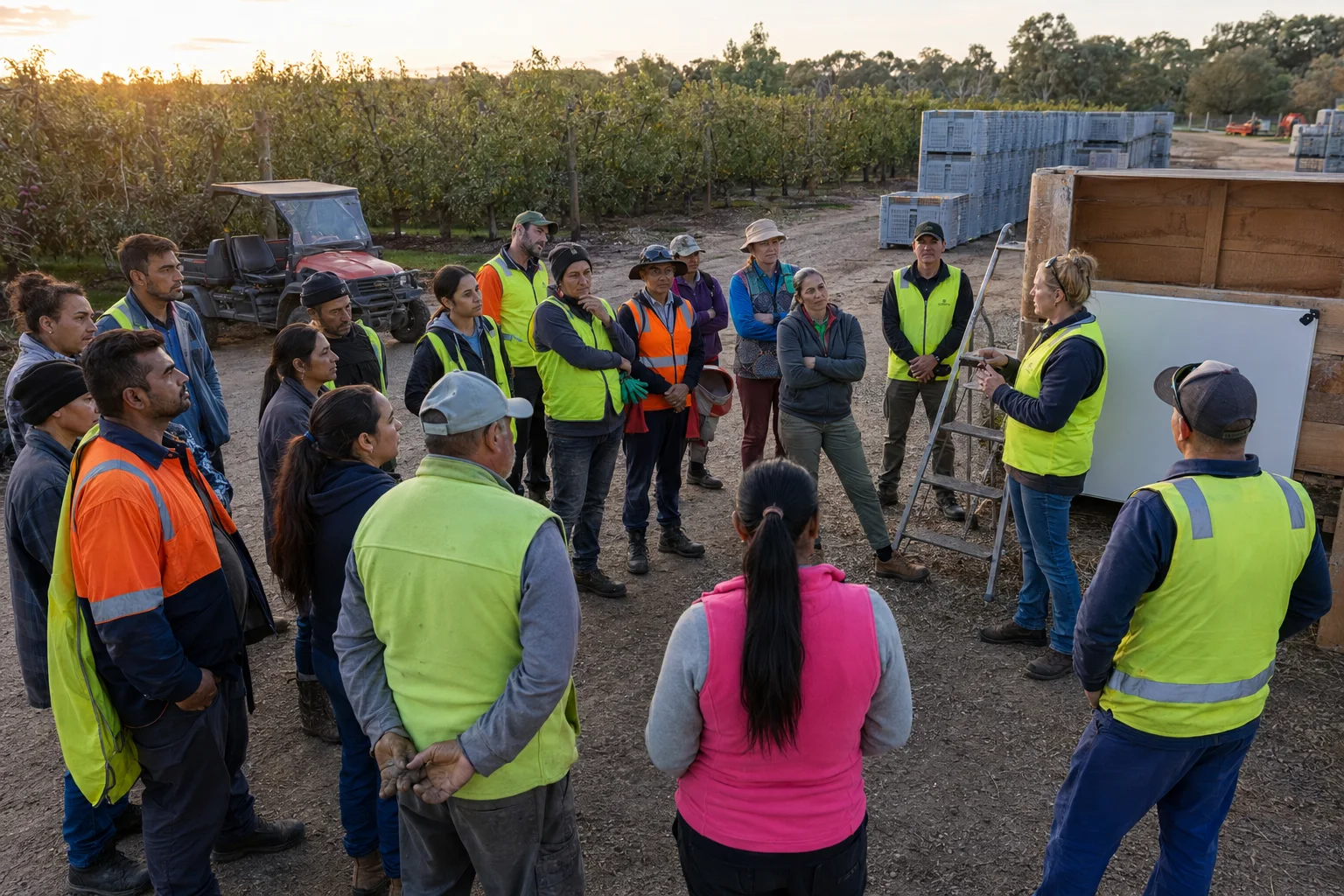
Image note: The accompanying image is illustrative and AI-generated. It depicts fictional people and a fictional discussion, not the workers, business or event in the enforcement announcement.