
New National WHS Incident Notification Rules Do Not Automatically Apply in Victoria
• Hari Yellina
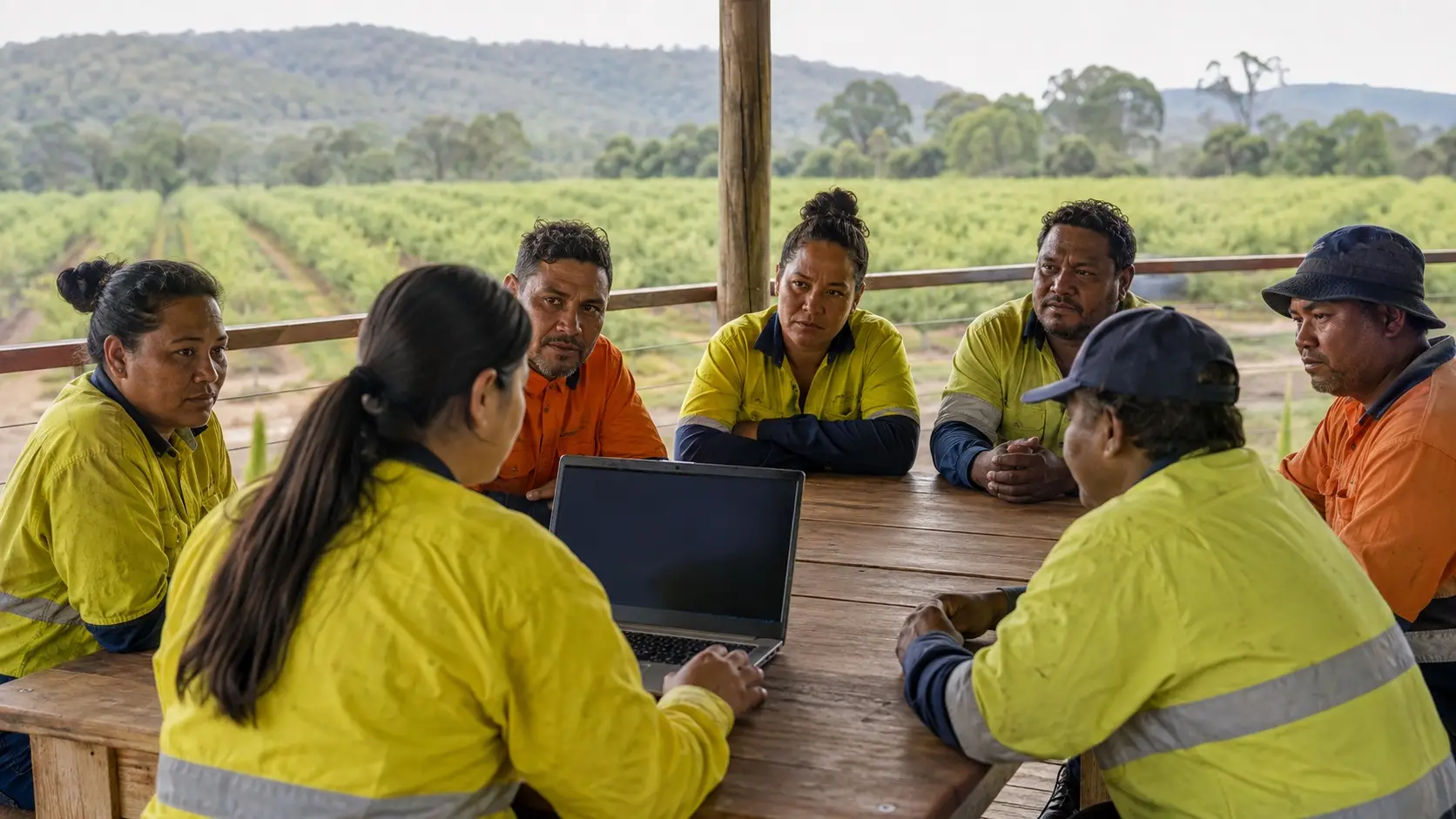
Featured image: an illustrative discussion about incident reporting on an orchard. AI-generated illustration; not a specific Orchard Tech workplace or incident.
Legal position checked: 10 September 2026. Victoria. Safe Work Australia published model WHS incident-notification amendments in December 2025. Those changes apply only when a jurisdiction adopts them into its own WHS laws. Victoria’s primary workplace safety statute is the Occupational Health and Safety Act 2004. Victoria has not yet adopted those model amendments into the OHS Act. Publication of a national model is not a Victorian notification duty.
A picker is off work for sixteen days after a packing-line incident. A supervisor who attended a national webinar asks whether the absence must now be notified as a “notifiable extended absence”. Another supervisor asks whether a serious threat of violence in the donga is automatically notifiable because “the model WHS Act now covers psychological harm”.
Those are hypothetical questions. In Victoria, answer them from WorkSafe’s current OHS rules, not from a Safe Work Australia handbook aimed at model-WHS jurisdictions.
What the model changed — and what that means
Safe Work Australia’s incident notification page is explicit: the model Act has been updated, and the changes only apply once they are adopted under local WHS laws. Employers should check with their local regulator before changing notification systems.
The December 2025 model amendments expand and clarify notification, including:
- violent incidents, including sexual assault, that expose a person to a serious risk of psychological harm;
- work-related suicide or attempted suicide of a worker, and suicide or attempted suicide of other persons in specified settings;
- a worker’s absence, or likely absence, of 15 or more consecutive calendar days due to work-related psychological or physical injury or illness;
- further dangerous-incident and serious-injury categories, including certain mobile plant, fall, electrical, crush, fracture and brain-injury events.
Those categories are useful to know if you also operate in a model-WHS jurisdiction such as New South Wales. They are not, by themselves, the Victorian list.
What Victoria already requires
WorkSafe’s guide, Notifiable incidents under the OHS Act 2004, remains the Victorian reference. An employer or self-employed person must, for a notifiable incident at a workplace under their management and control:
- Notify WorkSafe immediately on 13 23 60.
- Preserve the site until an inspector arrives or directs otherwise, except to protect a person, aid the injured, or make the site safe.
- Give written notification within 48 hours.
- Keep the record for at least five years.
Notifiable incidents include death; specified serious injuries and medical treatment (including medical treatment within 48 hours of exposure to a substance, and immediate in-patient hospital treatment); and incidents that expose a person to a serious risk to health or safety from immediate or imminent exposure to listed hazards — including uncontrolled spills of substances and dangerous goods, fire or explosion, electric shock, fall or release from height, and specified plant events (including tractors and earth-moving machinery).
WorkSafe’s own advice is: if you are unsure, notify anyway.
Work through the sixteen-day absence
In the hypothetical, the absence length is not the Victorian trigger. Ask instead:
- Was there a death, a listed serious injury, hospital in-patient treatment, or medical treatment within 48 hours of a substance exposure?
- Was there a near miss that exposed someone to a serious risk from a listed hazard, such as a plant collapse or a chemical leak?
- Has notification already been made? Immediate notification is not optional because payroll later shows sixteen days of sick leave.
If the original event was notifiable, the delay in noticing the absence does not create a new model-law category in Victoria. If the original event was not notifiable under the OHS Act, copying a 15-day model trigger into your Victorian procedure would be inventing a duty.
Separately, a long absence may still matter for workers compensation, return to work, and psychosocial risk. Those are different legal tracks. See psychosocial hazards on Victorian farms.
Violence, suicide and psychological harm
The model amendments are partly designed to capture serious psychological harm that older notification lists missed. Victoria already has psychological health regulations in force, and OHS duties for health and safety including psychological health. That is not the same as a new, automatic WorkSafe notification category for every suicide, threat or assault.
If a violent incident or a suicide-related event occurs on a Victorian farm, still ask the current OHS questions: death, serious injury, medical treatment, and serious risk from a listed physical hazard. Also call emergency services where needed. Then take advice. Do not wait for Victoria to adopt the model before you call 13 23 60 about a death or a serious injury.
Labour hire: more than one notifier
WorkSafe states that more than one employer can have a duty to notify if each has management and control of the workplace in the relevant sense. A host and a labour hire provider should agree, before the season, who calls 13 23 60, who preserves the site, and how the other is told within minutes. Delegation of the phone call does not remove the legal duty.
If you also place people in New South Wales, keep two checklists. NSW is a WHS jurisdiction. Victoria is not. A single “national notification SOP” that quotes the model Act will be wrong in Robinvale.
A Victorian notification card for supervisors
Suggested aid, not a prescribed form:
- Danger still present? Call 000 first.
- Is this a Victorian OHS notifiable incident? If unsure, call 13 23 60.
- Preserve the scene except for rescue, first aid or essential safety.
- Complete the written form within 48 hours and store it for five years.
- Tell the other duty holder on the placement the same day.
- Do not add a 15-day absence rule “because Safe Work Australia said so” unless Victoria has adopted it.
Plant-specific Victorian changes from 1 July 2024 still deserve a separate read: Report an incident. For dangerous goods fires, spills and explosives, other notification duties can apply under the Dangerous Goods Act as well.
To discuss a Victorian placement, use the employer enquiry page.
General information checked 10 September 2026. Always use the current WorkSafe list for Victorian notification. This article does not decide whether a particular event is notifiable.
Related Articles

Victoria’s Dangerous Goods Reforms: What Farms Can Prepare for Before 2028 — Without Treating Them as Current Law
The new dangerous goods package is passed, not commenced. Keep complying with the current Act, and use the lead time to map chemicals, transport and who signs off.
Read More →