Victoria’s Dangerous Goods Reforms: What Farms Can Prepare for Before 2028 — Without Treating Them as Current Law
• Hari Yellina
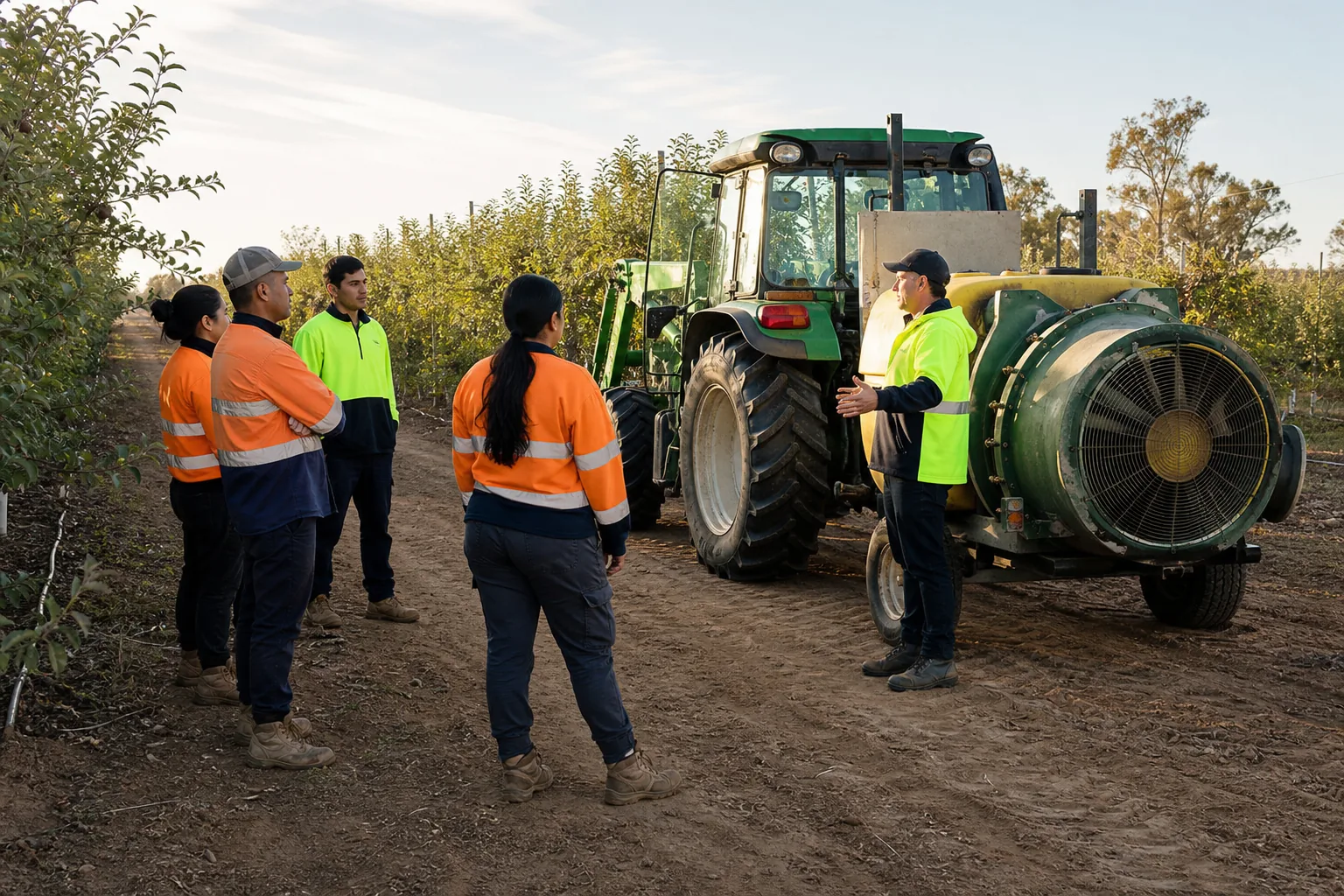
Featured image: an illustrative pre-start briefing beside an orchard sprayer and tractor. Dangerous goods duties cover farm chemicals and fuel, including how they are stored and moved. AI-generated illustration; not a specific Orchard Tech workplace.
Legal position checked: 10 September 2026. Victoria. The Occupational Health and Safety Amendment (Dangerous Goods) Act 2026 and the Dangerous Goods Transport Act 2026 have passed Parliament. WorkSafe says they are planned to commence in April 2028. Until then, the Dangerous Goods Act 1985 and associated regulations still apply. Do not brief crews as if the 2028 package has started.
A spray supervisor finds three unmarked drums behind the mix shed, a bowser with no current manifest nearby, and a labour hire crew due to start mixing at first light.
That is a hypothetical example. The useful question is not “when does the new Act begin?”. It is: who can explain, today, what is stored, how it moves, and who stops work if the paperwork and the shed do not match?
The 2028 package is a reason to improve that explanation. It is not a reason to wait.
What has actually happened
WorkSafe’s dangerous goods reform page now states that the legislation has passed and is planned to commence in April 2028, to give duty holders time to prepare.
The package does two separate jobs:
- It amends the Occupational Health and Safety Act 2004 so storage, handling and use of dangerous goods sit inside the OHS framework, with a new general duty for safe handling.
- It creates a standalone Dangerous Goods Transport Act 2026 for transport by road, rail and vessel on inland waters.
When the changes commence, WorkSafe says the Dangerous Goods Act 1985 and associated regulations will be repealed. Associated regulations are to be reviewed and remade under the OHS Act or the new transport Act. The Victorian Government has also committed to extending the OHS Regulations to April 2028 so the new Acts and regulations can commence together.
Authorised versions are on the legislation register: the OHS Amendment (Dangerous Goods) Act 2026 and the Dangerous Goods Transport Act 2026.
What has not happened
The current Dangerous Goods Act still governs fires, spills, leaks and explosives reporting in the terms WorkSafe publishes today. OHS incident notification under sections 37–38 of the OHS Act also still applies. A farm cannot stand down those duties because a 2028 commencement is on a slide.
The new officer due-diligence duty, civil penalty tools and aggravated offences described in WorkSafe’s “broader changes” list are part of the same package. They are not a separate, already-commenced code of conduct. Until commencement, officers still have the duties that exist under the current OHS Act. Do not invent a 2026 due-diligence offence from a reform overview.
Why a farm crew meets this law
Orchard and horticulture work routinely involves substances that can be dangerous goods: spray products, fuels, gases, batteries, cleaning chemicals and, on some sites, explosives or fumigants. Labour hire workers often handle them under the host’s mix instructions, using the host’s plant, then travel between blocks.
That creates three practical seams:
- Storage and handling at the shed the host manages.
- Use by workers who may be employed by the provider.
- Transport between the depot, the farm and another property — which will sit under a different Act once the 2028 package commences.
A placement that only files a chemical register in the provider’s office, and never checks the host’s shed, has not examined the work.
A walk-through of the hypothetical mix shed
Put the crew, the host supervisor and the provider’s site contact in the same conversation and ask:
- What products will be used on this shift, in which quantities, and where are the current safety data sheets?
- Who owns each container that is not on the day’s list?
- Who is licensed, trained and authorised to mix, and who is only authorised to carry or observe?
- How is leftover mix disposed of, and who checks the bowser and waste area at the end of the shift?
- If product moves on a ute between blocks, is that treated as workplace handling, as transport, or as both — and who holds the current transport documents?
If those answers disagree, stop and reconcile them under current law. The 2028 general duties will still need a factual map of what is on site. Building that map now is preparation. Leaving unmarked drums because “the new Act is years away” is not.
Provider and host: coordinate, do not assume
In a labour hire placement both businesses can have OHS duties to the worker. Section 35A of the OHS Act requires consultation, cooperation and coordination so far as is reasonably practicable where duties are shared. Dangerous goods controls are a typical shared-duty problem: the host usually controls the shed; the provider employs the people handling the product.
A practical split for the hypothetical crew:
- Host: current manifest, segregation, signage, emergency plan, mix instructions, spill kit and who can halt a job.
- Provider: confirm workers’ training matches the actual products, raise mismatches, and do not send a person to mix from a verbal instruction that the shed paperwork cannot support.
Write down who will do what before the first tank is filled. A generic induction slide about “chemical safety” does not complete that conversation.
What to prepare during the lead time
WorkSafe’s reform page is still being updated. Use the lead time for operations, not for guessing future regulation text:
- List every dangerous goods and hazardous chemical actually used or stored on properties you regularly enter.
- Separate storage/handling from transport movements, including farm-to-farm trips.
- Name the officer or manager who will be expected to show due diligence when the new officer duty commences — and what information they would need.
- Register for WorkSafe’s reform updates rather than relying on this article after 2026.
Do not rewrite your 2026 SWMS as if the Dangerous Goods Act 1985 has already been repealed. It has not.
Related Orchard Tech reading
For the separate October labour hire definition changes, see Victoria’s labour hire law changes before October. Psychosocial duties that already apply are covered in psychosocial hazards on Victorian farms. To discuss a placement that includes spraying or chemical handling, use the employer enquiry page and say so in the task description.
General information for Victorian workplaces, checked 10 September 2026. Commencement can be proclaimed earlier than April 2028. Recheck WorkSafe and the authorised Acts. This article does not replace a dangerous goods assessment, transport classification or legal advice.