Ten PALM Country Profiles: Participation, Trends and Stream Mix
• Hari Yellina
PALM data series | Data period: August 2026 | Reviewed: 26 October 2026
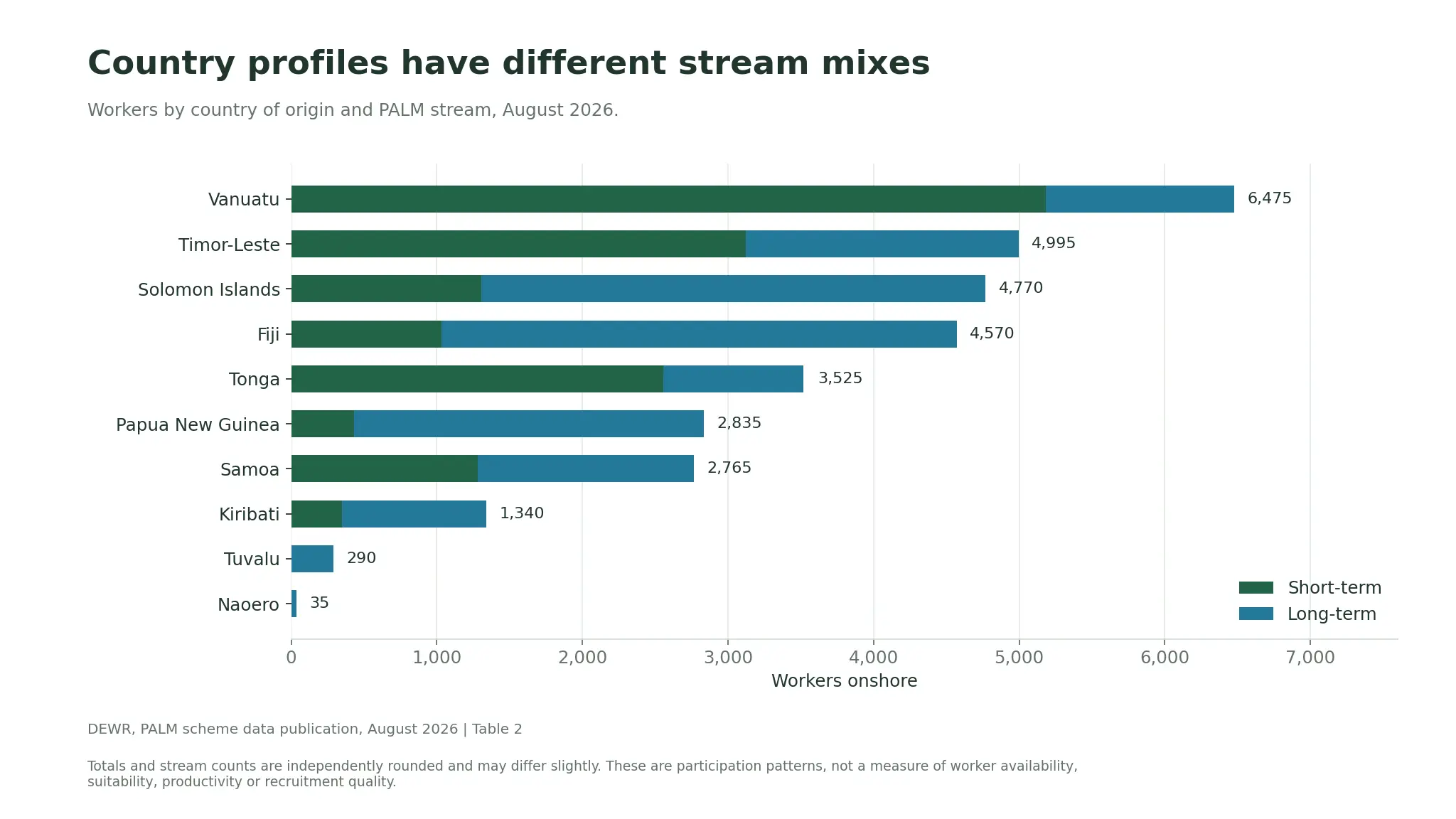
The August 2026 PALM workbook shows different participation patterns across ten countries. Vanuatu had the largest published count, with 6,475 workers, followed by Timor-Leste with 4,995 and Solomon Islands with 4,770.
Country profiles help readers understand the composition of the scheme. They are not rankings of worker quality, productivity or suitability, and they do not show a pool of people available for a new employer.
Look at stream mix as well as total participation
The chart shows short-term and long-term participation side by side within each country total. The accompanying table makes the figures available as text. Totals and components are rounded independently; Tonga’s two stream counts, for example, sum to 3,520 while its published total is 3,525.
View the data behind this graph
| Country | Total | Short term | Long term |
|---|---|---|---|
| Vanuatu | 6,475 | 5,185 | 1,290 |
| Timor-Leste | 4,995 | 3,120 | 1,875 |
| Solomon Islands | 4,770 | 1,305 | 3,465 |
| Fiji | 4,570 | 1,030 | 3,540 |
| Tonga | 3,525 | 2,555 | 965 |
| Papua New Guinea | 2,835 | 430 | 2,405 |
| Samoa | 2,765 | 1,280 | 1,485 |
| Kiribati | 1,340 | 350 | 990 |
| Tuvalu | 290 | 0 | 290 |
| Naoero | 35 | 0 | 35 |
What the ten profiles show
- Vanuatu: 6,475 workers, including 5,185 short-term and 1,290 long-term participants. Its recorded profile has a large short-term component.
- Timor-Leste: 4,995 workers, comprising 3,120 short-term and 1,875 long-term participants.
- Solomon Islands: 4,770 workers, with 1,305 short-term and 3,465 long-term participants.
- Fiji: 4,570 workers, including 1,030 short-term and 3,540 long-term participants.
- Tonga: a published total of 3,525, with 2,555 short-term and 965 long-term participants.
- Papua New Guinea: 2,835 workers, comprising 430 short-term and 2,405 long-term participants.
- Samoa: 2,765 workers, including 1,280 short-term and 1,485 long-term participants.
- Kiribati: 1,340 workers, with 350 short-term and 990 long-term participants.
- Tuvalu: 290 workers, all recorded in the long-term stream in this release.
- Naoero: 35 workers, all recorded in the long-term stream. The country label follows the DEWR workbook.
A zero in a published stream describes that observation. It should not be turned into a statement that people from a country can never participate in that stream or perform a particular job.
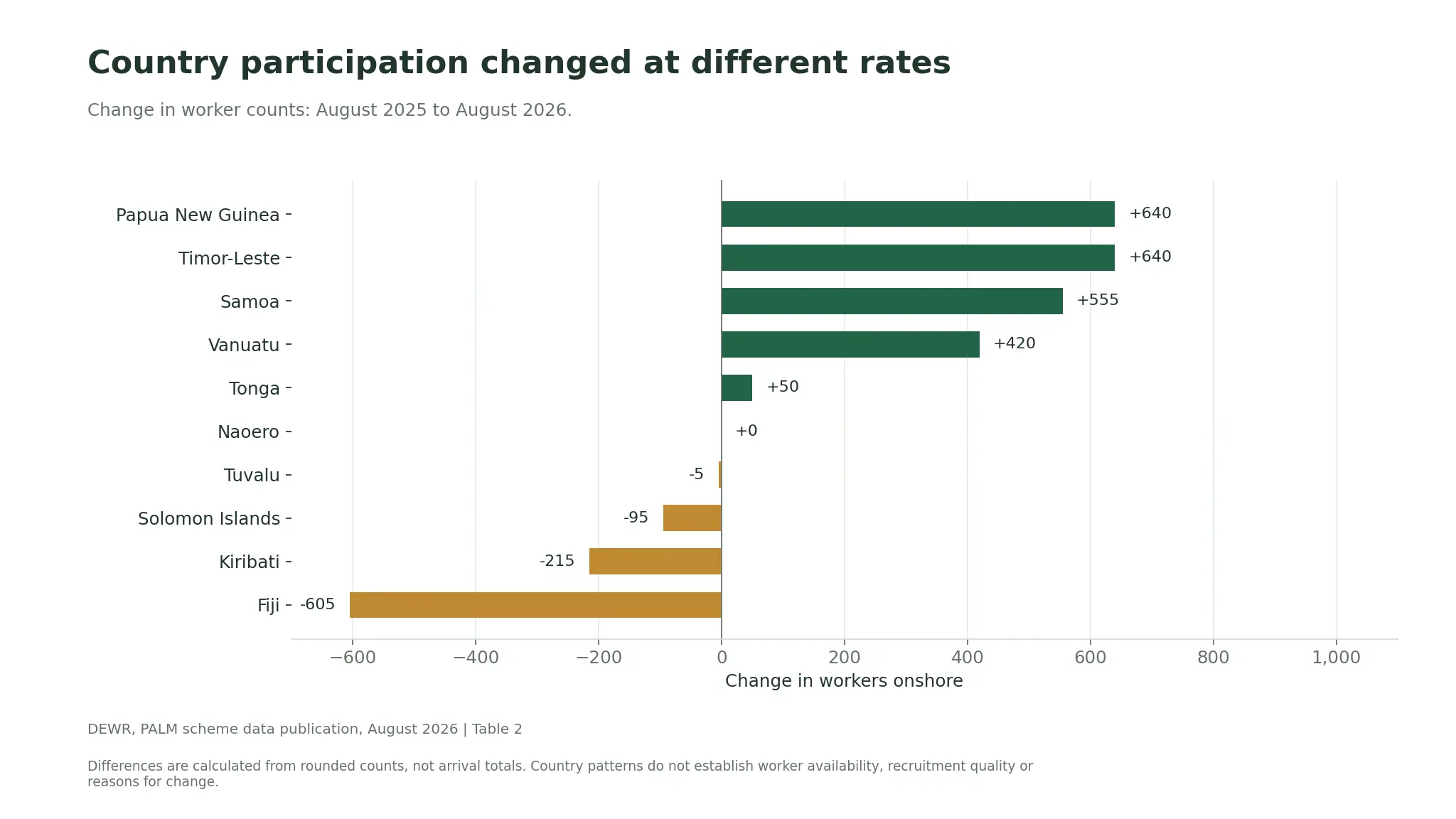
Annual changes tell a different story from size
Papua New Guinea and Timor-Leste each recorded an increase of 640 workers between August 2025 and August 2026. Samoa increased by 555 and Vanuatu by 420. Fiji recorded 605 fewer workers than a year earlier, while Kiribati recorded 215 fewer.
These are changes in onshore participation, not counts of arrivals or departures. The workbook does not establish how many individual people moved between industries, why participation changed, or whether a particular recruitment policy caused the difference.
View the data behind this graph
| Country | August 2025 | August 2026 | Change workers |
|---|---|---|---|
| Papua New Guinea | 2,195 | 2,835 | 640 |
| Timor-Leste | 4,355 | 4,995 | 640 |
| Samoa | 2,210 | 2,765 | 555 |
| Vanuatu | 6,055 | 6,475 | 420 |
| Tonga | 3,475 | 3,525 | 50 |
| Naoero | 35 | 35 | 0 |
| Tuvalu | 295 | 290 | -5 |
| Solomon Islands | 4,865 | 4,770 | -95 |
| Kiribati | 1,555 | 1,340 | -215 |
| Fiji | 5,175 | 4,570 | -605 |
Use country context without making assumptions about individuals
Country information can prompt an employer to check language support and communication arrangements for the actual people in a placement. It cannot identify a person’s preferred language, literacy, qualifications or familiarity with a task. Ask those questions directly and record the answers appropriately.
A practical induction plan can include a clear explanation of the job, a way to ask questions, an understanding check and an identified contact for follow-up. Choose the language and delivery method around the individuals concerned. Do not assume that nationality alone answers those questions.
The same approach applies to workforce selection. Use the role’s legitimate requirements and the individual’s demonstrated capability. The chart offers no basis for preferring or excluding an applicant because of their country of origin.
Connect the profile to a workable support plan
When discussing a proposed crew, establish the work and the support needed together. Our PALM welfare follow-up guide provides practical ideas for making conversations lead to action. The stream analysis explains why participation patterns vary across the scheme.
Country-level data is most useful when it improves the questions being asked. A confirmed placement still depends on actual people, current arrangements and the work the business can offer.
Explore the PALM data series
- PALM Scheme in August 2026: The Numbers Behind the Workforce
- 17,700 PALM Workers in Agriculture: What the Data Means for Growers
- PALM Workers Across Australia: A State Comparison with a Victorian Focus
- Short-Term and Long-Term PALM: How the Workforce Mix Has Changed
- Women in the PALM Scheme: What Participation Data Shows
- 565 Approved Employers: Understanding Direct Employment and Labour Hire
- Why PALM Numbers Rise and Fall: Reading Seasonal Workforce Data
Source and method
Source: DEWR PALM scheme data, August 2026 workbook and June 2026 quarterly report, checked 26 October 2026. Charts and calculations are Orchard Tech’s analysis. Worker counts are privacy-rounded to the nearest five; components may not sum to totals. Employer counts are not rounded. Percentages calculated from rounded counts are approximate.
The views expressed in this report are those of the authors and do not necessarily represent those of DEWR.
About the author
Hari Yellina is Chief Executive Officer at Orchard Tech. His articles cover agricultural workforce planning, labour hire and practical workplace responsibilities.