Almond Harvest Jobs in Robinvale 2027: Shaking, Sweeping, Pick-Up and Bank-Out Explained
Updated • Hari Yellina
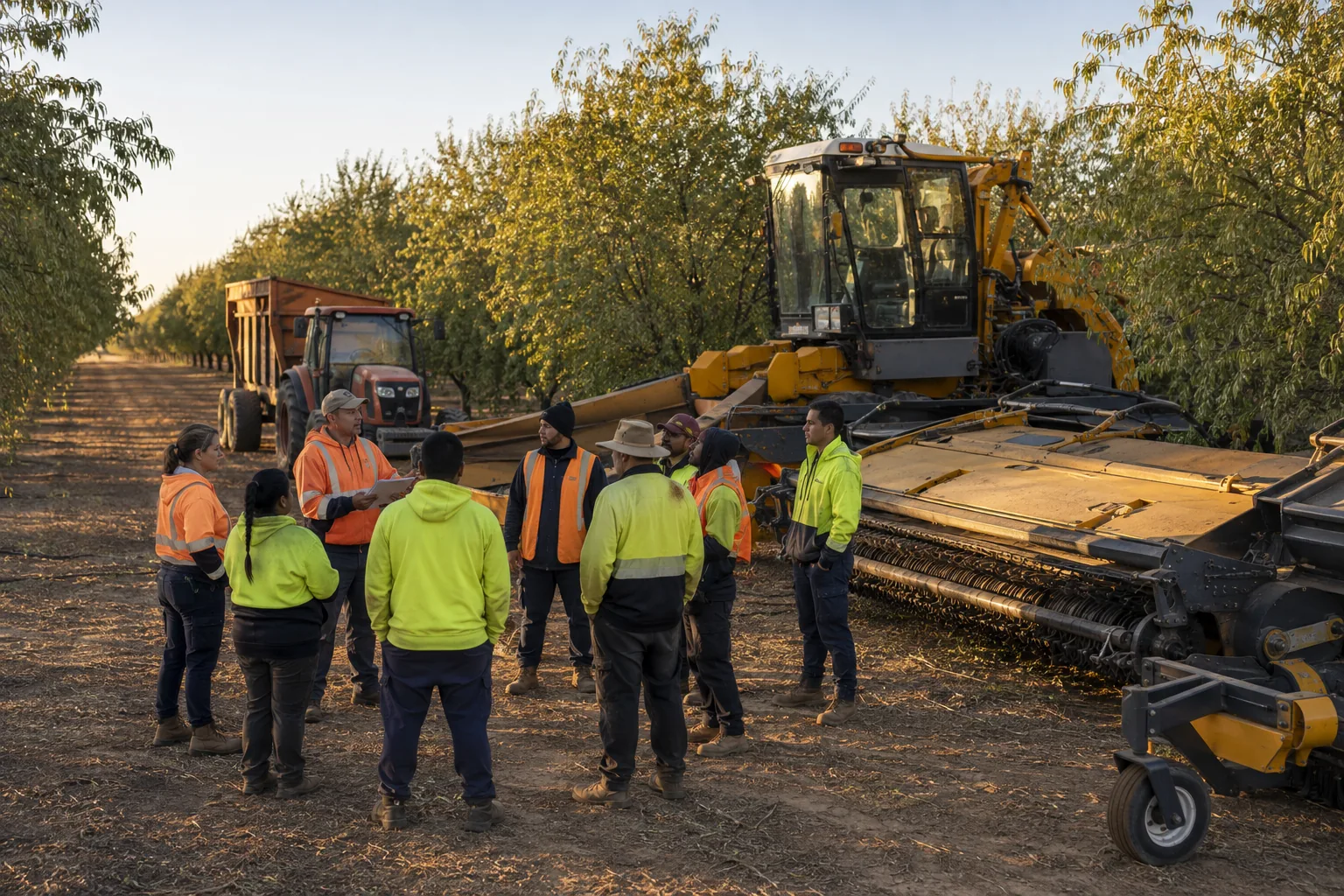
Illustrative image generated for Orchard Tech. It does not show actual Orchard Tech workers, clients or a real worksite.
Last reviewed: 5 September 2026. Harvest dates, duties, availability and site requirements can change with seasonal conditions and final arrangements. Check the current Find Work page before making plans.
Orchard Tech is inviting expressions of interest for almond harvest work around Robinvale in 2027. There are four separate machinery jobs in this harvest sequence: shaking, sweeping, pick-up and dump/bank-out. The planned start is 1 February 2027, subject to seasonal conditions, final placement arrangements and job availability.
Current opportunity at a glance
- Season: 2027 almond harvest
- Location: in and around Robinvale, Victoria
- Currently advertised start: from 1 February 2027, subject to seasonal conditions, final placement arrangements and job availability
- Four separate jobs: shaking, sweeping, pick-up and dump/bank-out
- Planned employment and pay: adult casual employment paid at no less than Level 3 under the Horticulture Award 2020 (MA000028), subject to the actual duties and any higher applicable entitlement. Under this Award, the adult rates shown below apply from age 20; different junior percentage rates apply to employees under 20 unless a higher rate is paid.
How an almond harvest moves through the orchard
Australian almond harvesting is a connected sequence, but shaking, sweeping, pick-up and dump/bank-out are four different jobs. The exact equipment and handover points differ between orchards. Each selected worker must be inducted and assessed for the job and machine they will actually operate.
Shaking
The shaker operator positions a mechanical tree shaker, closes its padded clamp around the trunk and applies a controlled shake so mature almonds fall onto the orchard floor. The operator must line up accurately, use the correct pressure and shake time, watch tree condition, and avoid bark, root and irrigation damage. Other workers must remain outside the shaker’s exclusion area.
Sweeping
The sweeper operator uses rotating brushes and controlled airflow to move fallen almonds away from trunks and irrigation lines and into a clean row, called a windrow. The operator must form a windrow that the pick-up machine can follow while managing dust, visibility, machine clearances, nearby people and changing ground conditions.
Pick-up
The pick-up operator drives the harvester over the windrow. Belts, chains or similar collection equipment lift the almonds, and the machine removes some soil, leaves and small debris before transferring the crop to the dump/bank-out equipment. The operator monitors the pick-up head, ground speed, crop flow, blockages and alignment with the receiving machine. No one should approach moving parts until the plant is stopped and isolated.
Dump / bank-out
The dump or bank-out operator drives the receiving cart, wagon or tractor-trailer alongside or behind the pick-up machine, keeps it safely aligned while it is loaded, monitors load distribution and then carries the almonds to the designated unloading point. The operator unloads into the site’s conveyor, load-out, stockpile or transport trailer as directed. This job may also be called carting or bank-out. Equipment and unloading systems vary, so applicants should state exactly what they have operated.
A worker may have experience in more than one of these jobs, but applicants should list each job separately. Experience on one machine does not by itself establish competency on another.
The Almond Board of Australia’s harvest guidance describes shaking, sweeping or blowing, conditioning, gathering or pick-up and stockpiling. Its 2026 harvest update also identifies carting as a separate part of harvest work. The Almond Board of California’s harvest overview similarly explains that pickup machines collect windrows into carts or trailers. Orchard Tech and the host farm will explain the actual job, machine and handover point before work begins.
Machinery experience helps, but site competency still matters
Experience with tractors, shakers, sweepers, pick-up harvesters or trailers is useful. It does not automatically authorise a person to operate unfamiliar plant at a new site. Workers should receive a workplace and task-specific induction, instruction on the machine and its controls, and a practical competency check before operating independently.
When you enquire, explain:
- which harvest activities you have performed;
- the equipment types and approximate sizes you have operated;
- the crops and seasons you have worked;
- any relevant current licences or training;
- whether you have experience working around irrigation lines, dust or early-morning or late-night work; and
- your availability for the advertised season.
WorkSafe Victoria’s seasonal agriculture case study explains why even experienced workers need workplace-specific training and induction before using unfamiliar machinery.
What workers should expect at a safe harvest site
Harvest brings multiple machines, people and vehicles into the same blocks. A safe site should organise the work so that machinery and people do not rely on guesswork. Controls may include:
- documented pre-start checks and fault reporting;
- defined machinery routes, pedestrian paths and exclusion zones;
- agreed radio channels or other two-way communication;
- a clear rule that equipment is stopped and isolated before a person approaches a blockage or moving part;
- lighting and visibility controls for early, late or night work;
- fatigue, heat, dust, weather and lone-work arrangements;
- safe loading, unloading and parking areas; and
- a process for reporting hazards, incidents or unexpected task changes.
WorkSafe Victoria’s Plant Compliance Code says employers should separate powered mobile plant from pedestrians so far as reasonably practicable, supported by traffic controls, warning devices and communication. Workers must follow the site’s controls and stop if the task cannot be done safely.
Level 3 casual pay for these four jobs
Orchard Tech plans to engage adult casual employees for these four machinery jobs at no less than Horticulture Award Level 3. The Award’s Level 3 indicative duties include driving mechanical harvesters and operating tractors over 70 kW. Classification must still follow the work actually performed, and a higher classification or entitlement must be paid if it applies.
The following adult Level 3 casual minimums apply from the first full pay period starting on or after 1 July 2026. For this Award, adult rates apply from age 20. Different junior percentage rates apply to employees under 20 unless a higher rate is paid. These examples assume the employee is a casual other than a shiftworker; different rules may apply to a formal shiftworker. Amounts are before tax, exclude superannuation and may be increased by applicable allowances:
| When the hours are worked | Award calculation | Level 3 casual minimum |
|---|---|---|
| Ordinary hours from 5:00 am to 8:30 pm, excluding public holidays | 125% of the $26.84 Level 3 ordinary hourly rate, including the 25% casual loading | $33.55 per hour |
| Ordinary hours outside that span, from 8:31 pm to 4:59 am, excluding public holidays | 140% of the ordinary hourly rate: 25% casual loading plus the additional 15% outside-span loading | $37.58 per hour |
| Overtime: more than 12 hours in one engagement or day, or more than 304 ordinary hours over 8 weeks | 175% of the ordinary hourly rate, inclusive of the casual loading | $46.97 per hour |
| All hours worked, whether ordinary or overtime, on a public holiday | 225% of the ordinary hourly rate, inclusive of the casual loading | $60.39 per hour |
The extra 15% is an outside-span loading; this article does not describe it as a night-shift rate. Every hour worked must be recorded and paid, including applicable overtime and public-holiday rates.
Eligible workers also receive the statutory 12% super guarantee in addition to wages, calculated on qualifying earnings under current superannuation law. The pay rates and rules should be rechecked before work starts and whenever Fair Work or super requirements change. Workers can verify current minimums with the Fair Work Ombudsman’s Pay and Conditions Tool and the ATO’s super guarantee rate table.
How to express interest in the 2027 harvest
- Read the current details on the Find Work page.
- Open the 2027 harvest enquiry form.
- State which activities interest you, your machinery experience and your availability.
- Wait for Orchard Tech to confirm whether a suitable role is available and what evidence or next steps are required.
Sending an expression of interest is not an offer of employment. Do not travel, resign from another job or pay anyone on the assumption that a placement has been confirmed.
Frequently asked questions
Can I apply for more than one harvest activity?
Yes. List each activity you have performed and the equipment you have used. Orchard Tech will discuss which available role, if any, matches your experience and the host’s requirements.
Do all four roles have the same pay rate?
Orchard Tech plans to pay the four adult casual machinery jobs at no less than the Level 3 rates set out above. The actual duties, plant, skill, responsibility and supervision still determine whether any higher classification or entitlement applies. Orchard Tech will confirm the written terms for an available job.
Is 1 February 2027 a guaranteed start date?
No. It is the currently advertised start point. Crop maturity, weather, host requirements, worker suitability and final placement arrangements can change dates and availability.
Do I need Australian almond-harvest experience?
Role requirements vary. Describe any transferable tractor, harvest, machinery or orchard experience honestly. Every selected worker still needs site-specific induction and competency checks.
What if I am interested in non-machinery orchard work?
Use Orchard Tech’s future-work enquiry and explain your experience and availability.
General information only. This article does not guarantee a vacancy, start date, placement, classification or rate. Employers, hosts and workers should confirm the current arrangements for the actual work and consult the relevant regulator or professional adviser where necessary.
Sources checked 5 September 2026: Almond Board of Australia harvest guidance and 2026 harvest update; Almond Board of California harvest overview; WorkSafe Victoria’s seasonal-agriculture case study and Plant Compliance Code; Horticulture Award 2020 clauses 11.2, 13.2, 21.4 and 27.4, Schedule A.3 and Schedule B.3; Fair Work Ombudsman Pay and Conditions Tool; ATO super guarantee rate table and Payday Super guidance.
About the author
Hari Yellina is Chief Executive Officer at Orchard Tech. View his profile and more articles.