Farm Tanks and Pits: Recognise a Confined-Space Job Before Sending a Worker
• Hari Yellina
“Can someone clean the tank before lunch?” sounds like a short allocation. Before sending a worker, the supervisor needs to identify whether entry is proposed and whether the space meets Victoria’s confined-space definition. The size of the job or the worker’s familiarity with the farm does not answer that question.
Check more than whether the space is small
WorkSafe Victoria’s farm alert explains that an enclosed or partly enclosed space is assessed against the full definition. It must be likely to be entered, have limited or restricted entry or exit, be at normal atmospheric pressure while someone is inside, and potentially contain a harmful contaminant, unsafe oxygen level or stored substance other than liquid that could cause engulfment.
Those conditions work together. A tank, pit or silo is not classified solely by its name, and a roomy structure is not automatically outside the definition. Arrange an assessment of the actual space and proposed work. An absence of smell or a quick visual look cannot establish a safe atmosphere.
Ask whether entry can be avoided
Before allocating entry work, consider whether the task can be completed another way. WorkSafe identifies avoiding entry as the first risk-control consideration. The decision should involve someone competent to assess the space and the task, including whether a proposed alternative introduces another hazard.
A useful supervisor handover describes the asset, its location, what needs to be achieved and whether any part of a person’s body would enter. Give the assessor the actual task rather than an instruction that already assumes a worker will go inside. Keep access restricted while the decision and work arrangements remain unresolved.
Use the specific work system
The Victorian confined spaces compliance code explains identification, assessment, employer duties and risk control. Where entry is required, the work needs the applicable confined-space arrangements, including competent personnel, permits, isolation, atmospheric assessment, communication and prepared emergency arrangements.
This is a recognition and referral article, not an entry method. A general farm induction, ordinary PPE allocation or another worker watching informally does not establish that the necessary system is in place. Our machinery isolation article addresses a relevant but separate hazard; isolation alone does not resolve atmosphere or engulfment risks.
Make the assignment boundary clear
In a hypothetical allocation, a host asks a general harvest crew to help clean a storage tank. The coordinator identifies that entry may be involved and refers the task for assessment before assigning anybody. The revised plan either avoids entry or puts the work with the properly planned competent team. The crew’s normal harvest role has not been treated as evidence of confined-space competence.
Record who is responsible for the assessment and who can authorise the eventual task under the site system. Explain the restriction to relief supervisors and contractors as well as the current crew. The induction record should connect workers to that instruction without pretending to replace the specific entry requirements.
Do not improvise a rescue entry
WorkSafe’s historical farm alert warns that people entering to help can also be overcome. If someone collapses in a suspected confined space, call 000 and activate the site’s emergency arrangements; do not send an unprepared coworker inside. A planned rescue capability belongs in the work system before entry, rather than being invented after an emergency begins.
Sources and further reading
Official sources checked on 14 October 2026. Practical examples are hypothetical.
About the author
Hari Yellina is Chief Executive Officer at Orchard Tech. His articles explain practical workforce planning for Australian agricultural businesses.
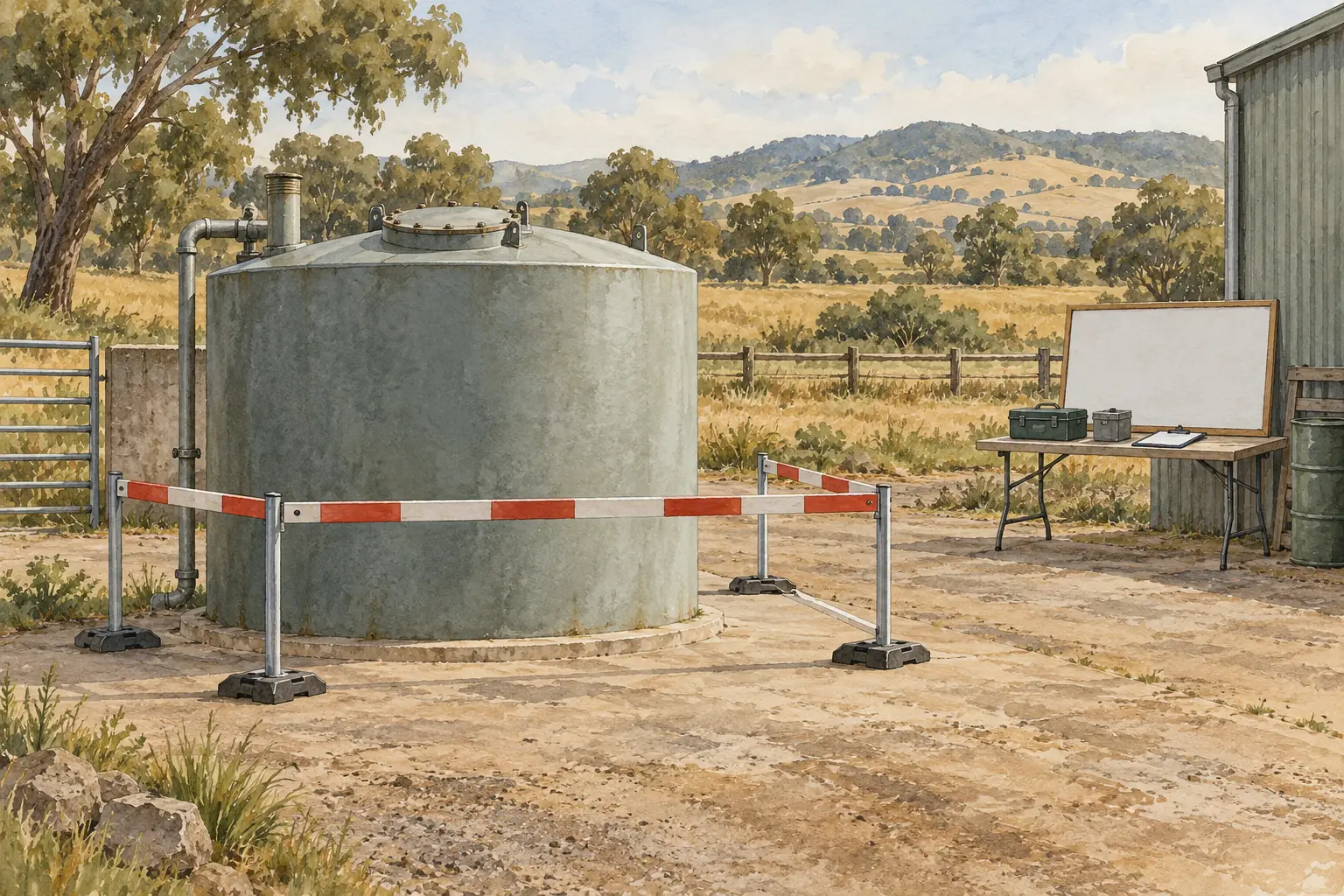
AI-generated illustration of a fictional restricted tank area; it does not demonstrate an entry or rescue procedure.