WorkCover Claimants’ Rights and RTW Coordinator Training: What Victorian Employers Should Not Treat as Current Law
• Hari Yellina

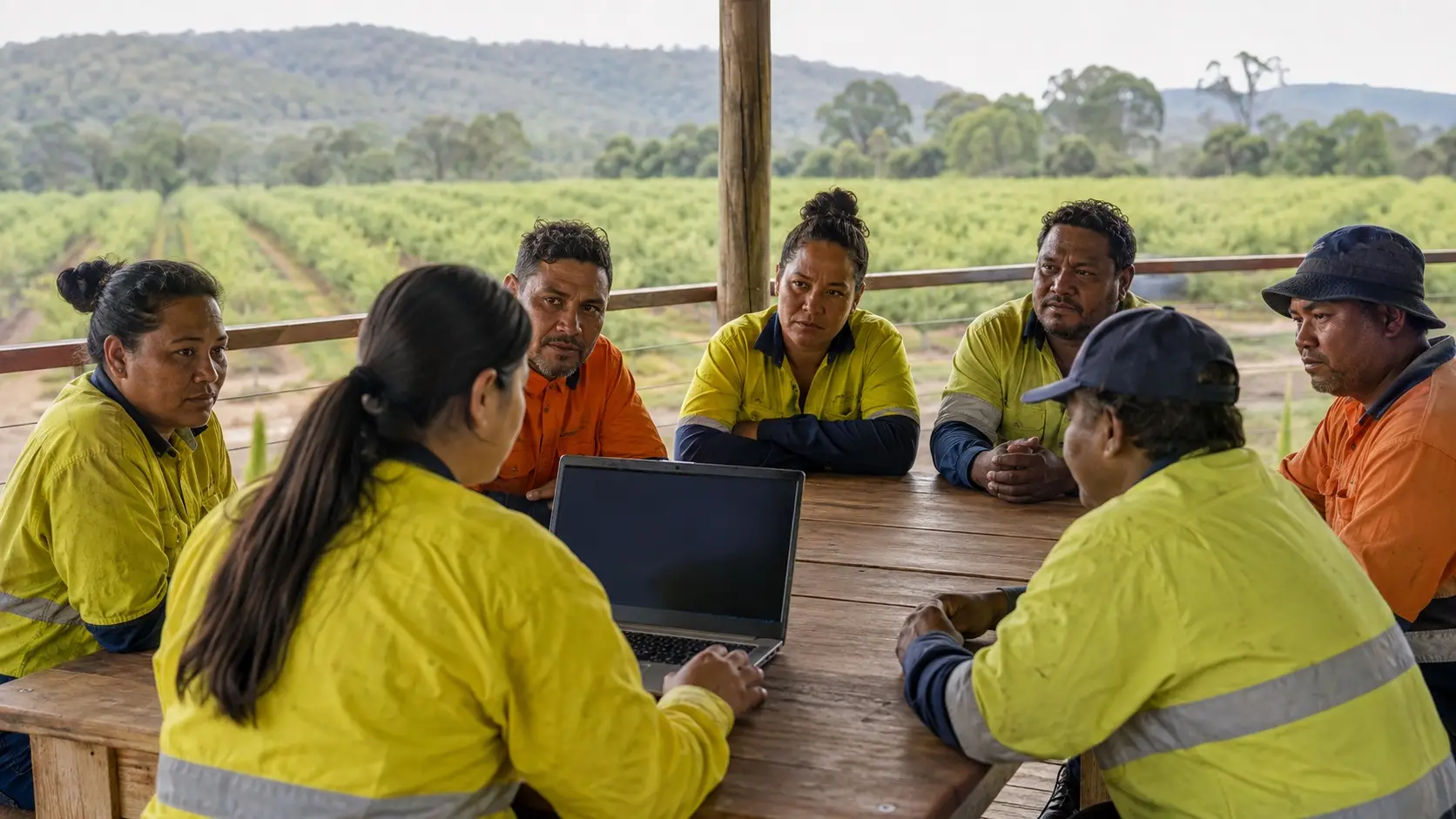
Featured image: illustrative discussion about a return-to-work plan. Not a specific Orchard Tech workplace or named worker.
Legal position checked: 10 September 2026. Victoria. The Code of Claimants’ Rights and the extra employer duties about return-to-work (RTW) coordinator training, facilities and assistance are not yet operating. WorkSafe still lists them as commencing on a day to be proclaimed. If the RTW training provisions have not commenced by 1 July 2027, they commence that day. Do not tell injured workers, hosts or coordinators that those extra provisions already apply.
A packing-shed leading hand is appointed “RTW coordinator” because their name is already on the first-aid poster. They are handed a printed Code of Claimants’ Rights and told to follow it for a worker with a shoulder injury.
That is a hypothetical. Two mistakes are stacked together: treating a draft or unpublished Code as binding, and assuming that putting a name on a poster completes the employer’s current return-to-work duties.
What is in force, and what is not
The Workplace Injury Rehabilitation and Compensation Amendment Act 2025 did two different things.
Already operating (from 6 August and 1 November 2025): family support, provisional payment and related compensation changes. Those are covered in the companion article on family support after a workplace death.
Not yet operating, on WorkSafe’s current published breakdown:
- The Code of Claimants’ Rights.
- Changes to employer obligations to provide training, assistance and facilities for RTW coordinators.
See WorkSafe, Changes to the Workplace Injury Rehabilitation and Compensation Act.
The Code is a service standard for the scheme — when it is made
WorkSafe and Engage Victoria describe the Code’s purpose as ensuring claimants are treated with dignity and respect, and setting service standards for WorkSafe, its agents (including authorised agents, independent medical examiners, occupational rehabilitation providers and private investigators) and self-insurers.
Public comment on the draft ran from 27 April to 27 May 2026 and has closed. Engage Victoria has said the Code must be approved by the Minister for WorkSafe and the TAC, and that the Minister will determine the commencement date.
Until the Code is formally made and commenced:
- Do not quote draft clauses to a worker as if they were enforceable rights under the Code.
- Do not tell a worker that a Code complaint process is already available in the form described in the draft.
- Existing claim, conciliation and complaint pathways under the current WIRC Act and WorkSafe arrangements still matter. Point people to WorkSafe and the agent, not to a document that has not commenced.
RTW coordinators: do not confuse current duties with the future training rule
Victorian employers already have return-to-work obligations when a worker has an incapacity, including appointing an RTW coordinator in the circumstances the current Act requires. Those existing duties did not freeze in 2025 while Parliament debated extra training rules.
What is waiting to commence is the extra requirement that appointed coordinators complete approved training (or hold an approved qualification) within a required period, and that employers give coordinators the facilities and assistance they reasonably need — which later commentary describes as including time and support to complete training. WorkSafe is to publish approved training providers. Small-employer settings may differ once the provisions and any directions are in force.
Until commencement:
- Do not tell a coordinator they have already breached a training offence that has not begun.
- Do not wait until 2027 to appoint a coordinator, keep contactable hours, or support a plan for an injured worker who is off work now.
A labour hire example
The hypothetical shoulder injury happens on a host farm. The worker is employed by the provider. The host wants them back on the line in three days. The provider’s “coordinator” has never seen the packing speed, the crate weight or the second-job rotation.
Useful steps under current law and good practice:
- Confirm who the employer is for the claim.
- Get accurate information about the actual tasks, not a job title.
- Talk with the worker about what they can safely do, and involve treating practitioners through the proper claim channel.
- Coordinate with the host so a “light duties” offer is real work, not a corner of the shed with no supervision.
- Keep medical information off the crew group chat.
When the extra training rules commence, the person doing that job will need the approved training as well. That is a reason to choose the coordinator deliberately now. It is not a reason to leave the role vacant until 2027.
What supervisors should say this season
Accurate:
- “If you are injured, tell us, get medical help, and we will start the WorkCover process through the employer.”
- “A Code of Claimants’ Rights has been drafted. It is not in force yet. WorkSafe will say when it starts.”
Inaccurate:
- “You now have Code rights, here is the PDF.”
- “We don’t need an RTW coordinator until the new training law starts.”
A short watch-list
Suggested internal watch-list, not a statutory form:
- Who is the current RTW coordinator for Victorian placements, and can a worker actually reach them?
- Where will you record the Minister’s commencement notice for the Code and the training rules when they appear?
- Who will book approved training once WorkSafe publishes the list — without waiting for a claim to appear the same week?
Family support changes that already apply are in the companion death-claims article. For psychosocial duties that already apply on farm, see psychosocial hazards on Victorian farms. WorkSafe’s status page remains the checkpoint: WIRC Act changes.
General information checked 10 September 2026. Recheck WorkSafe before telling a worker that the Code or the extra RTW training rules have commenced. This article is not claims or legal advice.