Victorian Labour Hire Intermediaries: Check Every Supplier After 1 October 2026
• Hari Yellina
Victoria · Last reviewed 5 October 2026. A farm that hires a picking or packing crew through an intermediary should be able to name each business in the supply chain and check whether each business supplying labour holds its own current Victorian labour hire licence. The business on the invoice may not be the business employing and paying the workers. Since 1 October 2026, Victoria’s amended definition expressly focuses on whether each arrangement is wholly or principally for the supply of labour, including supply through intermediaries. A licence held by one company is not a blanket licence for every other supplier in the chain.
This is a practical answer to one question: how does a Victorian horticulture host verify a multi-business labour supply arrangement before a crew arrives? Our earlier overview of Victoria’s 2026 labour hire changes explains the timetable. This article concentrates on the evidence to collect for an actual booking now that the 1 October change has commenced. It is not a substitute for deciding a difficult licensing classification with professional advice.
What changed on 1 October—and what did not?
The Labour Hire Authority (LHA) says the amendment has taken effect. Under its current section 7 guidance, the main category covers an arrangement whose character is wholly or principally labour supply, where the provider is obliged to pay workers directly or indirectly through one or more intermediaries. The change clarifies the position of a business that on-supplies another company’s workers without employing them itself—a “bare intermediary”.
It does not follow that every contractor, service company or business named on a farm invoice needs a labour hire licence. The LHA says to examine the terms and the whole relationship: are workers filling roles under the host’s direction, or is a business delivering a defined service using its own specialist methods and substantial inputs? Hourly pricing may be relevant, but no single factor decides the answer. The real work matters more than a contract label.
The LHA also says the separate extension proposed for specified construction activities later in October is anticipated, not part of the 1 October rule being explained here. Do not treat a proposed construction date or transitional period as permission to use an unlicensed horticulture supplier now.
Draw the chain for one booking
Consider a hypothetical orchard that books six pickers through an agency. The quote is from Business A, the roster comes from Business B, and the workers say Business C pays them. Those different names are a question to resolve, not proof of wrongdoing. A trading name, authorised agent or subcontract may explain them—but the host needs the legal entities and their roles, not a verbal assurance that “the group has a licence”.
Write one line per arrangement: who contracts with whom; who supplies the people; who employs or is obliged to pay them; who directs the work; who invoices; and which business ultimately receives the work. Ask the intermediary to explain each link in writing. The LHA’s current guidance gives a horticulture example in which both the original supplier and the on-supplying intermediary provide labour hire services under separate arrangements and each requires a licence. Use that example as a prompt to investigate, not as an automatic legal ruling on a different commercial arrangement.
A licence-check record a farm can actually use
- Identify the legal entity. Record the full legal name and ABN for every apparent labour supplier, plus any trading name. Match the quote, contract, invoice and provider explanation. If the company approaching the farm is not the one on the register, ask who authorised it to act.
- Check the live LHA register. Search the Labour Hire Licence Register for the relevant entity. Record the licence number, status, relevant conditions and the date and time checked. An application or a photo of a licence is not the same as an active licence. The LHA says applicants cannot provide services until a licence is granted.
- Check the person making the offer. Where identity is unclear, the LHA recommends verifying the contact’s authority and contacting the nominated officer using details on its register, not only a number supplied in the sales email.
- Repeat for each supplying entity. One company’s licence does not answer whether a second company that separately on-supplies workers also needs a licence. If an intermediary’s activity is genuinely something other than labour supply, document why and get advice where classification is uncertain.
- Record the arrangement, not just a screenshot. Keep a short dated note linking the provider check to the actual worksite, tasks, expected period, contractual entity, intermediary, worker employer and person who resolved any mismatch. Retain the source of the information with the contract and placement file under suitable access controls.
- Make changes reportable. The written agreement should require notice of any new subcontractor, change of legal entity, change in licence status or conditions, and a new check before that entity supplies workers. The LHA recommends these expectations in host contracts.
- Monitor after booking. The LHA’s “Follow My Providers” tool can notify a host when a followed provider’s licence is granted, suspended, cancelled or varied. It supports monitoring, but it does not replace checking the identity and role of an unannounced new supplier.
What if the names or licence status do not match?
Do not quietly amend the supplier name in the purchasing system and proceed. Ask the provider to reconcile the discrepancy, check the live register again, and escalate the booking to the person responsible for labour hire procurement. If the business that would supply workers has no active licence when one is required, do not treat “application pending” as approval. If the arrangement’s legal character is genuinely uncertain, obtain advice before the placement rather than guessing from an invoice description.
A clear supplier-chain record protects workers as well as purchasing staff. It gives the farm and provider a shared answer about who supplies labour, who pays workers, who manages site safety and who must be contacted if the arrangement changes. Do not put worker passports, medical records or unrelated personal documents in the licence-check file; our worker-information guide explains why access to those details should be limited.
Keep the legal status straight
The supply-chain definition described above is law in force from 1 October 2026, according to the LHA’s commencement announcement and current provider guidance. The anticipated later construction extension is a separate future regulatory matter. The Labour Hire Legislation Amendment (Licensing) Act 2025 is the amending Act; the LHA’s current pages explain its operation for providers and hosts. This article addresses Victoria and does not translate the rule into another state’s scheme.
Orchard Tech can explain the entities and placement arrangements involved in an Orchard Tech booking and coordinate with a host on the information needed for a check. We do not promise that a generic article establishes another business’s licence status or determines every contracting model. This is general information, not legal advice. Check the current register for the specific entities and seek advice where an exclusion or complex arrangement is disputed.
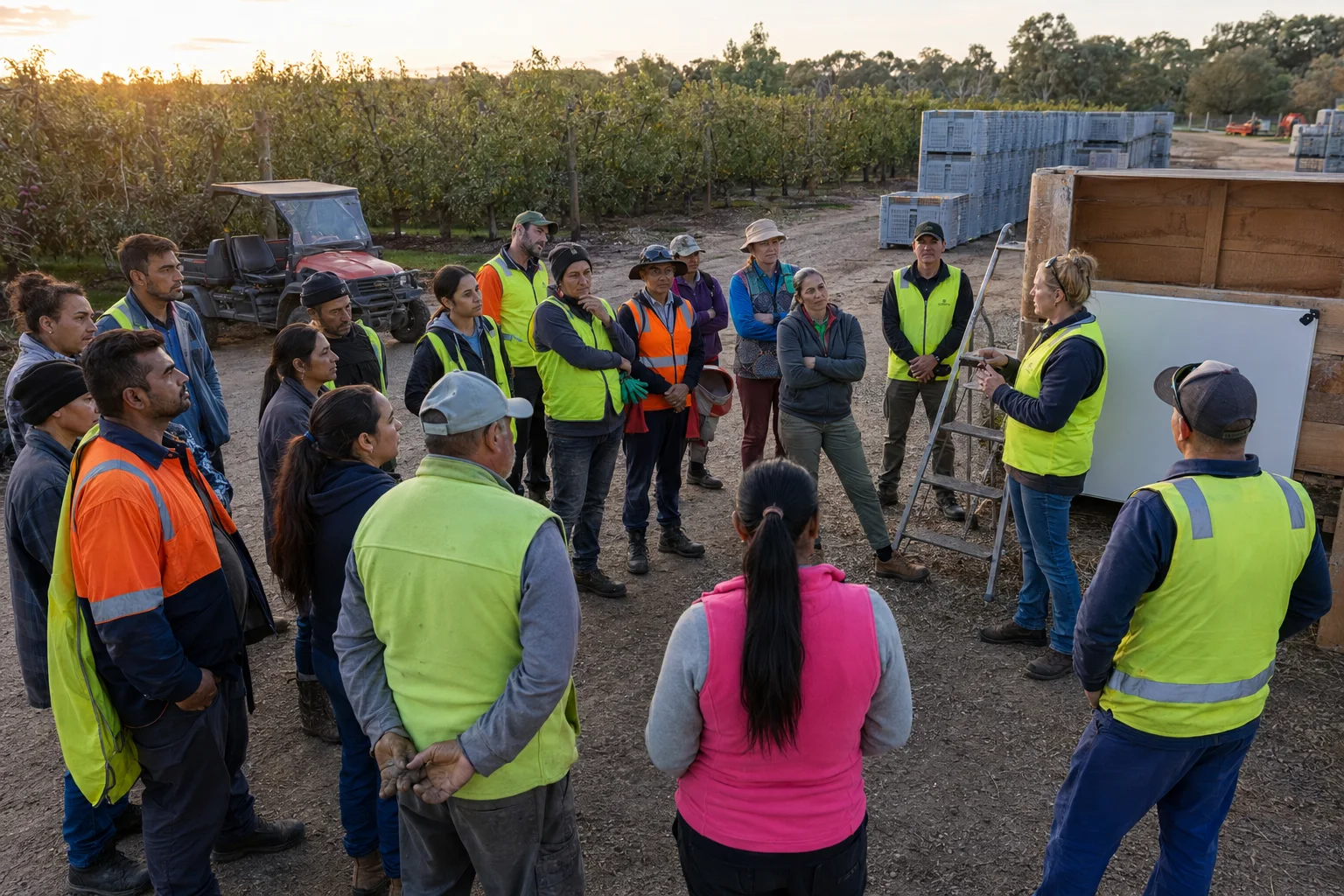
Featured image: AI-generated illustration of fictional adults in an orchard discussion. It does not depict Orchard Tech staff, clients, a worksite or an actual event.
About the author
Hari Yellina is Chief Executive Officer at Orchard Tech. View his profile and more articles.