Harvest Crew Food Safety: Turn the Induction into a Demonstration
• Hari Yellina
A worker signs an induction sheet and walks into the harvest block. The form records attendance. What will show the supervisor that the worker knows how to protect the produce during today’s job?
For berry, leafy vegetable and melon businesses, a short practical demonstration can make the difference between a rule that was heard and a task that can be performed correctly.
Start with the correct commodity and jurisdiction
Standards 4.2.7, 4.2.8 and 4.2.9 cover berries, leafy vegetables and melons respectively. Agriculture Victoria says these standards took effect in Victoria on 12 February 2025. They are already operating requirements. Their scope should not be assumed to cover every orchard crop in the same way. Agriculture Victoria’s horticulture food safety guidance
Check the business’s registration, relevant activities and food safety arrangements. Victoria’s current guidance also identifies registration renewals falling due in 2026. A previous registration or an industry certificate deserves checking against the current requirements and renewal date. Businesses operating across state borders should check each regulator’s arrangements separately. Agriculture Victoria
Match the instruction to the job
FSANZ explains that people performing relevant activities, and their supervisors, need food safety and hygiene knowledge and skills appropriate to their work. The task matters: harvesting, washing, trimming and handling equipment can involve different controls. FSANZ: Skills and knowledge, page 1
A useful first-shift plan therefore starts with the worker’s actual assignment. Identify what they will touch, which equipment they will use and who can answer a food safety question. A general introduction to the farm can sit alongside this instruction, but the person should also learn the particular procedure that applies at their workstation.
The practical suggestions below support that process. They do not replace the business’s required food safety system or establish a prescribed training record.
Use a simple “show me” check
For a new hand-harvesting crew, the supervisor could ask each worker to demonstrate or explain:
- Where to prepare for work. Locate the handwashing facilities and demonstrate the site’s handwashing procedure.
- How to use the equipment. Show which harvest container or tool is ready for use and what to do if its condition is doubtful.
- Where a concern goes. Identify the person to contact when produce, water, equipment or a working area may be contaminated.
- What happens after an interruption. Explain the site’s steps before resuming produce handling following a break or another activity.
Use the site’s own procedures and equipment for the demonstration. Pictures, translated explanations and a supervised attempt can reveal a misunderstanding that a signature would miss. FSANZ recommends making instructions understandable, using photos or diagrams, and developing a workplace culture in which people can ask questions. FSANZ training guidance
Make reporting an ordinary part of the shift
FSANZ’s horticulture guidance says businesses must do what they reasonably can to ensure personnel and visitors follow health and hygiene practices that do not make produce unsafe or unsuitable. That includes helping people understand and follow the site’s requirements. FSANZ: Health and hygiene of personnel and visitors
Tell workers how to raise a health or hygiene concern privately with the designated contact. Explain who assesses the next step under the site’s procedure. Keep a person’s health information out of a public crew message. A worker should be able to ask for help without needing to make their own judgement about product safety.
A hypothetical dropped container
A picker drops an empty harvest container into a muddy wheel track. They know the farm has a cleaning procedure, but cannot locate the replacement containers or the supervisor.
The instruction needs to resolve those practical questions: where to place the doubtful container, how to obtain a ready container and who decides whether cleaning or another action is required. Practise that sequence during induction. The example is a teaching exercise, not a universal cleaning method or a decision that any particular produce is safe.
Record what the worker was able to do
An internal record can identify the task, procedure explained, demonstration observed, questions resolved and any further supervision needed. For example: “Hand harvesting; located wash station; demonstrated site procedure; identified reporting contact; follow-up demonstration arranged for container handling.”
That tells the next supervisor more than “induction complete”. Revisit the instruction when a worker changes tasks, uses different equipment or moves to a site with different controls. Include supervisors in the check: they need to explain the procedure and respond consistently when a concern is raised.
For the wider arrival process, read Farm Induction for Labour Hire Workers. Before a crew changes properties, also review Harvest Crew Biosecurity. Food hygiene and property biosecurity need their own practical instructions within that handover.
Sources checked 10 October 2026. This article focuses on Victorian berry, leafy vegetable and melon operations. Confirm the applicable standard, regulator and business procedures for the actual commodity and activity.
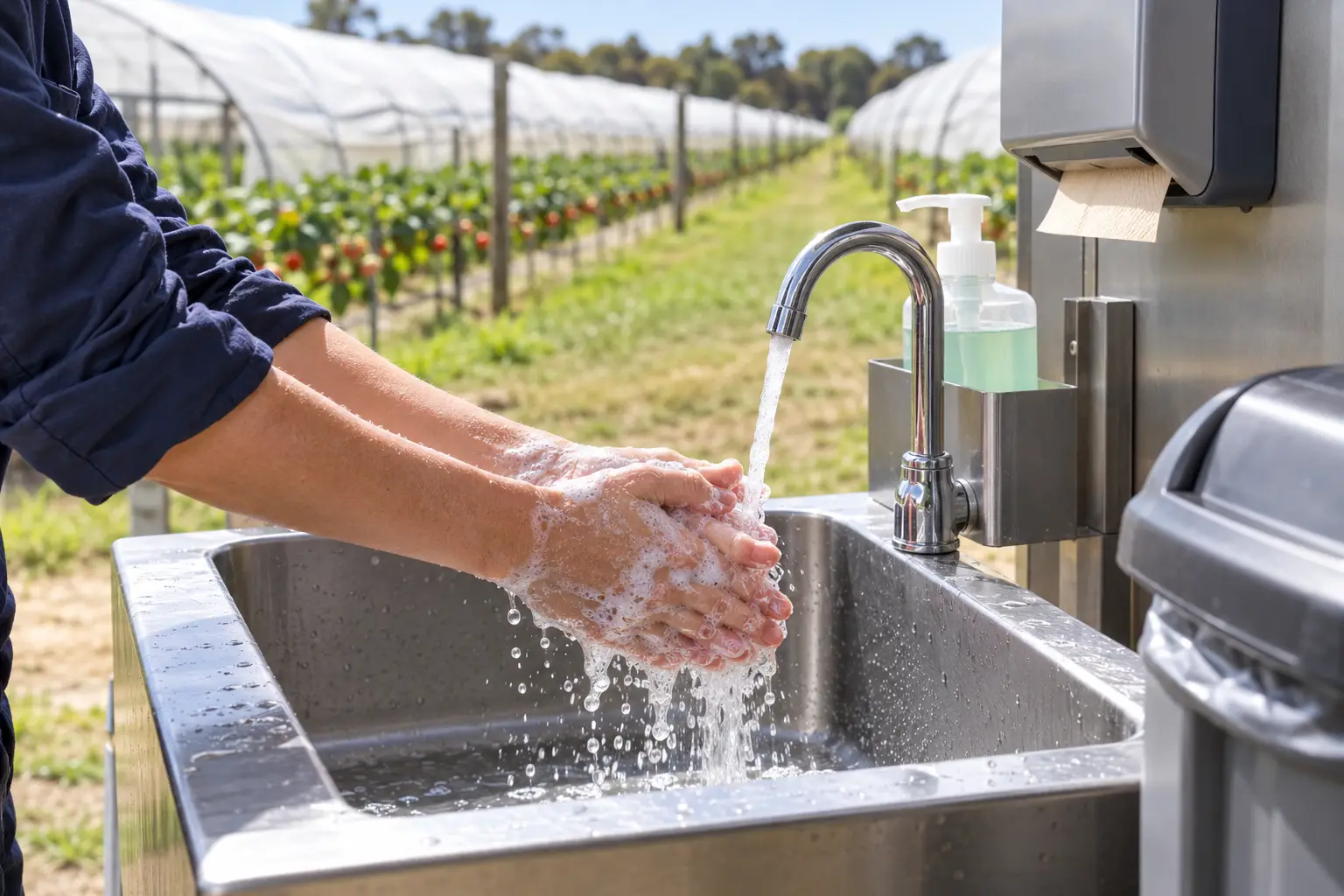
Featured image: AI-generated illustration of a fictional hygiene station. It does not depict an Orchard Tech worker or facility.