Australia’s 2026–27 Horticulture Outlook: What Growers Should Consider Before Booking Crews
• Hari Yellina
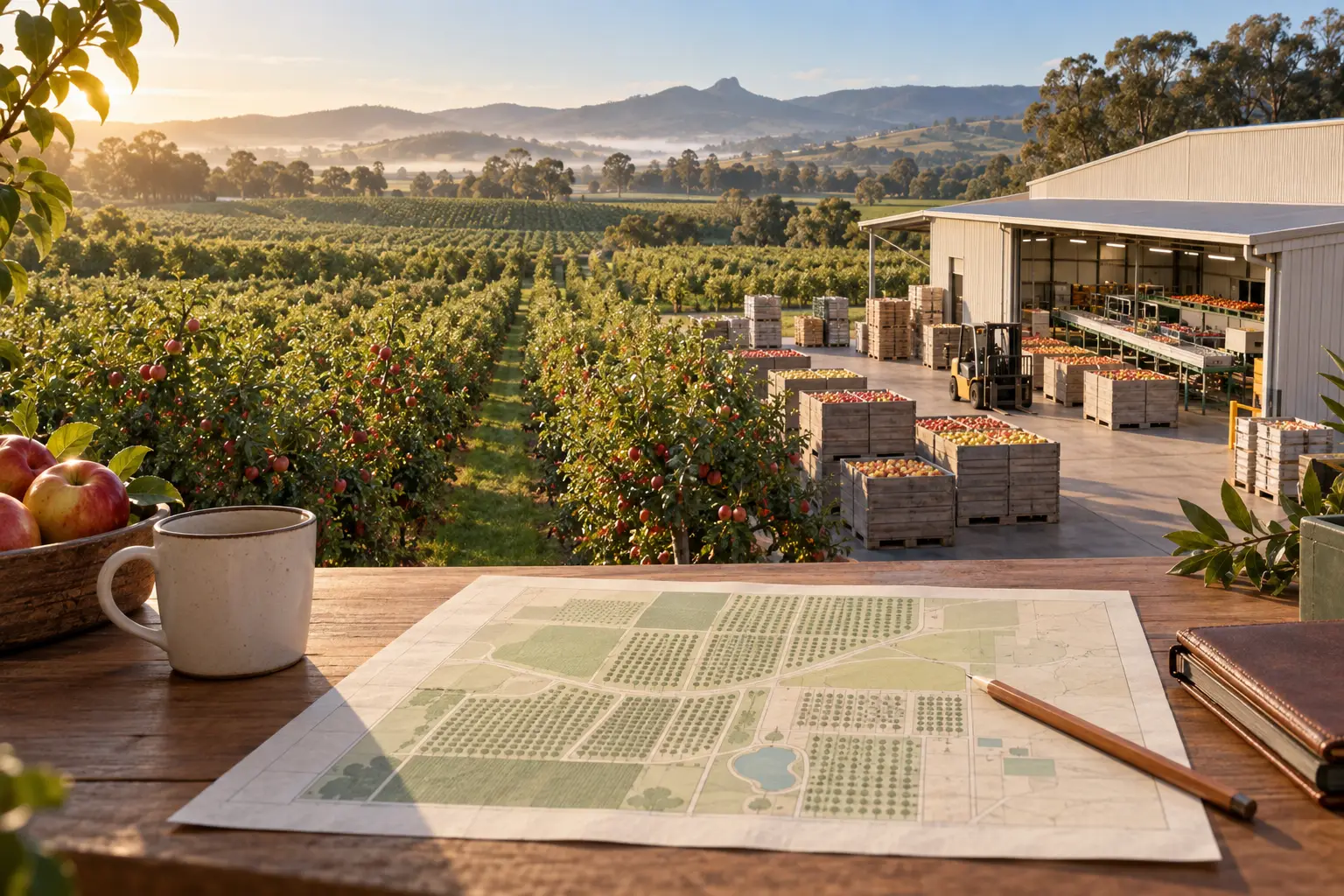
Featured image: AI-generated fictional illustration of orchard harvest planning.
A national forecast can help a grower understand the season ahead. It cannot tell a farm manager how many people to book for a particular block on a particular Monday. The useful step is to connect the economic outlook with the work that will actually move through the farm.
What the latest horticulture outlook says
In its September 2026 Agricultural Commodities outlook, ABARES forecasts a record Australian horticulture production value of $18.8 billion for 2026–27. It forecasts export value rising 3% to $4.4 billion, with higher export prices supported by global demand.
These are national forecasts of value. A change in value can reflect prices, quantities and the mix of products sold. It does not establish a matching increase in picking hours, a local labour shortage or a guaranteed return for an individual grower. The workforce planning approach below is our operational analysis, rather than an ABARES forecast of crew numbers.
Start with the crop estimate, then identify the work
For each block, write down the current crop estimate, likely harvest window, quality requirements and confidence in those assumptions. Date the estimate and name the person who will revise it. A booking based on an undated estimate is difficult to adjust when maturity changes.
Separate the work into stages. Picking, collecting bins, sorting, packing and dispatch do not necessarily need the same people or happen at the same rate. More fruit arriving at the shed is only useful if the shed can handle it without an expanding queue.
- Field work: consider crop accessibility, harvest method, expected picking passes and movement between blocks.
- Handling: identify bin movement, transport and receiving capacity.
- Packhouse: assess grading, packing, changeovers and the dispatch window.
- Support: allow for supervision, induction, recordkeeping and planned cover.
A simple capacity example
Consider a hypothetical farm with 1,200 bins to pick over ten harvest days. Its own previous records suggest a particular crew can pick 100 bins per day under comparable conditions. That implies twelve crew-days of picking work. Squeezing twelve crew-days into ten calendar days requires a change in capacity, the window or the crop plan.
Before adding pickers, the manager checks the shed. If it can receive only 100 bins daily, producing 120 bins a day could move the delay from the orchard to the receiving area. The response might involve the packing shift, transport timing or a revised harvest sequence. These numbers are invented to illustrate the calculation; they are not productivity benchmarks.
Use productive task time carefully. It is a planning measure and must not replace paid hours, breaks, minimum engagements or the applicable employment conditions in the payroll calculation.
Prepare for a different window, not just a bigger crop
Build three versions of the plan: the expected window, an earlier start and a compressed window. Show which assumption changes in each version. For example, a crop of the same size becoming ready in seven days rather than ten can create a sharper peak without any increase in annual production.
Agree a review point with the labour hire provider. A useful booking brief includes the crop and location, provisional start range, tasks, estimated daily capacity, supervisor, transport arrangements and the date the estimate will next be confirmed. Keep estimated demand separate from confirmed worker availability.
Our orchard workforce harvest checklist covers the practical preparations around the crew booking. Use the new economic outlook to inform the assumptions, then use current farm information to decide the capacity you need.
Research checked 2 October 2026. Forecasts may change as the season develops. The planning example is hypothetical.
About the author
Hari Yellina is Chief Executive Officer at Orchard Tech. View his profile and more articles.