
Thunderstorms at Harvest: Where Will the Crew Shelter?
• Hari Yellina
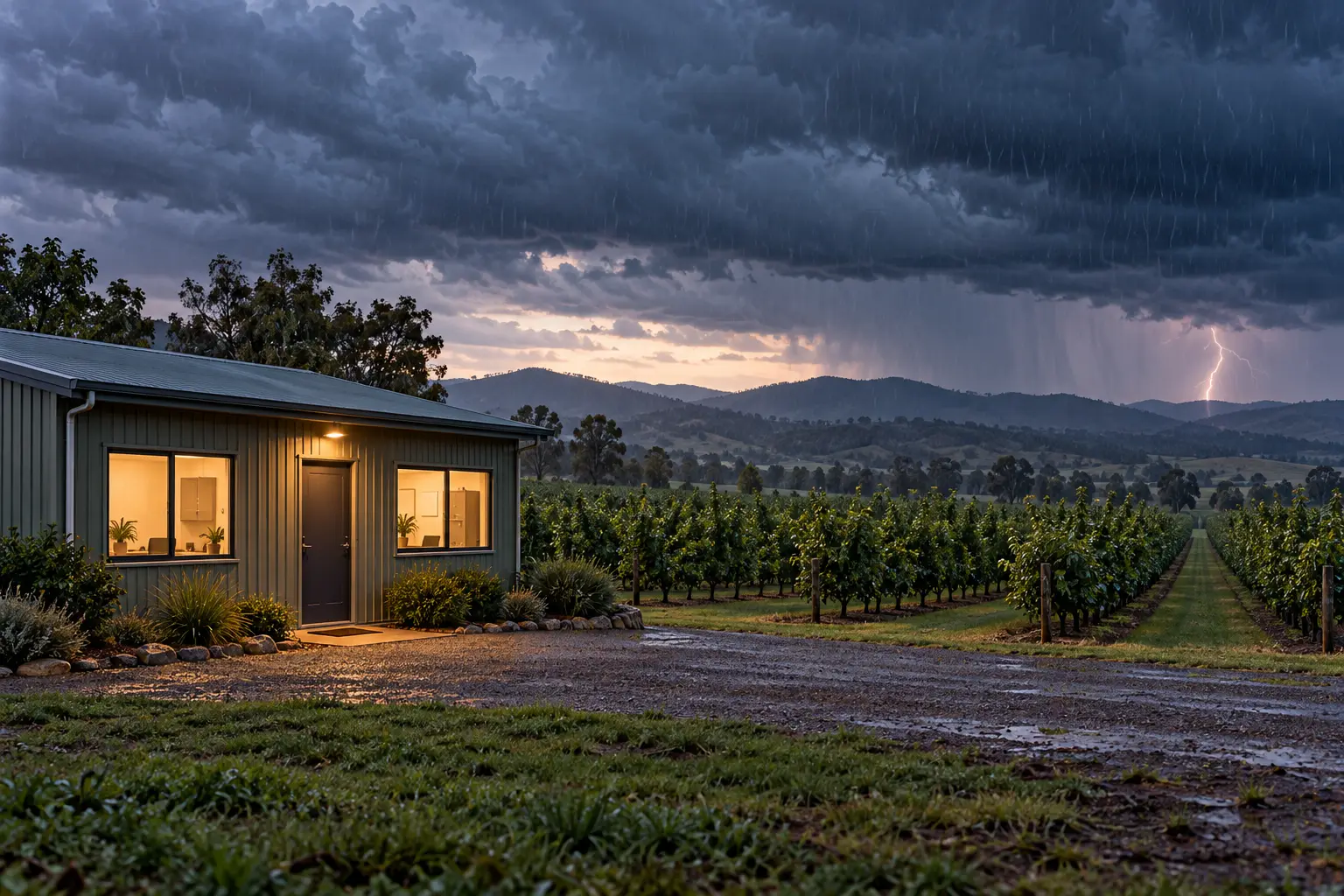
A harvest crew works across several rows. Their usual break area is an open shelter near the block, while the enclosed farm building is much farther away. If a thunderstorm develops, telling everyone to “head back” leaves important questions unanswered: back to where, by which route, and early enough for every worker to arrive?
A storm plan needs a suitable destination and a workable way to reach it.
A warning is not the only reason to act
The Bureau of Meteorology explains that every thunderstorm produces dangerous lightning. Its thunderstorm warnings cover storms classified as severe or very dangerous; it does not issue a warning for every thunderstorm. The absence of a severe thunderstorm warning should therefore not be treated as proof that outdoor work is safe. Bureau guidance on warning services
Build the shift plan around forecasts, current warnings and changing conditions at the property. Assign someone to monitor them and agree how the crew receives an instruction when conditions require action. This article is preparedness guidance, not a forecast of storms at any particular farm today.
Check what “shelter” actually means
The Bureau says there is no safe place outdoors during a thunderstorm. Its advice is to move to a solid building or a hard-top vehicle, avoid small open structures and fabric tents, and never shelter under trees. Bureau thunderstorm safety advice
A shade canopy may be useful during a hot break, but it does not satisfy that thunderstorm advice. Identify the available buildings or vehicles and assess whether the proposed arrangement is suitable for the particular site and conditions. An illustration, a building name on a map or a roof alone is not evidence of suitability.
Before allocating a remote block, check access to the destination. Is the building available and unlocked during the shift? Can it accommodate the people expected to use it? If vehicles form part of the plan, are suitable vehicles, seats and drivers actually available? Resolve those questions while the weather permits orderly movement.
Allow time for the whole crew to move
The following questions form a practical planning exercise, rather than a fixed legal checklist:
- How long does it take the most distant worker to reach the agreed shelter?
- What changes if someone has reduced mobility, the access track becomes slippery or the vehicle is elsewhere?
- Who gives the stop-work instruction, and who covers that role during breaks?
- How will instructions reach a worker outside phone coverage or someone needing language support?
- Who confirms that every worker has arrived, including anyone collecting equipment or working separately?
Use those answers to set an early action point appropriate to the site. Avoid a plan that requires a last-minute trip through worsening conditions. Carry out a practice handover in safe weather and adjust the arrangements when the block or crew changes.
A hypothetical two-block shift
Two supervisors share a crew across neighbouring blocks. Each assumes the other is monitoring the weather. A vehicle that normally collects workers has been sent on a delivery, and the newer workers know only the open break shelter.
The planning gap exists before a storm arrives. Give weather monitoring a named owner, check the transport arrangement before deployment, and show every worker the agreed destination. If the arrangement cannot support the planned work location, resolve that before sending the crew there.
Agree the arrangement with the labour hire provider
In Victoria, hosts and labour hire providers sharing OHS duties must consult, cooperate and coordinate, so far as reasonably practicable. WorkSafe also says that changed locations or roles can require further consultation. WorkSafe’s shared-duty guidance
For a storm plan, that discussion can identify the work location, shelter, communication method and responsibilities for moving and accounting for workers. Ask workers whether the proposed route and instructions are workable. Recording an agreed contact helps the next supervisor use the plan consistently.
Reassess access before restarting
A clearing sky does not establish that the property is ready for work. VICSES identifies storm hazards including damaged trees, powerlines, debris and affected roads. It advises avoiding floodwater and keeping away from fallen powerlines, which should be assumed live. VICSES storm guidance
Have an appropriate person assess access and the work area before restarting, follow current emergency advice, and obtain qualified help for electrical or structural concerns. Do not send workers to investigate a fallen wire or cross floodwater to check a block. For life-threatening emergencies call 000; for storm emergency assistance from VICSES call 132 500. VICSES
Keep the location information connected to the farm emergency access plan. If work is interrupted, address payroll, transport and worker support separately using the relevant arrangements; PALM weather disruption responsibilities explains that part of the response.
Sources checked 10 October 2026. Adapt the plan to the actual property, crew and conditions, with current Bureau, VicEmergency and emergency-service advice.
Featured image: AI-generated illustration of a fictional orchard and building. It is not a local weather forecast or a representation of an Orchard Tech property.