
Last reviewed: 29 August 2026. This page provides general Victorian farm-safety information, not advice for a particular workplace or incident. The hazards, people, equipment and controls must be assessed for each farm and each task.
Farm safety works best when it is treated as part of planning the job, not as a judgment about a person after something goes wrong. Farmers, managers, workers, contractors, labour hire providers and hosts may see different parts of the same risk. Sharing that information early makes it easier to remove hazards, choose safer equipment and organise work so everyone can finish safely.
What the current national data shows
Safe Work Australia’s Key Work Health and Safety Statistics Australia 2025 reports that 44 workers in the agriculture, forestry and fishing industry died from traumatic injuries in 2024. The industry recorded a fatality rate of 13.7 per 100,000 workers, the highest industry rate reported for that year.
Those are national, industry-level figures. They are not a count for Victorian farms, do not describe every kind of farming work and do not assign blame for any individual event. Their practical message is that prevention deserves sustained attention. WorkSafe Victoria’s agriculture hub should be used for current Victorian guidance and safety alerts.
Build safety into each task
WorkSafe’s farming safety basics starts with identifying hazards, assessing the risks and consulting with employees and contractors. Where reasonably practicable, eliminate the risk. If it cannot be eliminated, reduce it through substitution, isolation or engineering controls before relying on procedures, training or personal protective equipment. Controls should be checked when the work, weather, equipment, people or location changes.
| Work or hazard | Questions to ask before work starts |
|---|---|
| Vehicles, tractors and machinery | Can pedestrians and moving plant be separated? Is the equipment suitable, guarded and maintained? Are isolation procedures used before clearing, cleaning or repairing it? Is the operator trained, competent and using the required restraint or protective equipment? |
| Falls and manual tasks | Can the task be done from ground level or redesigned? Is there stable access and suitable fall protection? Can a mechanical aid, different load or team method reduce lifting, reaching or repetitive strain? |
| Chemicals, confined spaces and electricity | Are substances labelled and safety information available? Are storage, mixing and application controls understood? Has a confined space been identified and controlled before entry? Are work and plant kept clear of overhead or underground electrical hazards? |
| Livestock and unpredictable movement | Are yards, gates, escape routes and handling methods suitable for the animals and task? Does the worker understand animal behaviour, the equipment and when another person is needed? |
| Heat, fatigue and isolated work | Are workload, rest, water, shade and travel planned for the conditions? Is there reliable communication, a check-in process and a response if a worker misses a check-in? Should a high-risk task be done with another person? |
| New workers or changed duties | Does the induction cover the actual farm, task and emergency plan in a form the worker understands? Has competency been checked? Is supervision suitable? Has a change of role, equipment or location triggered a fresh risk assessment? |
A checklist can help, but it is not the control itself. Someone must confirm that agreed controls are present, understood and working. Near misses, maintenance problems, changing crop conditions and worker feedback are reasons to review the system before harm occurs.
Labour hire safety duties are shared
In Victoria, WorkSafe explains that a host employer is taken to be the employer of a labour hire worker for occupational health and safety duties. The host and labour hire provider are both responsible for the worker’s health and safety, and a contract cannot exclude either party’s legal obligations. They must consult, cooperate and coordinate with each other, so far as reasonably practicable. See WorkSafe’s labour hire host guidance.
Before placement, the provider and host should exchange accurate information about the workplace, duties, hazards, controls, hours, supervision, required licences and worker capability. WorkSafe recommends that a trained and competent provider representative visit and assess the workplace. The worker needs a site- and task-specific induction, information in an appropriate form or language, suitable training and supervision, and the equipment needed to work safely.
Responsibility continues after the first day. The provider, host and worker should know who receives hazard and incident reports and how information will be shared. Workplace visits and consultation should test whether conditions still match the original assessment. A new task, location, item of plant or material change in hours can introduce new risks; it should be discussed and assessed before the labour hire worker performs the changed work.
Workers must be included
Employees must take reasonable care for their own health and safety and for others who may be affected by what they do or fail to do. They must also cooperate with lawful safety actions. At the same time, employers must consult affected employees and health and safety representatives where required. A useful system tells every worker how to report a hazard, near miss, injury or change in work without waiting for the next scheduled meeting.
Reports should lead to action: make the immediate area safe, record what was raised, involve the people who understand the task, decide what will change, assign responsibility and check whether the control worked. Reporting is a prevention tool, not an admission of fault.
Prepare for emergencies on a farm
Remote locations, limited phone coverage and difficult site access can delay help. WorkSafe’s guidance on working alone on farms recommends reliable communication and emergency procedures. A farm plan should identify entry points, property addresses and coordinates, emergency contacts, first-aid arrangements, who will meet emergency services, how isolated workers check in and what happens when contact is missed. Workers need to understand the plan, and it should be practised and reviewed.
If a situation is still dangerous or high-risk, call Triple Zero (000). Give the operator the best available location information and do not put another person at risk while trying to help.
Report serious incidents correctly
Not every injury or near miss is legally notifiable, but specified serious events must be reported. WorkSafe’s current incident-reporting instructions say to confirm whether the incident is notifiable and, if it is, notify WorkSafe immediately by calling 13 23 60. The incident must also be reported in writing within 48 hours, and a copy of the notification form must be kept for at least five years.
The incident scene must not be disturbed until a WorkSafe inspector arrives or WorkSafe gives permission. It may be disturbed where necessary to protect a person’s health or safety, help an injured person or make the area safe. These regulator-notification steps are separate from providing first aid, calling emergency services, recording the event in the workplace register and following any workers compensation process.
Sources checked 29 August 2026: Safe Work Australia, Key Work Health and Safety Statistics Australia 2025; WorkSafe Victoria agriculture, farming safety, labour hire, working-alone and incident-reporting guidance. Publisher: Orchard Tech. Last substantive review: 29 August 2026. Review by: 30 November 2026, or earlier if Victorian law or regulator guidance changes.
Related Articles


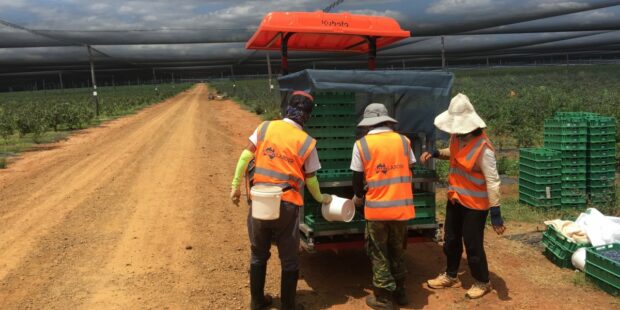
Horticulture Labour Shortage at Its Highest
Archive article. This article describes the period originally reported. It is not a current market, recruitment, health or regulatory update. For newer reading, visit the Orchard Tech Knowledge Centre and check the relevant official sources before acting. The ongoing pandemic and the shortage of seasonal workers and backpackers that are arriving in Australia has created […]
Read More →