
Packing-Shed Forklifts: Check the Walking Route Before the Crew Arrives
• Hari Yellina
Source checked: 18 September 2026. Victoria. General information; assess the circumstances of the actual work.
The shortest route from a packing line to the toilets can become a forklift crossing when bins are relocated. A traffic plan needs to work for these ordinary journeys, as well as for the main loading area. Before a busy shift, walk the routes people will actually use.
Begin with separation
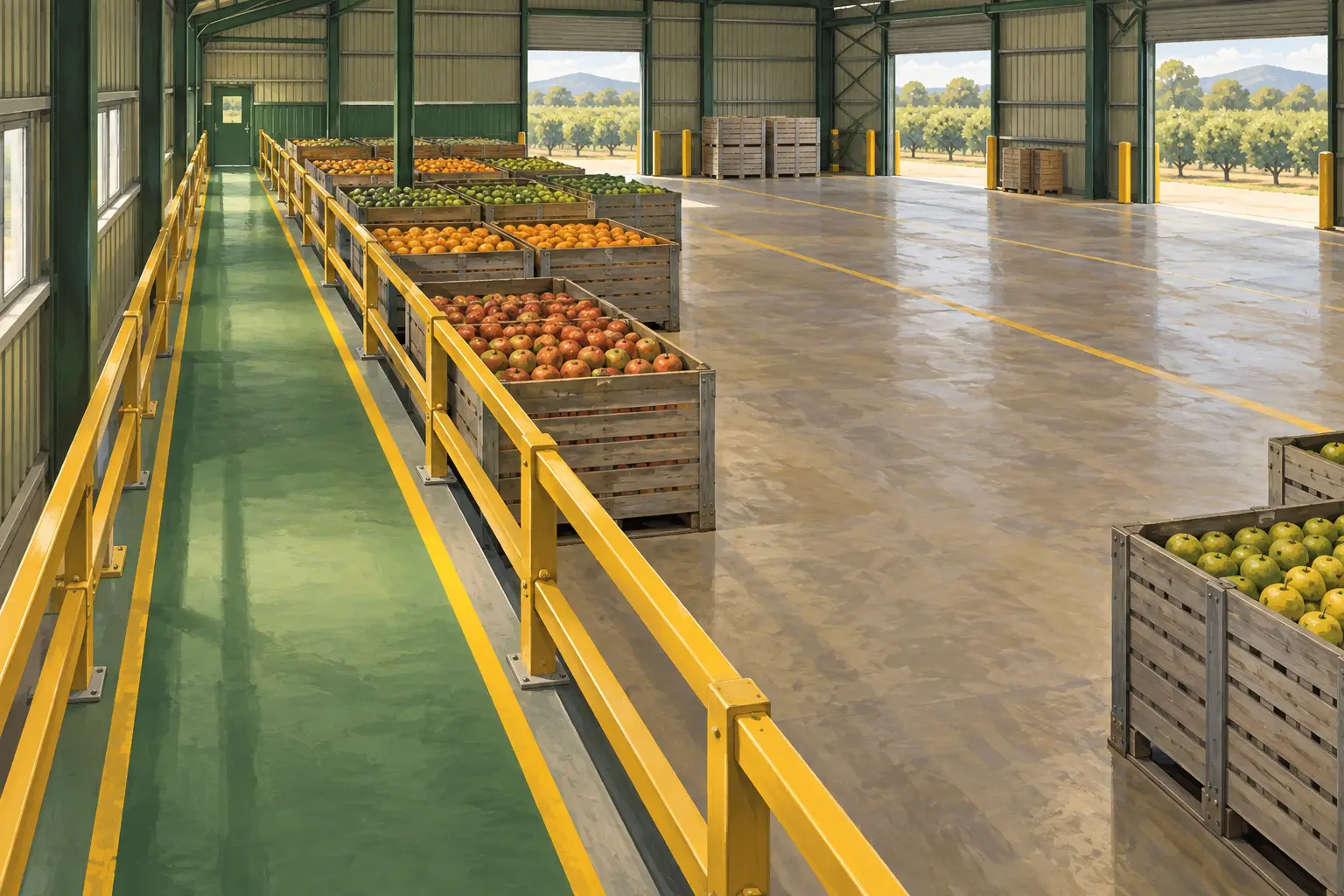
WorkSafe Victoria’s forklift guidance prioritises eliminating or reducing risks through the hierarchy of control. It identifies physical barriers, exclusion zones and protected pedestrian routes among the controls. Painted lines, signs, training and high-visibility clothing provide lower levels of protection and do not replace a proper assessment of separation.
Follow three journeys
As an operational review, trace the route from arrival to the workstation, from the workstation to amenities, and from a delivery vehicle to its designated waiting area. Check what happens when doors open, a pallet is set down or a temporary stack blocks the view. Ask a new worker to explain the route after the briefing; uncertainty is useful evidence that the arrangement needs attention.
Account for temporary changes
In a hypothetical packing shed, an overflow stack narrows a pedestrian path during the afternoon rush. Treat the change as a traffic-management issue before people start using the forklift lane as a shortcut. Reassess the layout and communicate the revised arrangement. A supervisor should know who has authority to prevent an unsafe route being used while the problem is corrected.
Include visitors and drivers
WorkSafe’s guidance also addresses protected waiting areas for transport drivers. Make arrival instructions match the physical layout, including where a driver waits during loading. Review the plan after changes or incidents and consult affected workers, labour hire workers and representatives as applicable. Keep the displayed diagram consistent with the arrangement on the floor.
Official guidance and related reading
WorkSafe Victoria guidance. For the wider planning process, see Orchard Tech’s harvest workforce checklist.
About the author
Hari Yellina is Chief Executive Officer at Orchard Tech. His articles cover agricultural workforce planning, labour hire and practical workplace responsibilities.
Featured image: AI-generated illustration of an invented scene; it does not depict an Orchard Tech site or employee.