New Recruitment Data: What It Can—and Cannot—Tell Growers About Harvest Staffing
• Hari Yellina
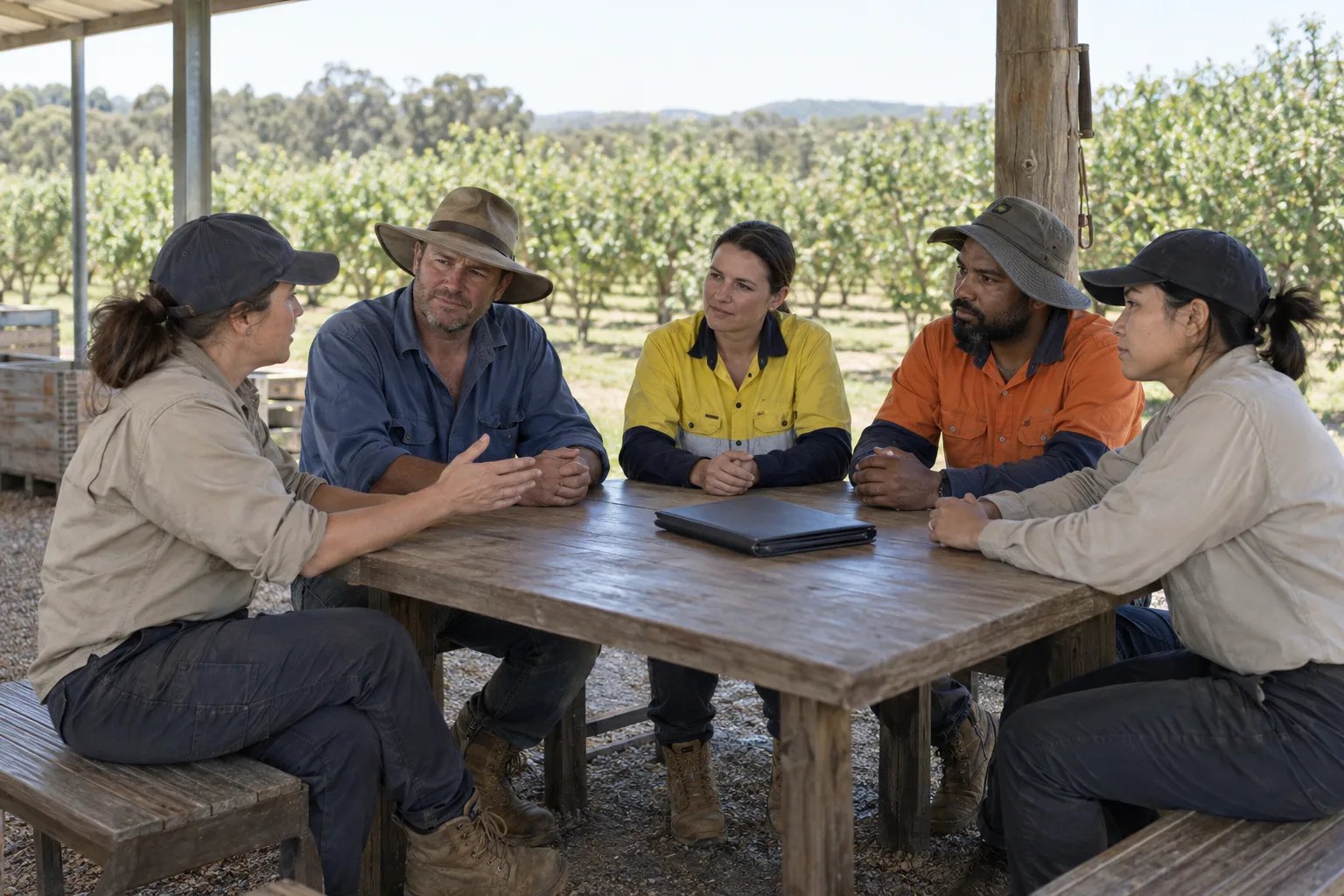
Hero image: AI-generated illustration of a fictional workforce-planning discussion, not actual Orchard Tech staff, clients or an event.
Australia, with practical examples for Victorian growers | Last reviewed: 21 September 2026
A harvest manager can receive plenty of applications and still have nobody ready for the required start date. Another farm may attract few applicants but fill every position through returning workers. Calling both situations a “labour shortage” hides the decision each business needs to make.
Jobs and Skills Australia’s new Employer Activity Insights tool, announced on 16 September 2026, offers a useful reason to look more carefully at recruitment evidence. It is a statistical release, not a new employment law, licence requirement or promise that workers will be available locally.
What changed in September?
The quarterly Occupation Shortage Report is now presented as an interactive Employer Activity Insights table. JSA says it allows users to explore recruitment conditions by broad occupation group, skill level and region, and adds a vacancy-duration measure. Read the 16 September announcement.
The value for a grower is not a headline to paste into a labour request. It is a better set of questions: are jobs attracting applicants, are those applicants suitable, and how long is recruitment taking? Each question can point to a different operational response.
Start with what the survey actually measures
The underlying Survey of Employers who have Recently Advertised collects recruitment experiences from employers and recruiters who recently advertised vacancies online. That scope matters. It is not a headcount of everyone available to work near Robinvale next Monday, nor a complete record of recruitment through personal networks and returning crews.
A useful reading sequence is to identify the reporting period, the occupation grouping and the geographical level before drawing a conclusion. A national result cannot establish the conditions for one crop, one town or one short harvest window. Equally, a difficult vacancy on one farm does not establish a national shortage.
The Employer Activity Insights page warns that its national time-series chart does not change with the interactive table’s filters. It also marks data suppressed for small samples with a dash. Do not present the national chart as a selected regional result, or interpret a suppressed cell as zero.
The separate Occupation Shortage List provides a point-in-time assessment of occupational shortages. A shortage rating and a particular employer’s recruitment outcome answer different questions. Neither replaces checking the people, skills and dates required for an actual job.
Separate four points where recruitment can break down
The following is an Orchard Tech planning framework, not a JSA statistical classification.
- Attracting applicants. If few people respond, examine where the vacancy appears and whether the advertisement explains the location, duties, hours, duration and practical travel arrangements. Record the actual channels used rather than assuming every potential worker saw the advertisement.
- Matching the work. If many respond but few match the task, check whether essential skills were stated clearly. Separate genuinely necessary capabilities from preferences. Do not solve an operator shortage by quietly assigning machinery work to someone recruited for a different role.
- Converting an offer into a start. An applicant who is interested is not yet a confirmed starter. Track offers, acceptance, agreed start dates and unresolved arrangements separately. Ask why an offer was declined rather than guessing that pay, transport or another employer was the cause.
- Keeping the placement workable. A vacancy can reopen after a start. Record the reason and distinguish a planned short engagement from an unexpected departure. Repeated replacement recruitment can look like a sourcing problem when the issue needs a different conversation.
A hypothetical orchard example
Suppose an orchard needs eight people for a defined picking period. It receives 24 applications, makes eight offers, gets six acceptances and has four people confirmed for the first shift. The example is invented; it is not an Orchard Tech placement or a survey result.
Reporting “24 applicants for eight jobs” makes the position look comfortable. Reporting only “four workers short” misses where progress stopped. The supervisor needs to understand two unanswered offers and two accepted offers without a confirmed start, while maintaining a plan for the four confirmed starters.
A separate skilled operator vacancy should have its own record. Combining it with picking vacancies may conceal a bottleneck: extra pickers cannot substitute for a person authorised and capable of doing the operator’s job.
The next action might be a clearer offer, an earlier recruitment decision or a revised work sequence. It should follow the evidence. None of these numbers proves that a particular recruitment channel or worker group is unsuitable.
Use a small weekly recruitment record
For each role, keep a concise record that a supervisor and labour-hire contact can interpret consistently:
- Role, location, duties, required capabilities and proposed start and finish dates.
- Positions required and the date recruitment began.
- Applications, suitable candidates, offers, acceptances and confirmed starts as separate counts.
- What “suitable” means for that role, using job-related criteria.
- Outstanding arrangements and the person responsible for following them up.
- A decision date for the backup plan, and what will trigger it.
Keep applicant information in the appropriate restricted recruitment system. The operational summary can use counts and job references; it does not need to circulate passports, medical details or full applications to the entire crew.
If using JSA data alongside this record, label the source, period and selected filters. Do not describe the farm’s own acceptance rate as JSA’s vacancy fill rate: the definitions and observation periods may differ. Consult the explanatory notes before comparing measures.
Turn the evidence into a harvest decision
At the next workforce meeting, ask one concrete question: which role could prevent the planned work from starting, and what evidence would change our decision this week?
Use our orchard workforce planning checklist for the wider preparation sequence. Where arrivals remain uncertain, the visa delays and harvest planning guide addresses that separate risk. Recruitment progress should also leave time for a proper host-site induction.
Better data will not pick the crop. It can help a grower distinguish an attraction problem from a skills mismatch or an unconfirmed start—and choose an action before the gap becomes an urgent harvest problem.
General workforce-planning information. This article does not claim a quantified shortage for Robinvale or forecast local worker availability. The live interactive data cells were not independently reproduced for this article; no regional numerical comparison is presented.
About the author
Hari Yellina is Chief Executive Officer at Orchard Tech. View his profile and more articles.