From Picking to Plant Operation: Check the Task Before Reassigning a Labour Hire Worker
• Hari Yellina

Victoria · Last reviewed 28 September 2026. A labour hire worker recruited for picking or packing should not be put on a tractor, forklift or other powered plant just because a machine operator is absent. The host and labour hire provider need to discuss the changed task with the worker, assess the new hazards, check the person’s licence and competence where relevant, arrange site-specific instruction and supervision, and put agreed controls in place before the worker starts. WorkSafe Victoria says a placed worker should not perform new tasks until the risk assessment is complete and controls are implemented.
This guide addresses a narrow but common question: what should happen when a Victorian farm or packing-shed placement changes from manual work to plant operation? It complements our first-shift host induction guide and forklift pedestrian-route guide; neither an original induction nor a traffic plan alone authorises a different job.
Recognise the task change before the keys are handed over
“Can you move the tractor for an hour?” may sound minor, yet it changes the equipment, work area, exposure and possibly the worker’s competence requirements. Other examples include moving from sorting fruit to operating a packing line; from hand picking to a mobile platform; or from sweeping a shed to driving a forklift. A new attachment, a different machine model, unfamiliar terrain, longer hours or a new supervisor can also alter the risk even if the job title stays the same.
WorkSafe’s labour hire host guidance says hosts should not change a worker’s tasks or location without consulting the provider and worker. Its post-placement guidance calls for a new job safety analysis (JSA) and an updated agreed actions record when the role changes. This is an ongoing safety process, not a one-off signature at placement.
A practical seven-check handover
- Pause the new task. The supervisor should keep the worker on their agreed work or another assessed task while the host, provider and worker review the proposed change. Do not treat a verbal “I have driven one before” as clearance.
- Define the actual work. Record the machine and attachment, work area, ground and weather conditions, load, nearby pedestrians and vehicles, expected hours, supervisor, and what the worker will not do. “Operate farm machinery” is too broad to assess well.
- Consult and reassess. Involve the worker and, where relevant, the health and safety representative. Update the JSA and agreed actions record with the host and provider. WorkSafe’s labour hire templates provide a starting point; a completed form does not substitute for observing the real task.
- Verify legal and practical competence. Determine whether the particular plant and work require a high risk work licence, then check the correct class and validity. WorkSafe lists forklift operation among licensed high-risk work. A tractor is not automatically in the same licence category. Even where no high-risk work licence is required, the person must be suitably trained and competent for this machine, attachment and site. A card or years of experience elsewhere do not prove that by themselves.
- Check the plant and controls. The host should confirm suitable equipment, maintenance and pre-start checks, safe routes, pedestrian separation, terrain and rollover controls, guarding, emergency arrangements, and a way to stop use and report a defect. For tractors, WorkSafe highlights rollover and crush risks on slopes, rough or muddy ground, near ditches and when attachments change stability.
- Demonstrate and supervise. Give understandable, machine- and site-specific instruction; have the worker demonstrate the critical task under suitable supervision; record any limits on independent operation and the person who will supervise. WorkSafe’s agriculture training example makes the point that prior farm experience does not remove the need for workplace-specific training.
- Agree and record the release to work. Name the host and provider contacts, control owners, confirmation time and review trigger. Update the worker’s job and training record, hours or timesheet arrangements where relevant. Tell the worker whom to contact if conditions differ from the assessment or the task changes again.
Licence check: forklift is not a tractor
A Victorian high risk work licence has specific classes, including LF for forklift truck operation. WorkSafe also requires forklift familiarisation and task/workplace-specific instruction; a licence is a starting condition, not the whole safety system. Do not use a generic “machinery ticket” as proof for a forklift.
For tractors and other farm plant, check the actual applicable legal requirements and the operator’s competence rather than assuming either “every machine needs a licence” or “farm experience is enough”. WorkSafe’s farm-machinery guidance and tractor rollover guidance can help frame the site assessment. This article does not determine a licence requirement for every model, attachment or operation.
What if the host and provider cannot agree?
Do not let operational pressure turn a disputed control into an informal trial. Escalate to the named host and provider safety contacts, keep the worker out of the new task, and resolve the assessment, training or supervision gap before work starts. The worker should know how to raise a concern without being told to solve the risk alone. WorkSafe’s shared-duty guidance explains why consultation, cooperation and coordination continue when the work changes.
A short record worth keeping
For a single task change, a useful record identifies: worker and placement; original and proposed tasks; exact plant and site; worker consultation; hazards and controls; licence-class/competence check; induction and demonstration; supervising person; host/provider agreement; start authorisation; and a review date or change trigger. Keep it with the placement’s safety records, not merely in a supervisor’s text-message thread.
Orchard Tech can coordinate with a host about the proposed role and the worker’s placement. The host remains responsible for its plant, site-specific risks and supervision, while the provider retains its own OHS duties; neither party can contract those duties away. This guide is general information for Victorian workplaces, not a site assessment or legal advice. Use the current WorkSafe guidance and obtain competent advice for unusual plant or high-risk work.
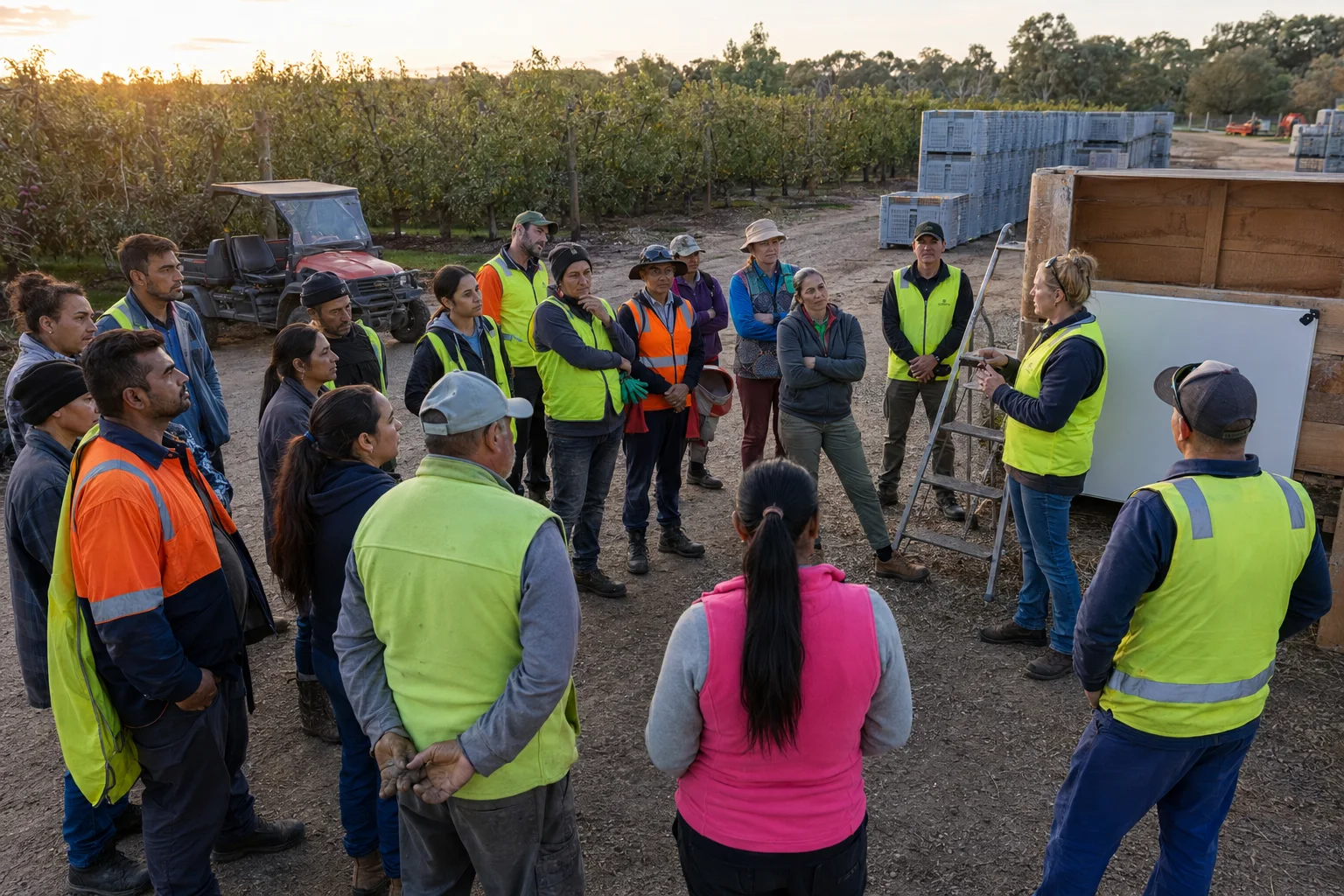
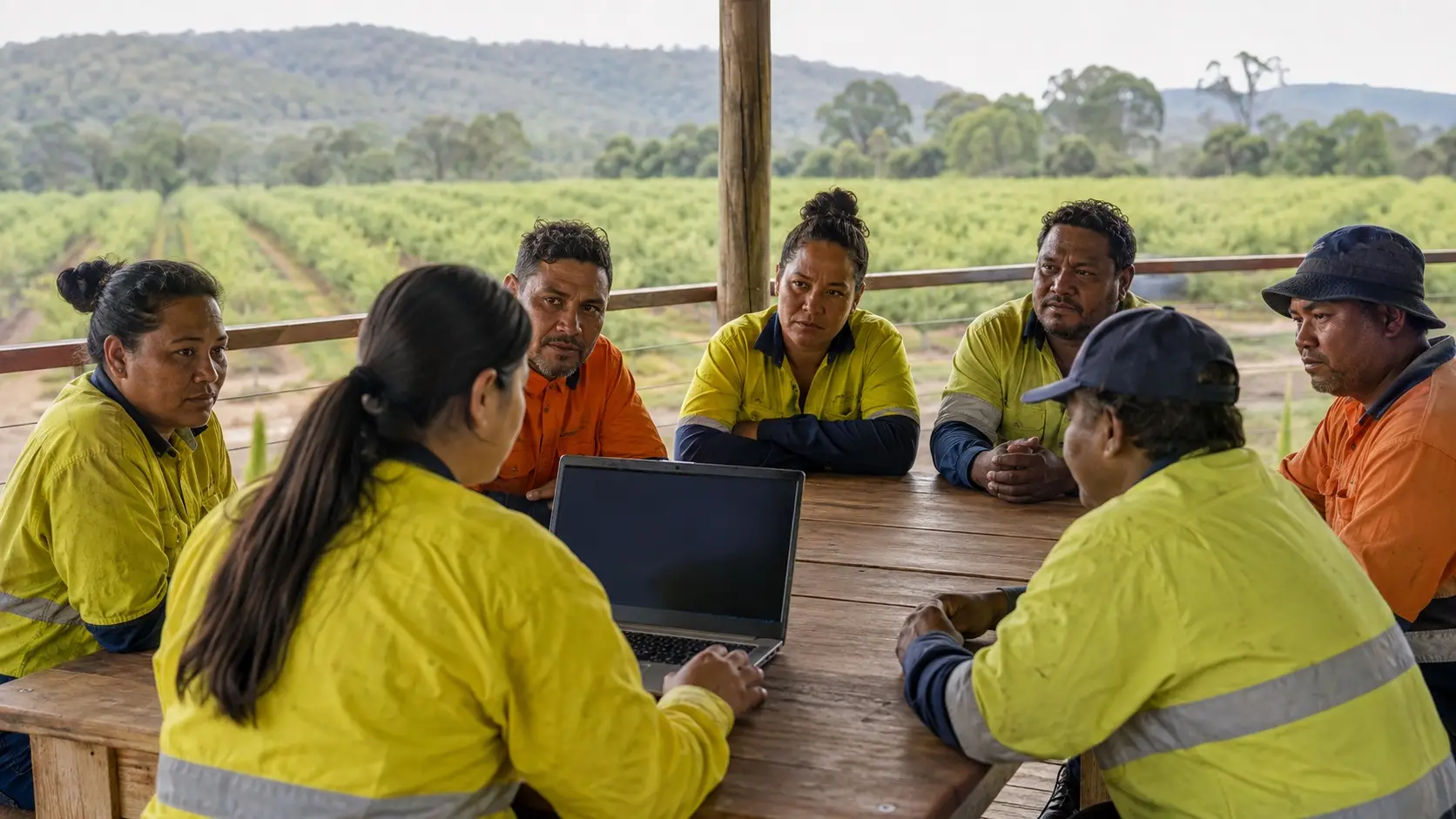
Image: AI-generated illustration of a fictional orchard discussion. It does not show an Orchard Tech worker, client, worksite or actual event.