Before Booking Harvest Labour: Count Supervisor Capacity Too
• Hari Yellina
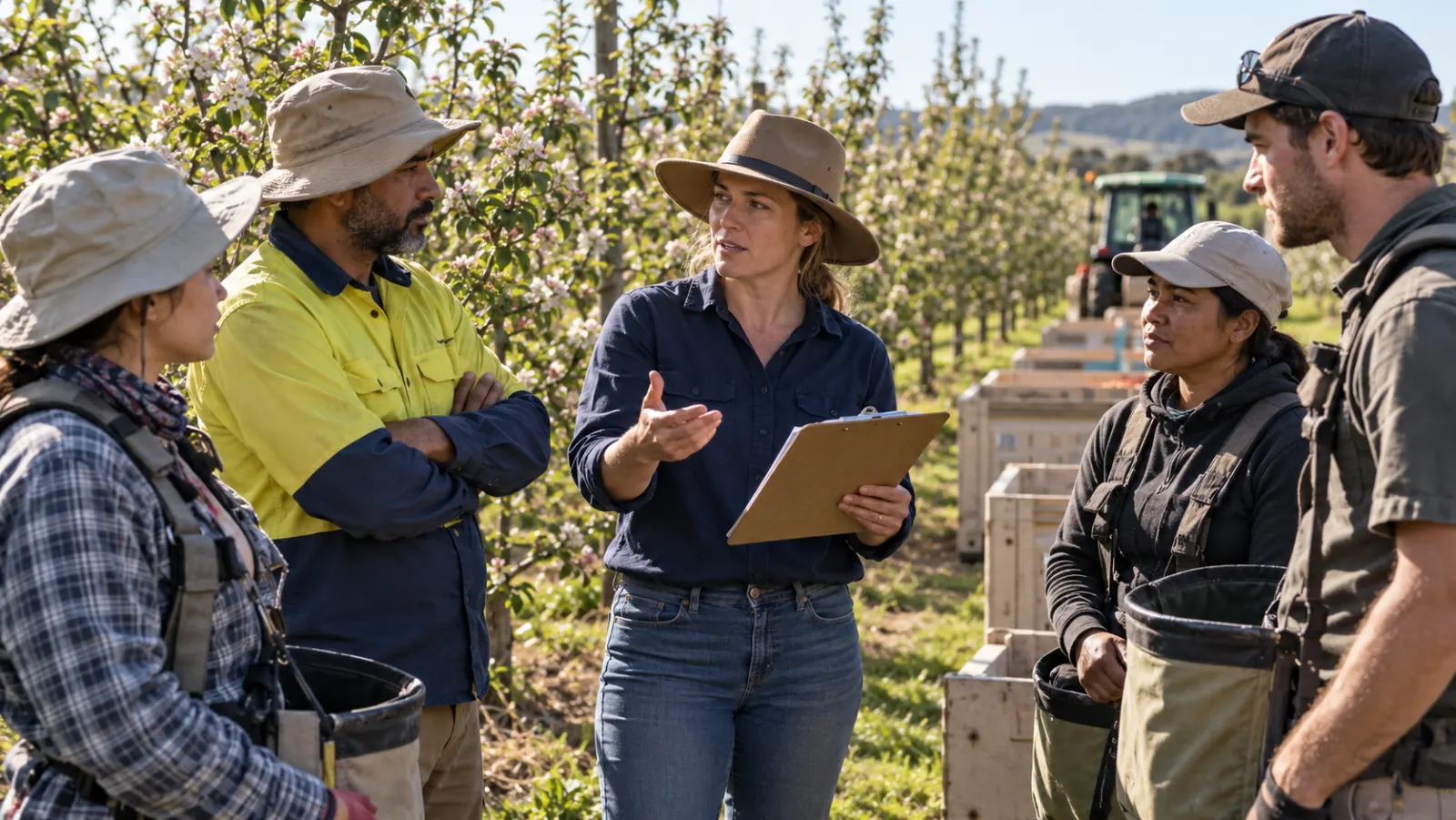
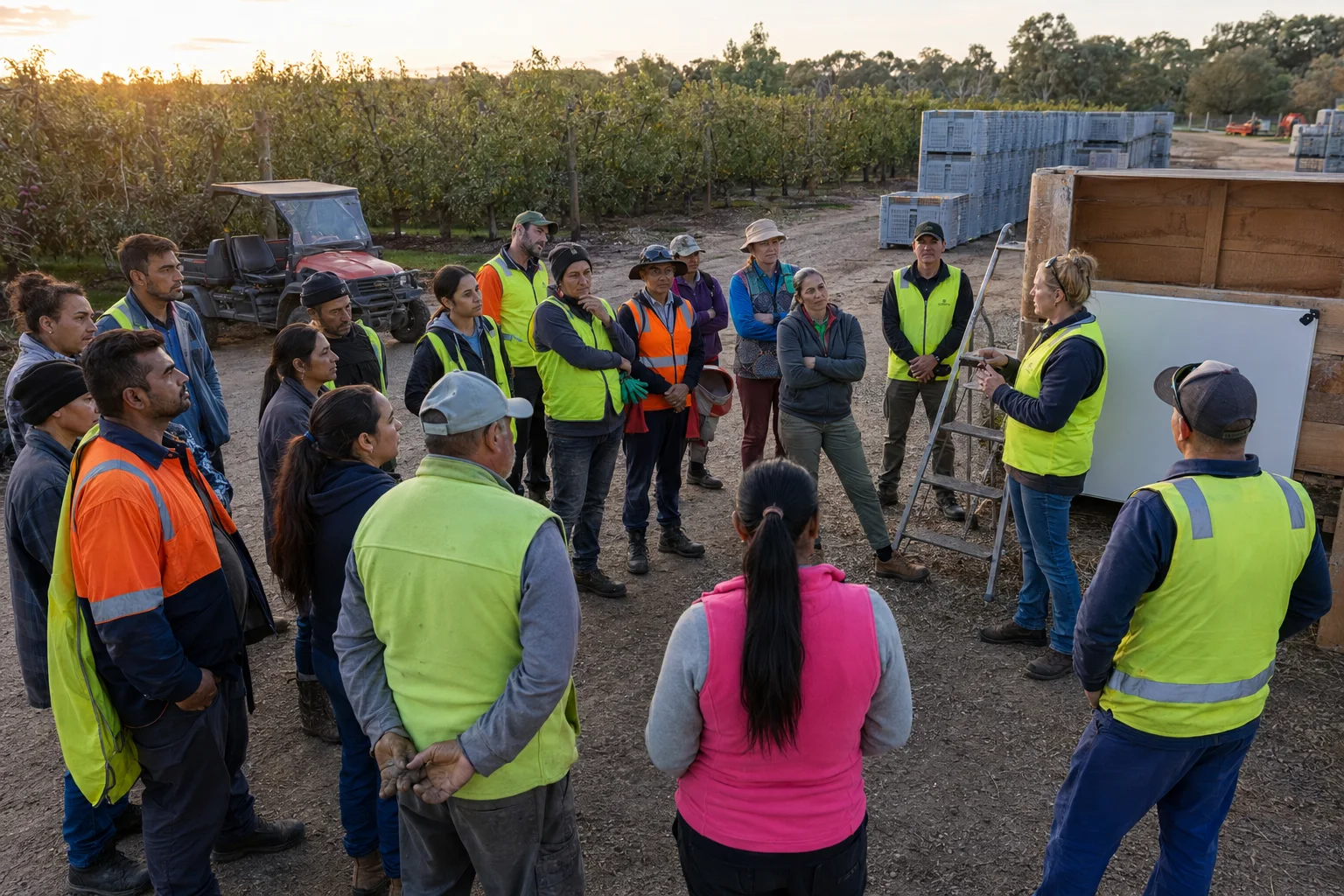
Illustrative AI-generated image. The people and orchard are fictional; this is not a photograph of Orchard Tech staff, workers or a client site.
Jurisdiction: Victoria, Australia | Last reviewed: 19 October 2026
How many workers can one orchard supervisor actually support on the first morning of harvest? There is no useful universal number. The answer changes with the task, the layout, the workers’ familiarity with the site, the equipment, the language support available and the time the supervisor must spend on other duties. A request for 30 workers without a plan for who will induct, direct and check their work is not yet a complete workforce plan.
Jobs and Skills Australia’s 2026 Jobs and Skills Report, published on 12 October, emphasises better job design, working conditions and use of existing capability as part of responding to workforce needs. That is national research, not a new Victorian staffing rule or a forecast of available harvest workers in Robinvale. For a farm, it is a prompt to ask whether the work has been organised so the people already engaged can start and remain effective.
Supervision is a job, not a name on a roster
In Victoria, WorkSafe explains that a host employer has OHS duties to labour hire workers, including providing appropriate information, instruction, training and supervision. The labour hire provider has duties too; the parties must consult, cooperate and coordinate. A supply contract cannot transfer those duties away. WorkSafe also says hosts should define tasks and make sure workers have the knowledge and capability to do them safely.
WorkSafe’s seasonal agriculture case study shows why an experienced worker still needs site-specific instruction: equipment and practices vary between farms. It describes a host arranging training through supervisors and leading hands, and both parties recording who provides the training. The case study is guidance, not a prescribed supervisor-to-worker ratio.
Before placing workers, WorkSafe advises a labour hire provider to ask for the supervisor’s name, contact details and method of supervision. “The farm manager will be around” is less useful than an agreed person, location, shift and escalation route.
Count the work that falls on the supervisor
A supervisor may have to deliver site induction, demonstrate a task, check understanding, allocate rows, respond to hazards, coordinate plant and vehicles, manage breaks, record attendance and speak with the labour hire provider. These demands are not evenly spread through a shift. The first hour with new arrivals can be much heavier than the third day with a returning crew.
For each proposed crew and shift, write down:
- Who is new? Distinguish first-day workers, returning workers and workers changing tasks or locations. Do not assume yesterday’s induction covers a different machine or block.
- What needs direct observation? List tasks where a demonstration and an observed attempt are needed before a worker proceeds independently.
- Where will people be? One supervisor cannot be physically present in several distant blocks or a packing shed at the same time. Identify a competent leading hand and clear handover arrangements where appropriate.
- What else competes for attention? A supervisor operating plant, moving bins or handling urgent quality decisions may not be available to answer a worker’s safety concern.
- How will workers understand instructions? Check whether language assistance, visual demonstration or extra time is needed, and ask the worker to show the task back rather than merely signing a sheet.
- Who acts when something changes? Name the person who can pause work, arrange a safe alternative and tell the provider when duties, hazards or the worksite change.
A hypothetical morning that looks fully staffed on paper
Imagine a farm requests 20 workers for two orchard blocks. Twelve have worked there before; eight are new. One supervisor is scheduled to induct all eight new workers at 6:30 am, allocate the full crew to both blocks, complete a spraying re-entry check and then drive produce bins. The headcount request may be realistic, but the first-hour supervision plan is not.
This is an illustrative example, not an Orchard Tech placement or a prescribed staffing standard. A better plan might stagger arrival times, assign a competent leading hand to one block, complete the re-entry check before the crew is dispatched, and reserve enough time for each new worker to demonstrate the assigned task. If those measures cannot be provided, the start sequence or crew size needs to change. The decision follows the actual task and risks, not an invented “one supervisor per X workers” formula.
Agree the handoffs before the booking is confirmed
A short planning conversation between host and provider should settle six points:
- The task, site, shift and number of workers by start date—not just a weekly total.
- The named site supervisor and a capable alternate for absences or simultaneous work areas.
- Who gives general employment information and who gives farm-specific induction, demonstration and ongoing supervision.
- How training, task changes and observed competence will be recorded without circulating unnecessary personal documents.
- How workers will raise a hazard, ask a question or stop an unsafe task, including when the supervisor is away.
- When the host will tell the provider that the scope, location, machinery or hours have changed so the placement can be reassessed.
WorkSafe’s guidance on consulting, cooperating and coordinating supports this shared approach. It does not mean the provider can simply assume the host has completed an induction, or that the host can assume the provider knows every site-specific risk.
Use a simple capacity test each week
At the weekly labour meeting, compare the next seven days’ planned starts and task changes with the people available to supervise them. Mark the busiest first-hour period, not just the total number of supervisors on payroll. Where capacity is tight, choose an operational change—stagger starts, add a qualified leading hand, revise the work sequence or reduce the initial crew—then confirm who owns it and when it will be checked.
Our harvest workforce checklist covers the wider lead-up. The host-site induction guide addresses first-day information, while our forklift and pedestrian route guide shows why a changed work area can require a fresh conversation.
A good labour request asks not only “Can we get the people?” but “Who will help them do the right work, safely, at the right place, from the first shift?” Orchard Tech can discuss workforce supply and the host’s work plan; neither a booking nor this article is a guarantee of worker availability, a substitute for site risk assessment, or legal advice.
Editorial note: JSA’s report is research published 12 October 2026. No new OHS law or mandatory supervisor ratio is claimed here. Review after a material change to WorkSafe labour-hire guidance or JSA workforce evidence.
About the author
Hari Yellina is Chief Executive Officer at Orchard Tech. View his profile and more articles.