A Certificate Is Not a Green Light: Check Farm Worker Qualifications and Competence
• Hari Yellina

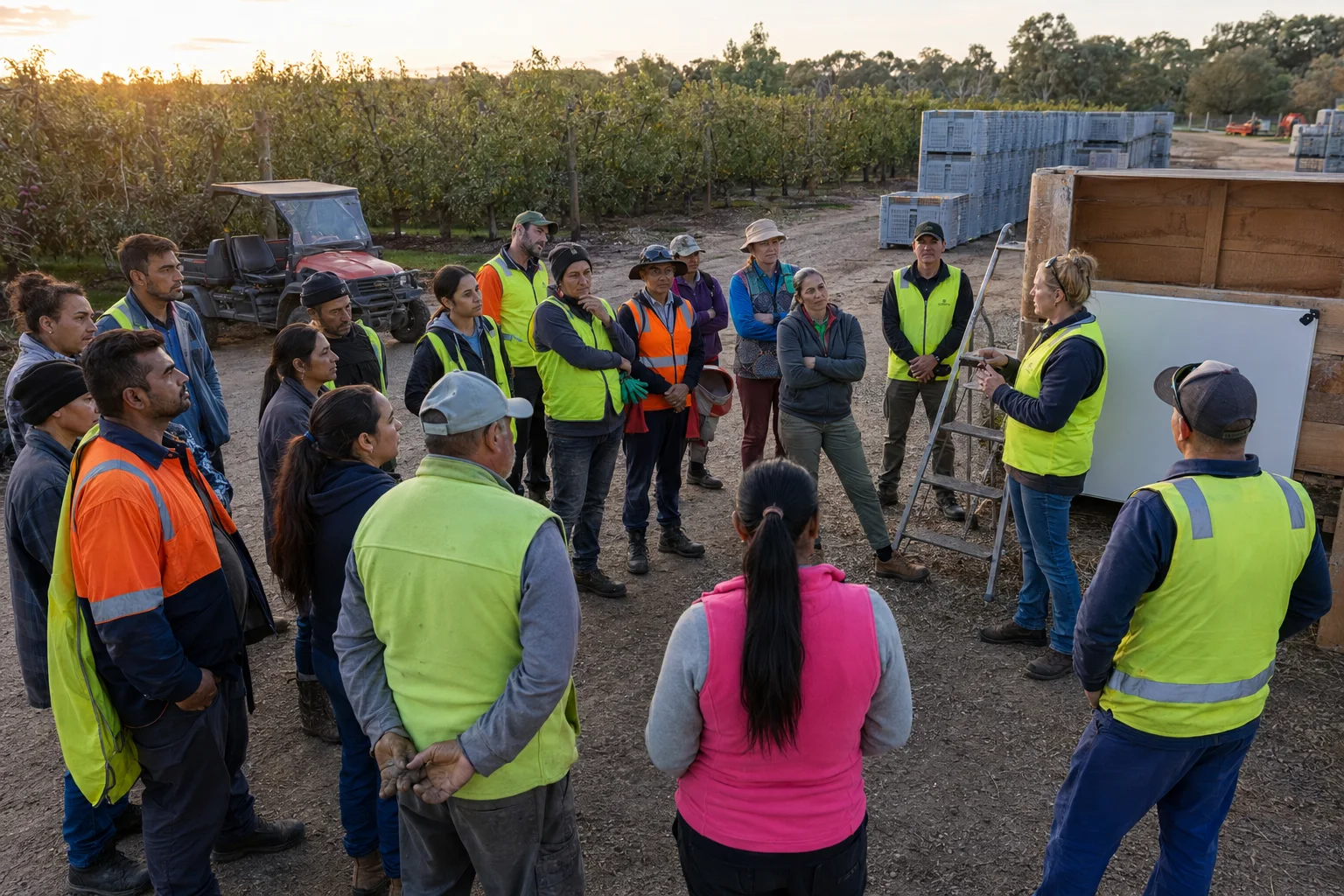
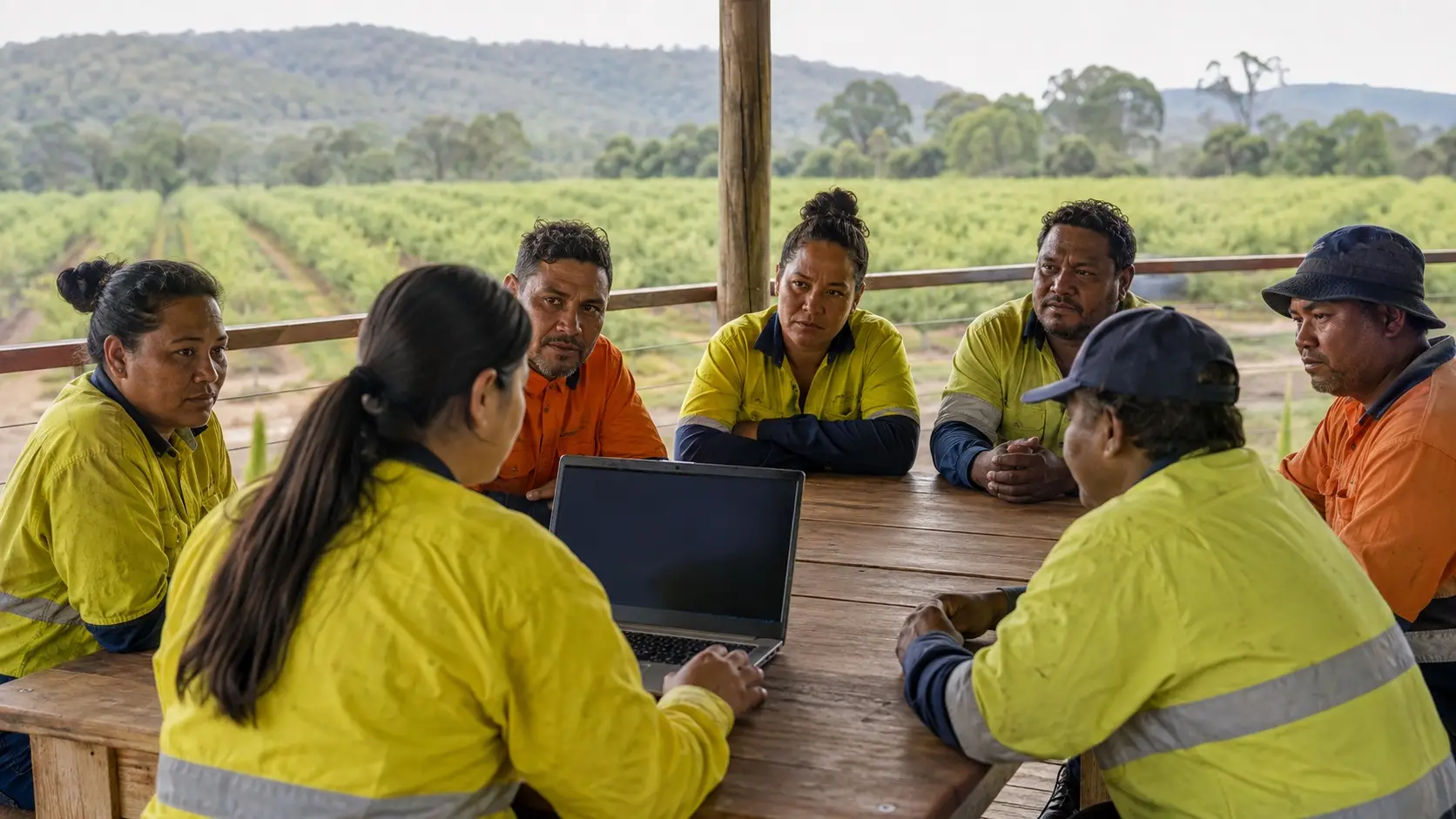
Illustrative AI-generated image. The people and orchard are fictional; no Orchard Tech worker, client or actual verification meeting is depicted.
Jurisdiction: Victoria, Australia | Last reviewed: 26 October 2026
A certificate in a worker’s file answers one question: someone has presented a document. It does not, by itself, establish that the document is genuine, that a required licence is current, or that the person can do a particular farm or packing-shed task safely. That distinction matters when a harvest team needs a first-aider, a traffic controller, a forklift operator or a person to work at height.
On 13 October 2026, WorkSafe Victoria issued a safety alert about verifying employee qualifications after being informed of alleged fraudulent certificates. The alert is regulator guidance and a reminder of existing occupational health and safety duties. It is not a new law, a finding that any particular Orchard Tech or host worker has a false certificate, or a claim that every qualification must be rechecked by a fixed deadline.
Three checks that answer different questions
1. Is a qualification authentic? A nationally recognised training certificate is usually issued by a registered training organisation (RTO). Where its authenticity is in doubt, WorkSafe recommends checking the issuer on the National Training Register and contacting the RTO to confirm the certificate. A plausible logo or a scan forwarded by email is not independent confirmation.
2. Is a legal licence required and valid? Some work is prescribed high-risk work under Victoria’s OHS Regulations and requires the appropriate WorkSafe-issued high-risk work licence. WorkSafe’s alert lists forklift truck and order-picking forklift classes among its examples. A training certificate and a high-risk work licence are different documents. Where a licence’s validity is in doubt, use WorkSafe’s licence validation guidance; its online service specifically describes validating digital licences. Check the actual class, conditions and task rather than accepting a generic “machinery ticket”. Do not assume every orchard machine has the same licensing rule as a forklift.
3. Can this person do this task safely here? Even a genuine certificate or valid licence is not the whole competence decision. The host still needs to consider the worker’s knowledge, experience, familiarity with the actual equipment and site, the instructions given and the supervision available. WorkSafe expressly cautions that employers cannot rely solely on a qualification or certificate as evidence of safe competence.
A practical booking conversation for hosts and providers
Before booking a worker into a safety-critical task, the host and labour-hire provider can agree a short sequence:
- Describe the task precisely. “Forklift operator” should become the actual class of plant, work area, loads, pedestrian interfaces, shift and supervision plan. “First-aider” should become the expected response role, location and coverage period. This makes it possible to identify the relevant evidence.
- Decide which evidence is legally required. Identify any prescribed licence for the exact activity. For other tasks, decide what training and experience are appropriate without inventing a mandatory certificate that the law does not require.
- Check a document when there is a reason to doubt it. Use the issuing RTO or the relevant licence authority, not just a copy supplied by an intermediary. Resolve mismatched names, dates or course details with the worker and issuer before the person takes on the task. Do not accuse a worker of fraud on the basis of a formatting anomaly alone.
- Test the work, not just the paperwork. Give site- and equipment-specific instruction and have a competent person observe the relevant task or demonstration. Record any limits, extra training and required supervision. A person may hold a valid licence yet still need familiarisation with an unfamiliar vehicle, attachment or route.
- Agree who records and revisits the decision. Keep a concise record of what was checked, by whom, when and for which role; avoid circulating whole identity or training files to people who do not need them. Set a trigger for rechecking when the licence expires, the task or plant changes, or a concern arises.
This is an operational checklist, not a new WorkSafe-prescribed five-step form. WorkSafe’s labour-hire host guidance says hosts and providers share OHS responsibilities and must consult, cooperate and coordinate so far as reasonably practicable. It specifically addresses worker skills, relevant qualifications and licences, training records, instruction and supervision. Neither party should simply assume the other completed the verification.
Example: a sudden request to operate a forklift
Imagine a packing shed needs someone to drive a forklift because the usual operator is absent. A worker who has been sorting fruit says they have operated one elsewhere and shows a photo of a certificate. The supervisor should not treat that photo as clearance. The host and provider first identify the work and required licence class, check the licence as appropriate, assess the worker’s competence on this equipment and route, and arrange familiarisation and supervision. If the task differs from the placement originally agreed, they also reassess the changed job before work starts.
This is a hypothetical example, not an Orchard Tech placement or a report of a suspected false document. Our forklift and pedestrian-route guide covers the work-area controls. The host-site induction guide covers first-shift instructions. For a role change, WorkSafe says the provider and host should revisit the job safety analysis and agreed actions; a worker should not take on the new task before the risk assessment and controls are complete.
What if a certificate appears questionable?
Keep the person out of a task that depends on an unresolved qualification while the concern is checked, but handle the conversation fairly and privately. Confirm the issuer and course details through the proper channel, ask the worker for an explanation, and decide what safe alternative work is available. Do not broadcast a certificate, identity document or allegation through a group chat. WorkSafe points to the relevant RTO, education regulator and Victoria Police for suspected fraudulent activity; its alert also says there is no evidence to date linking the alleged fraudulent qualifications to WorkSafe high-risk work licences.
The useful management question is not “Do we have a card on file?” It is “Do we know what this job requires, is the evidence reliable, and can this person perform it safely on this site today?” A well-run check protects workers and keeps a staffing gap from becoming an improvised safety decision. It does not promise that a document check alone makes the work safe.
Editorial note: This article explains WorkSafe Victoria’s 13 October 2026 safety alert and existing OHS guidance. It is general information, not a determination of a particular worker’s competence, a finding of fraud or legal advice. Review after a material change to WorkSafe’s alert, licensing guidance or applicable Victorian law.
About the author
Hari Yellina is Chief Executive Officer at Orchard Tech. View his profile and more articles.