When Orchard Work Changes: Consult Labour Hire Workers Before the New Task
• Hari Yellina

Victoria · Last reviewed 12 October 2026
Suppose overnight rain makes an orchard’s usual pedestrian route unusable. A supervisor proposes sending the picking crew along a track that also carries forklifts and bin trailers. The change may look small on a map. The people who walk it may know where visibility disappears behind a stack of bins, where the ground stays slippery and when a trailer normally turns. Ask them before deciding the new route—not after the crew has started using it.
This is a hypothetical example, but the consultation duty is real. In Victoria, section 35 of the Occupational Health and Safety Act 2004 requires employers, so far as is reasonably practicable, to consult employees on specified health and safety matters that directly affect or are likely to affect them. WorkSafe explains that this includes labour hire workers. The duty is triggered when identifying or assessing risks, deciding controls, and proposing changes to the workplace, plant, substances or how work is done. WorkSafe’s section 35 summary sets out those triggers.
Two conversations, not one forwarded message
In a labour hire placement, there are two connected conversations. The host and provider must, so far as is reasonably practicable, consult, cooperate and coordinate with each other about duties they share towards the worker under section 35A. Each also has obligations to consult workers on relevant OHS matters. WorkSafe’s labour hire guidance distinguishes the provider–host process from consultation with workers. An email from the host to the provider is not, by itself, a chance for the affected crew to shape the decision.
The host usually knows the site, traffic patterns and equipment. The provider may know the worker’s assigned role, training, language needs and contact route. Both need a way to hear concerns and close the loop. Agreeing that one party will organise the conversation does not remove the other party’s OHS duties.
A practical consultation sequence when work changes
- Describe the proposed change before it happens. Name the task, location, time, people affected and reason for the change. Is the new route temporary, or will it become part of the normal harvest flow? If an immediate danger requires a stop, make the area safe first; consultation is not a reason to expose people while a meeting is arranged.
- Identify everyone whose safety may be affected. Include direct employees, labour hire workers and supervisors whose work interacts with the change. Check whether a health and safety representative (HSR) represents the group. WorkSafe says consultation must involve the HSR where employees are represented, and the HSR should generally receive information a reasonable time before employees.
- Share usable information. Show the proposed route or equipment arrangement where the work occurs. Explain the hazard and options being considered; allow reasonable time for questions. A dense English-only notice is not enough if some workers cannot use it to participate. WorkSafe’s cross-language compliance code gives practical guidance on language support. The code is guidance, not a separate blanket requirement to use one particular translation method.
- Invite views that could change the plan. Ask what the crew sees at the turn, during poor light, and when vehicles reverse. Make room for quieter workers to speak without having to contradict a supervisor in front of everyone. A brief site walk, small-group discussion or properly supported HSR conversation may be more useful than a generic toolbox signature sheet.
- Consider the views and explain the decision. WorkSafe describes consultation as sharing information, giving a reasonable opportunity to express views and taking those views into account. Agreement with every suggestion is not required; simply announcing a completed decision is not consultation. Record the concern, the control chosen, who owns it and what could not be adopted, with a reason.
- Coordinate the change between host and provider. Decide who will alter the route, check vehicle separation, brief each shift, update job or training records where needed and tell late arrivals. Confirm the provider knows if the change affects the worker’s role, skills, supervision or hours. For a new plant task, use a separate site-induction check rather than treating a route discussion as competency verification.
- Check the outcome in use. Watch the first shift, ask workers whether the control works in practice and revisit it if weather, traffic or layout changes again. A note that consultation occurred is evidence of the process, not proof that the control is effective.
What should the record show?
Keep a proportionate record: the proposed change and date; the affected work group and any HSR; information shared and language support used; worker concerns; the decision and responsible person; the briefing date; and the date the control was checked. The record should not become a substitute for the conversation. It should let the next supervisor or provider contact understand why the route was chosen and what still needs watching.
For the hypothetical wet-track example, the best outcome might be to delay the move, redirect vehicles, create a physically separated walking path or use another route. The answer depends on the site and risk assessment. Orchard Tech’s forklift and pedestrian-route guide covers a related traffic-control question, but no article can approve a particular farm layout remotely.
What changed in 2026—and what did not?
WorkSafe’s 2026–27 Statement of Regulatory Intent names agriculture as a priority industry and workplace consultation as a focus across Victoria. That is a regulator priority statement, not a new commencement date for section 35 or 35A. The duties described above were already in force. The practical reason to revisit consultation now is that fast-changing seasonal work makes an old briefing easy to mistake for a current decision.
The five-minute pre-change question
Before a changed task or route starts, a manager can ask: Who will be affected? What do they know that the plan does not? Has any HSR been involved? Can everyone understand and answer? Who will act on concerns, tell the next shift and check the result? If those answers are missing, the consultation process is probably not finished.
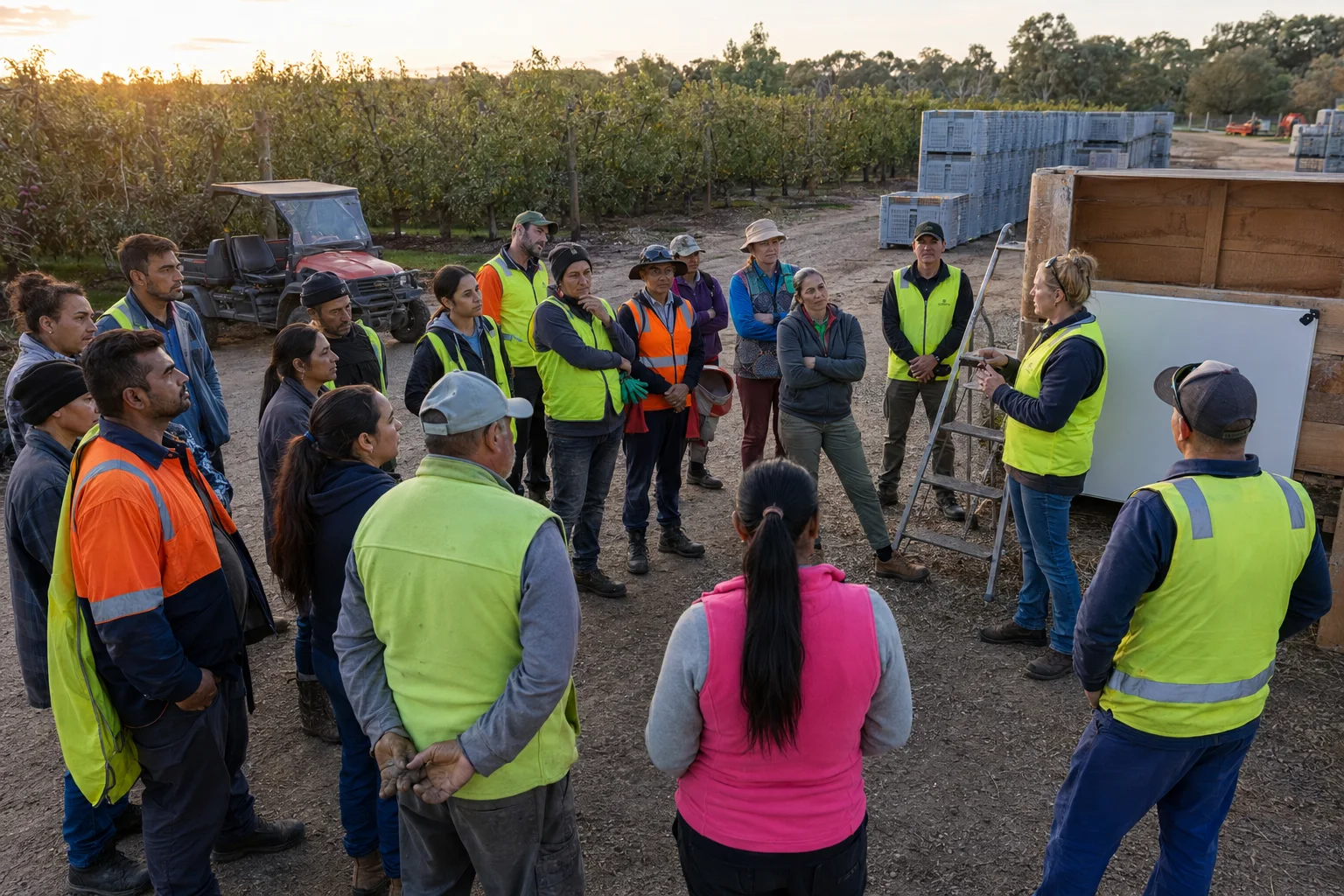
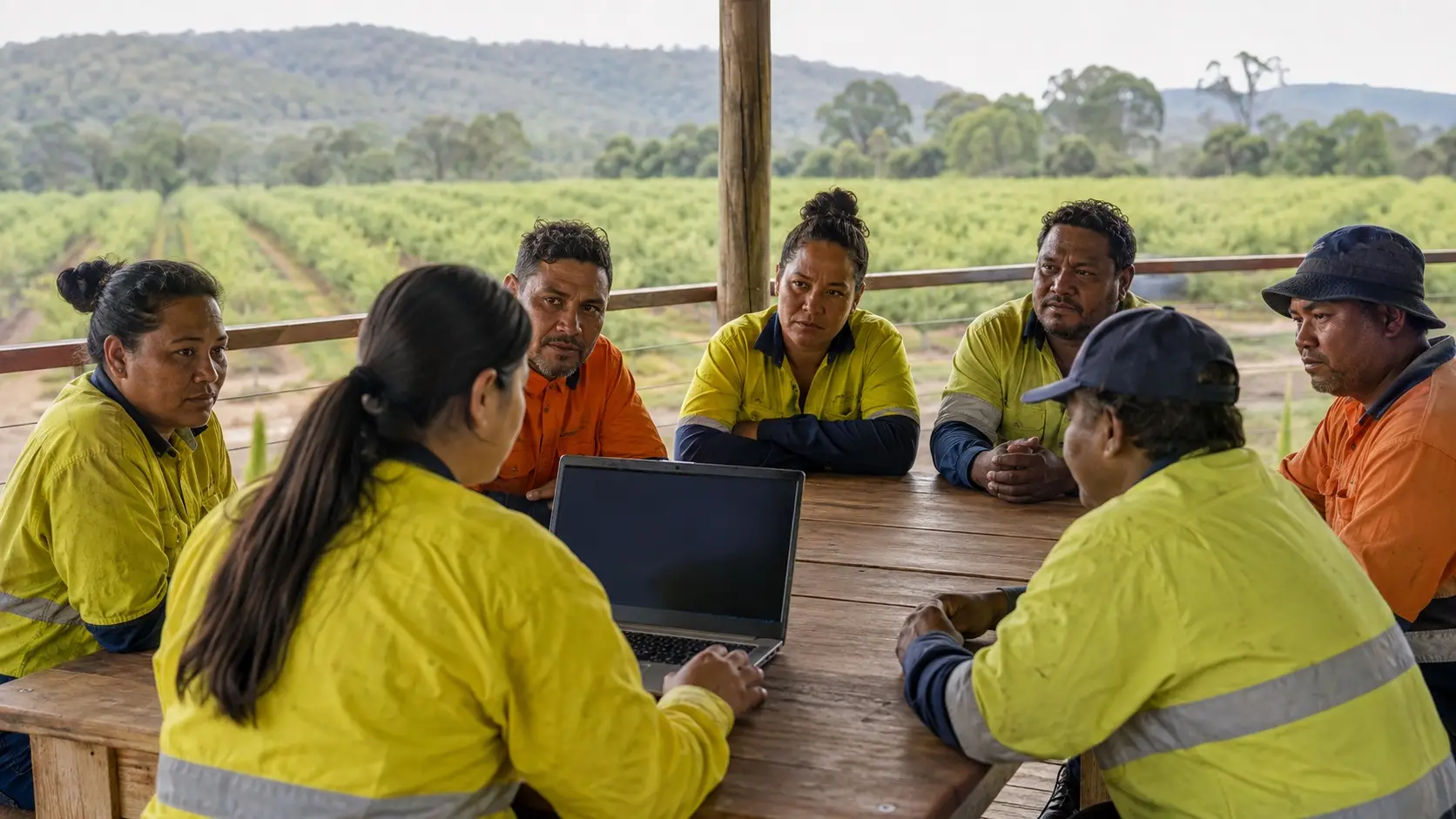
Illustration: AI-generated fictional scene. The people pictured are not identified Orchard Tech workers or a record of a real consultation.
About the author
Hari Yellina is Chief Executive Officer at Orchard Tech. View his profile and more articles.